
Hot air welding machines are essential industrial tools used for welding thermoplastic materials, joining plastic sheets, repairing waterproof membranes, fabricating plastic products, and performing specialised industrial welding applications. When a hot air welding machine develops a heating fault, experiences inconsistent temperature control, loses airflow, or stops operating completely, production can be interrupted and the quality of the finished work can be affected.
Pro-Logic Technologies Limited provides electrical and electronic equipment repair, industrial machine troubleshooting, heating system diagnosis, motor and blower servicing, control circuit repair, and maintenance support in Nairobi and surrounding areas. We assist customers who need professional assessment of hot air welding machines and related industrial heating equipment.
Whether your machine has a blank display, a faulty temperature controller, a damaged heating element, a weak blower, an electrical supply problem, or an intermittent operating fault, the first step is to identify the actual cause before replacing components.
Our approach focuses on systematic fault diagnosis, electrical safety, component testing, suitable replacement parts, and functional testing after repairs.
Hot Air Welding Machine Repair Services in Nairobi
Hot air welding machines combine several electrical, mechanical, and thermal systems. These systems must operate together to produce the correct temperature and airflow for the intended welding application.
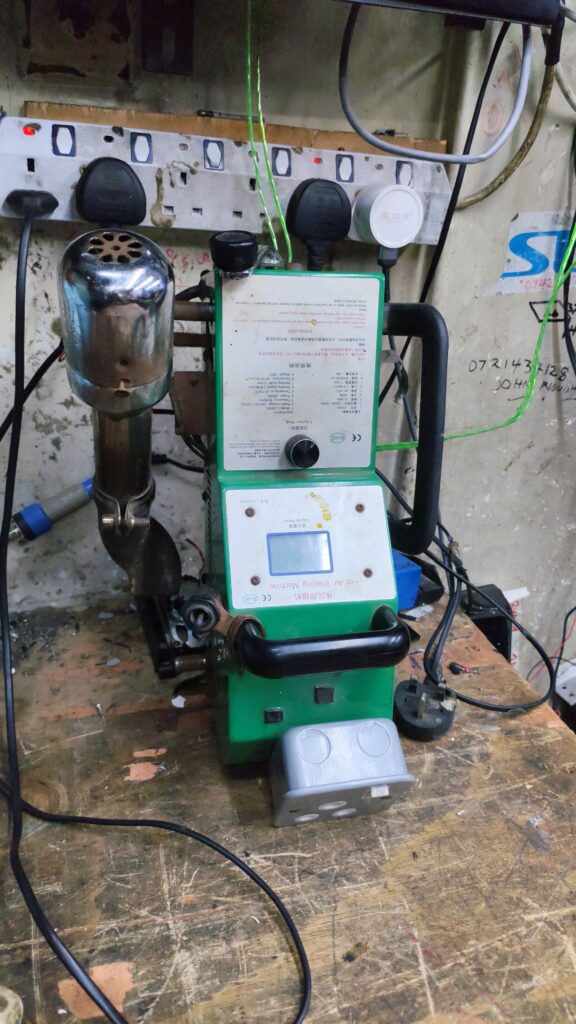
A typical machine may contain a heating element, blower motor, temperature sensor, electronic control board, power switching components, display, adjustment controls, wiring harness, protective devices, and an air outlet or welding nozzle.
A fault in any one of these sections can affect the performance of the complete machine.
Pro-Logic Technologies Limited offers technical support for diagnosing and repairing faults involving these systems, subject to the machine's design, condition, availability of parts, and suitability for repair.
Heating Element Diagnosis and Repair
The heating element is responsible for converting electrical energy into heat. Depending on the machine's design, it may use a ceramic heater, resistance heating coil, tubular heating element, or another specialised heating assembly.
A damaged heating element may cause the machine to produce no heat, warm up slowly, fail to reach the set temperature, or operate intermittently.
Common causes of heater failure include prolonged operation at excessive temperatures, restricted airflow, contamination, electrical overload, ageing, damaged terminals, and deterioration of the heating material.
Professional diagnosis involves checking the heating circuit, inspecting accessible terminals, examining the heater assembly, and carrying out appropriate electrical tests with the equipment safely isolated.
Where the heater is open-circuit, physically damaged, or outside its acceptable electrical specifications, replacement may be necessary. A suitable replacement must match the original assembly's voltage, power rating, physical dimensions, temperature rating, and electrical connections.
Installing an unsuitable heating element can cause overheating, inaccurate temperature control, electrical damage, or a fire hazard.
Temperature Controller Repair
Temperature regulation is one of the most important functions of a hot air welding machine. Different welding materials and applications require different operating temperatures, so a controller that cannot regulate heat correctly can compromise the finished product.
Temperature control problems may appear as excessive heat, insufficient heat, fluctuating temperature, an unresponsive adjustment knob, inaccurate display readings, or repeated shutdowns.
Potential causes include a defective temperature sensor, damaged control potentiometer, faulty electronic components, poor electrical connections, a malfunctioning switching device, or an incorrect feedback signal.
Diagnosis should begin by comparing the displayed temperature with a suitable independent measurement method and checking the sensor and control circuit against the manufacturer's specifications.
Depending on the design, the machine may use a thermocouple, resistance temperature detector, thermistor, or another sensing arrangement. These sensors are not interchangeable without considering the controller's electrical and calibration requirements.
Where the control board is repairable, damaged components or connections may be addressed after the underlying fault has been established.
Blower Motor and Airflow Repair
The blower delivers air across the heating assembly and directs the heated air towards the welding area. Correct airflow is necessary for stable operation and reliable heat transfer.
A weak blower can cause overheating inside the machine, unstable temperature readings, poor welding results, and premature heating element failure.
Common blower-related faults include worn bearings, damaged fan blades, restricted air passages, motor winding problems, loose connectors, and failures in the motor's power supply or control circuit.
Symptoms include unusually low airflow, abnormal noise, excessive vibration, intermittent starting, or a motor that fails to turn.
A technician should inspect the air inlet and outlet, check for obstruction, examine the fan and motor assembly, and test the relevant electrical circuits after safely isolating the equipment.
The blower should not be bypassed or operated in a way that exposes the heater to unsafe temperatures. On many machines, adequate airflow is essential for cooling and temperature regulation.
Electronic Control Board Repair
The electronic control board manages functions such as temperature regulation, heater switching, motor control, fault detection, and display operation.
Depending on the model, the board may contain a microcontroller, power supply circuit, relays, triacs, transistors, resistors, capacitors, connectors, and sensor interface components.
Common control board symptoms include a blank display, incorrect temperature readings, unresponsive buttons, intermittent operation, failure to activate the heater, or a machine that stops unexpectedly.
Potential causes include a damaged low-voltage power supply, failed switching components, cracked solder joints, corroded connectors, thermal damage, and electrical surges.
Board-level diagnosis should follow the manufacturer's circuit information where available. Technicians should also check the heater, blower, sensor, and power supply before condemning the control board.
Replacing a board without identifying the original cause may lead to repeated failures if a shorted heater, defective motor, or damaged external connection remains unresolved.
Common Hot Air Welding Machine Problems
Machine Does Not Switch On
A machine that does not power on may have an interrupted electrical supply, a damaged plug, a faulty cable, an open fuse, a failed switch, a defective internal power supply, or a damaged control board.
Initial checks should be limited to confirming that the external supply is available and that accessible cables show no visible damage.
Internal inspection should be performed by a qualified technician after the machine has been disconnected from the power source. Some components may retain hazardous electrical energy even after disconnection.
The diagnosis should establish whether the fault lies in the incoming supply, protection circuit, power switch, internal wiring, or electronic control section.
Machine Powers On but Produces No Heat
When the display and controls operate but the machine does not produce hot air, the fault may be limited to the heater circuit.
Possible causes include an open heating element, a defective switching device, a failed temperature sensor, an incorrect control signal, or a safety interlock that prevents heating.
A technician should verify the heater's electrical condition, examine its connections, and determine whether the controller is issuing the correct heating command.
If the machine uses a separate heater relay or solid-state switching device, that component should be assessed according to the circuit design.
Machine Produces Heat but the Temperature Is Too Low
Low heating performance can result from a deteriorated heating element, incorrect temperature feedback, restricted airflow, inadequate supply voltage, excessive heat loss, or an unsuitable operating setting.
The fault should not automatically be attributed to the heating element. A sensor that reports an incorrect temperature may cause the controller to reduce heating even when the actual outlet temperature is too low.
Airflow restrictions can also change the relationship between heater temperature and the temperature delivered to the workpiece.
A proper diagnosis compares the machine's settings, actual operating temperature, airflow, electrical supply, and sensor response.
Machine Overheats
Overheating is a serious fault because excessive temperatures can damage internal wiring, melt insulation, deform plastic components, damage the heating assembly, or create a fire risk.
Possible causes include a faulty temperature sensor, stuck switching device, failed controller, restricted airflow, damaged fan, or incorrect replacement components.
Stop using the machine if it overheats, produces smoke, smells strongly of burning insulation, or shows signs of melted wiring.
The equipment should be isolated and inspected before it is returned to service. A technician must confirm that both the temperature regulation system and any independent thermal protection devices operate correctly.
Temperature Display Is Blank
A blank display may result from a failed low-voltage supply, loose connector, damaged display module, defective control board, or a fault in the display interface.
If the machine otherwise appears to receive power, the problem may still be inside the electronic control system.
Diagnosis should include checking the display supply and relevant control signals according to the manufacturer's specifications. A display fault should be distinguished from a complete power supply failure.
Temperature Reading Fluctuates
Fluctuating readings may be caused by an unstable sensor connection, damaged sensor wiring, electrical interference, a failing controller, poor heater switching, or changing airflow.
The technician should inspect sensor wiring and connectors and compare the displayed reading with a suitable calibrated measurement instrument.
The controller's response should then be assessed under the machine's normal operating conditions, without exceeding the manufacturer's limits.
Blower Runs but Air Is Not Hot
This symptom often points towards a heating circuit fault, but other possibilities must be considered.
The heater may be open-circuit, the controller may not be activating the heating output, a protective device may have opened, or the sensor circuit may be reporting an abnormal condition.
The machine's operating sequence and control design determine the correct test procedure.
Machine Stops During Operation
Unexpected shutdowns can occur because of thermal protection, a failing power supply, loose connections, motor overload, defective electronic components, or an unstable external supply.
A technician should identify whether the machine shuts down immediately, after warming up, when the blower starts, or when the heater reaches a particular temperature.
The timing of the fault can provide useful diagnostic evidence and help distinguish a thermal problem from an electrical or electronic failure.
Hot Air Welding Machine Preventive Maintenance
Preventive maintenance reduces the likelihood of unexpected downtime and helps identify developing faults before they cause extensive damage.
The appropriate maintenance interval depends on operating hours, the working environment, the machine's construction, and the manufacturer's recommendations.
Air Intake and Outlet Inspection
Dust, plastic particles, adhesive residue, and other contaminants can restrict airflow. Regular inspection of accessible air passages helps maintain the intended air movement through the heating assembly.
Cleaning should be carried out with the machine disconnected and cooled. Compressed air or other cleaning methods should only be used where permitted by the manufacturer and where they will not drive contamination deeper into the equipment.
Electrical Cable Inspection
Power cables and connectors should be checked for cuts, crushed insulation, loose plugs, heat damage, and signs of arcing.
Damaged cables should be replaced with correctly rated components. Improvised joints, exposed conductors, and unsuitable extension leads can create serious hazards.
Heater Assembly Inspection
The heating assembly should be checked for physical deterioration, discolouration, loose terminals, and evidence of overheating.
Any replacement must meet the original equipment requirements. The heater's rated voltage, power, mounting arrangement, and thermal characteristics should be verified before installation.
Blower and Motor Inspection
Abnormal vibration, grinding noises, reduced airflow, and excessive motor temperature can indicate developing problems.
Inspection should cover accessible fan blades, mounting points, air passages, motor connections, and any specified lubrication points. Sealed bearings should not be lubricated unless the manufacturer provides for that maintenance.
Temperature Sensor Inspection
Sensor wiring should be secure and protected from heat and mechanical damage. Incorrect sensor placement can produce unreliable temperature control even if the sensor itself is functional.
Where the equipment permits calibration, the procedure should follow the manufacturer's requirements and use appropriate measurement equipment.
Control Panel and Connector Inspection
Controls should respond consistently, and connectors should be free of corrosion, heat damage, and mechanical looseness.
Internal electronic repairs must be undertaken by personnel competent to work on mains-powered equipment. Testing should not involve exposed live circuits unless a qualified technician is following an appropriate, controlled diagnostic procedure.
Industrial Hot Air Welding Equipment Support
Hot air welding technology is used in many industrial and commercial settings. The correct repair method depends on whether the equipment is a handheld welding tool, a bench-mounted machine, an automatic welding system, or a specialised plastic fabrication unit.
Pro-Logic Technologies Limited can assess electrical and electronic faults in compatible industrial equipment and determine whether repair, component replacement, calibration, or further specialist service is appropriate.
Applications may include plastic fabrication, thermoplastic sheet joining, membrane welding, industrial plastic repairs, and related heating processes.
Not every machine uses the same components or control architecture. Before work begins, the model, nameplate information, operating voltage, rated power, and reported symptoms should be recorded.
Repair of Hot Air Welding Machines Used for Plastic Fabrication
Plastic fabrication requires controlled heating and suitable airflow. A machine that produces unstable heat may create weak joints, excessive material deformation, uneven welds, or surface damage.
The cause may involve the temperature control system, heater output, airflow, nozzle condition, or the welding procedure itself.
Technicians should first determine whether the machine is operating outside its designed specifications. They should then distinguish an equipment fault from an issue involving the selected material, nozzle, welding speed, or process settings.
Repairing the machine alone cannot guarantee a perfect weld if the material preparation and welding parameters are unsuitable.
Hot Air Welding Machine Repair in Nairobi CBD
Nairobi CBD is an important commercial area for industrial equipment, electronics, fabrication supplies, workshops, and technical services.
Businesses using hot air welding equipment may require troubleshooting when a machine fails during production or begins to produce inconsistent results.
Pro-Logic Technologies Limited provides equipment diagnosis and repair support from its workshop at Luthuli Avenue, Kangari Building, 3rd Floor, Room KA7, Nairobi.
Customers should provide the machine's brand, model, rated voltage, and a description of the fault before arranging an assessment. A clear photograph of the nameplate and the affected section can also help establish which parts and test procedures may be required.
The availability of repair services, replacement components, and any on-site support should be confirmed before bringing in equipment.
Hot Air Welding Machine Repair Along Luthuli Avenue
Luthuli Avenue is a practical reference point for customers seeking technical equipment services within Nairobi's central business district.
Industrial workshops, plastic fabrication businesses, repair technicians, and equipment owners may need assistance with heating faults, control problems, blower failures, and electrical damage.
Pro-Logic Technologies Limited operates from Kangari Building, 3rd Floor, Room KA7, Luthuli Avenue, Nairobi.
Customers can contact the company to discuss the symptoms and determine the next steps for diagnosis. Where a machine is heavy, integrated into a production line, or difficult to transport, the assessment should establish whether workshop servicing or an alternative arrangement is suitable.
Why Professional Diagnosis Matters
Hot air welding machines combine electrical power, high temperatures, airflow, and electronic regulation. Replacing components without testing the complete system can create additional faults and unnecessary expenses.
Professional diagnosis helps establish whether the problem originates in the heating element, temperature sensor, blower, control board, power supply, wiring, or protection circuit.
A suitable repair process should include an initial assessment, identification of the fault, confirmation of compatible parts, repair or replacement where justified, and functional verification.
Where applicable, the final inspection should confirm safe electrical connections, stable airflow, appropriate temperature regulation, and correct operation of protective features.
Hot Air Welding Machine Repair Cost in Nairobi
The cost of repairing a hot air welding machine depends on the nature of the fault, the machine's construction, the availability of replacement parts, and the labour required.
A simple wiring or connector problem may require less work than a damaged heating assembly, blower motor, temperature controller, or electronic control board.
Other cost factors include the equipment's age, the condition of its internal components, the availability of technical documentation, and whether calibration or additional testing is required.
An accurate quotation should follow an assessment rather than an unsupported estimate based solely on a symptom.
Customers can help speed up the process by supplying the machine's model number, a clear photograph of the rating plate, details of the fault, and information about any previous repair attempts.
Hot Air Welding Machine Repair for Workshops and Businesses
Fabrication workshops depend on reliable equipment to maintain production schedules and consistent product quality. When a welding machine fails, the resulting delay can affect orders, labour allocation, and delivery commitments.
A structured maintenance programme helps reduce these risks by identifying faults early, checking critical components, and keeping appropriate service records.
Businesses operating several welding machines should record each unit's model, serial number, operating hours where available, service history, recurring faults, and replaced components.
This information makes it easier to identify repeated failures and determine whether they are associated with operating conditions, maintenance practices, component quality, or electrical supply problems.
Replacement Parts for Hot Air Welding Machines
Replacement parts must be compatible with the specific equipment. Similar-looking components may differ in resistance, current rating, operating temperature, dimensions, connection type, or control characteristics.
Common parts that may require replacement include heating elements, temperature sensors, blower motors, fan assemblies, switches, cables, connectors, display modules, control boards, and thermal protection devices.
Before ordering a part, confirm the manufacturer's part number where available. If the original part number cannot be identified, technical specifications and physical compatibility must be established by a qualified person.
A component should not be selected only because it fits mechanically.
Safe Operation of Hot Air Welding Machines
Safe operation requires attention to electrical protection, temperature, airflow, ventilation, and the material being welded.
Operators should follow the manufacturer's instructions, use suitable personal protective equipment, and ensure that the work area is appropriate for the materials and process.
The machine should be positioned on a stable, heat-resistant surface, with the hot nozzle directed away from people, cables, combustible materials, and sensitive surfaces.
The equipment should be allowed to cool according to the manufacturer's shutdown procedure. Where the design requires a cooling cycle, the blower should not be interrupted prematurely.
Machines with damaged insulation, exposed conductors, smoke, burning smells, repeated protective trips, or uncontrolled heating should be removed from service until inspected.
Frequently Asked Questions About Hot Air Welding Machine Repair
Can a hot air welding machine be repaired?
Many hot air welding machine faults can be repaired if suitable parts and technical information are available and the equipment remains in a repairable condition. The correct approach is to diagnose the fault before deciding whether repair or replacement is appropriate.
Why is my hot air welding machine not heating?
Possible causes include a failed heating element, a damaged temperature sensor, a faulty controller, a defective switching component, or a problem in the electrical supply. Testing is necessary to identify the specific cause.
Why does my hot air welding machine overheat?
 may result from restricted airflow, a failed blower, inaccurate sensor feedback, a faulty controller, or a switching component that remains activated. Stop using the machine until the cause has been identified.
Why is the display not showing the temperature?
A blank or incorrect display may be caused by a failed control power supply, a damaged display module, loose connections, a defective sensor, or a control board fault.
Can the heating element be replaced?
Yes, where the design permits replacement and a compatible component is available. The replacement must meet the equipment's electrical and thermal specifications.
Why is the airflow weak?
Possible causes include a blocked inlet, contaminated fan, damaged fan blades, worn motor bearings, motor winding problems, or a fault in the motor control circuit.
Does every hot air welding machine use the same heating element?
No. Heating elements vary by machine model, rated power, voltage, dimensions, temperature requirements, and construction. Compatibility must be confirmed before replacement.
How often should a hot air welding machine be serviced?
The service interval depends on the manufacturer's guidance, operating hours, environmental conditions, and workload. Equipment used frequently in dusty or demanding industrial environments may need more frequent inspection.
Can a hot air welding machine be repaired if its control board is damaged?
Some control boards can be repaired, while others may require replacement. The decision depends on the board design, the nature of the damage, component availability, and the cost of a reliable repair.
Do you repair industrial heating equipment?
Pro-Logic Technologies Limited provides electrical and electronic equipment troubleshooting and repair support. Customers should describe the equipment and its fault so that the suitability of the required service can be assessed.
Contact Pro-Logic Technologies Limited for Hot Air Welding Machine Repair
If your hot air welding machine is not heating correctly, has a blank display, produces weak airflow, overheats, or stops during operation, arrange a technical assessment before replacing expensive components.
Pro-Logic Technologies Limited provides electrical and electronic equipment repair and industrial machine troubleshooting support in Nairobi, Kenya.
Workshop: Luthuli Avenue, Kangari Building, 3rd Floor, Room KA7, Nairobi
Phone: 0723763173
Email: info@prologictechnologies.co.ke
Website: https://prologictecnologies.co.ke/
Contact the workshop with the machine's model, rating plate details, and fault symptoms to discuss diagnosis and repair options.
Professional testing, compatible replacement components, and appropriate functional checks help restore equipment operation while reducing the risk of repeated failures.