
Industrial electronic equipment(call 0723763173) depends on reliable and stable power. A programmable logic controller, human-machine interface, industrial sensor, automation controller, motor-control system, communication module, instrumentation system or production machine can stop operating when its power supply becomes unstable.
An industrial SMPS, or industrial switch-mode power supply, is responsible for converting electrical energy into controlled DC power required by electronic and electrical control systems. These power supplies are designed to provide regulated voltage while handling variations in input conditions, load changes and demanding industrial environments.
When an industrial SMPS develops a fault, the problem can range from a simple failed capacitor to a complex failure involving the switching stage, feedback loop, protection circuit, transformer, rectification section or downstream load.
Pro-Logic Technologies Limited provides industrial SMPS repair, testing, diagnostics, component replacement, PCB repair and power supply replacement services in Nairobi and for customers across Kenya.
Our approach focuses on understanding the complete power-conversion system rather than replacing components without establishing the cause of failure.
CONTACT: 0723763173
EMAIL: info@prologictechnologies.co.ke
WEBSITE: prologictecnologies.co.ke
WORKSHOP: Luthuli Avenue, Kangari Building, 3rd Floor, KA7, Nairobi, Kenya
WHAT IS AN INDUSTRIAL SMPS?
An industrial SMPS is an electronic power-conversion system that uses high-frequency switching techniques to convert electrical energy from an input source into one or more controlled output voltages.
The input may be:
- AC mains
- DC input
- Battery-derived DC
- Rectified industrial supply
- Another DC bus
The output may be used to power:
- PLCs
- HMIs
- Sensors
- Relays
- Contactors
- Solenoids
- Industrial controllers
- Communication modules
- Instrumentation
- Displays
- Electronic control boards
- Monitoring systems
- Automation equipment
Unlike a simple transformer and linear regulator arrangement, a switching power supply contains several interacting electronic stages.
A typical AC-input SMPS may include an input protection stage, electromagnetic interference filter, rectifier, high-voltage DC bus, switching semiconductor, high-frequency transformer, secondary rectifier, output filter, feedback circuit and protection system.
Every stage has a role.
A failure in one section can affect the entire system.
WHY INDUSTRIAL SMPS REPAIR REQUIRES DEEP DIAGNOSTICS
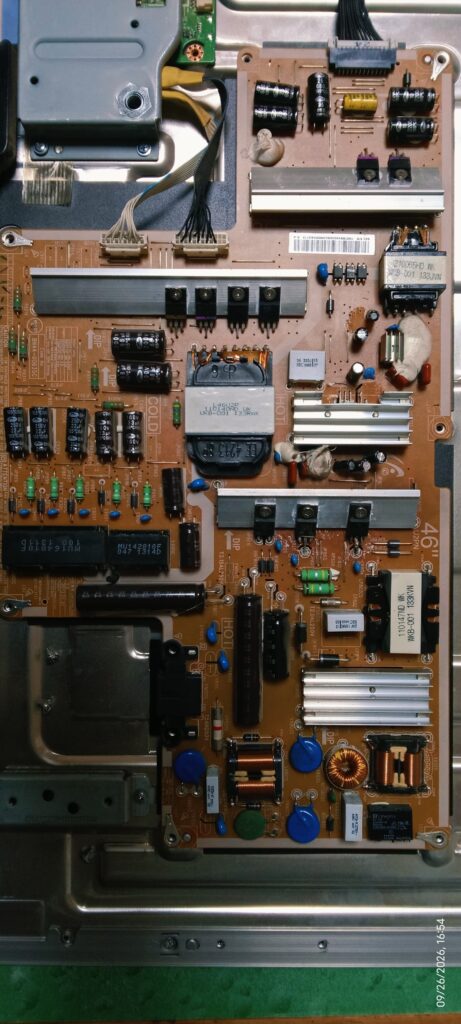
Industrial power supplies should not normally be diagnosed simply by looking for a burnt component.
A component may fail because another component or circuit has already developed a fault.
For example, a switching MOSFET may be shorted. Replacing it may temporarily restore the appearance of the board, but if the original cause was a defective gate-drive circuit, failed snubber network, transformer problem, feedback fault or excessive load, the replacement MOSFET may fail again.
Similarly, a blown fuse is not normally the root cause.
The fuse is a protection device. Its failure may indicate:
- A shorted bridge rectifier
- Shorted MOSFET
- Shorted IGBT
- Primary-side capacitor failure
- Surge damage
- Switching-controller failure
- Secondary-side short
- Wiring fault
- Downstream equipment failure
Professional industrial SMPS troubleshooting therefore follows the energy path through the circuit.
INDUSTRIAL SMPS REPAIR IN NAIROBI
Pro-Logic Technologies Limited provides industrial electronic power supply troubleshooting and repair services from our workshop in Nairobi.
Workshop location:
Luthuli Avenue
Kangari Building
3rd Floor, KA7
Nairobi, Kenya
Customers can contact us before bringing an industrial SMPS board, complete power supply unit or industrial electronic equipment for assessment.
Where appropriate, clear photographs of the power supply, board number, equipment model and fault symptoms can help with preliminary identification.
INDUSTRIAL SMPS FAULTS WE DIAGNOSE
Industrial switching power supplies can fail in many different ways.
Complete Power Failure
The equipment may appear completely dead.
There may be:
- No output voltage
- No indicator
- No startup
- No relay activation
- No control-system response
- No PLC power
- No HMI power
Possible causes include:
- Open fuse
- Failed bridge rectifier
- Failed switching semiconductor
- Startup circuit failure
- PWM controller failure
- Open resistor
- Primary capacitor failure
- Transformer fault
- Protection circuit activation
- PCB damage
The correct diagnosis requires systematic testing.
LOW OUTPUT VOLTAGE
An industrial SMPS may produce an output voltage below its expected value.
For example, a supply intended to provide a regulated DC output may produce a significantly reduced voltage under load.
Possible causes include:
- Deteriorated output capacitors
- Failed secondary rectifier
- Feedback-loop problem
- Excessive load
- Transformer problem
- Switching-stage problem
- Incorrect duty cycle
- Damaged controller
- High-resistance connection
- Output inductor problem
Low voltage can cause PLCs, sensors, relays and communication equipment to behave unpredictably.
HIGH OUTPUT VOLTAGE
An abnormally high output voltage can be particularly dangerous.
Possible causes include:
- Feedback failure
- Reference-voltage fault
- Optocoupler failure
- Regulation failure
- Control-loop instability
- Incorrect component
- Open feedback path
An excessive output voltage can damage downstream electronics.
For this reason, an industrial SMPS producing an abnormal output should not simply be connected repeatedly to expensive control equipment.
UNSTABLE OUTPUT VOLTAGE
An unstable supply can produce intermittent industrial equipment faults.
The symptoms may include:
- PLC restarting
- HMI going blank
- Sensors dropping offline
- Relays chattering
- Communication errors
- Controller resets
- Intermittent machine stoppage
- Alarm conditions
The power supply may appear functional when measured without the correct load but fail when the industrial equipment starts operating.
This is why appropriate load testing is important.
SMPS REPEATED STARTUP AND SHUTDOWN
An industrial SMPS may attempt to start repeatedly.
The sequence may look like:
Start → output appears → protection activates → shutdown → restart → shutdown.
This is sometimes called hiccup-mode operation.
Potential causes include:
- Overcurrent
- Short circuit
- Secondary overload
- Output capacitor failure
- Feedback problem
- Transformer issue
- Switching-stage fault
- Protection activation
The technician must establish what is triggering the shutdown.
INDUSTRIAL SMPS OVERHEATING
Heat is a major consideration in industrial power electronics.
Components such as:
- MOSFETs
- IGBTs
- Rectifiers
- Transformers
- Power resistors
- Inductors
can dissipate significant energy.
An SMPS operating at excessive temperature may suffer accelerated component degradation.
Possible causes include:
- Excessive load
- Blocked ventilation
- Failed cooling fan
- Dirty heatsink
- Incorrect switching operation
- High ESR capacitors
- Semiconductor degradation
- Poor thermal contact
- Excessive ripple current
Thermal inspection is therefore an important part of advanced diagnosis.
INDUSTRIAL SMPS BLOWN FUSE REPAIR
A blown input fuse can be an early indication of serious electrical stress.
The input fuse protects the circuit from excessive current.
When a fuse is open, the technician should investigate the circuit behind the fuse.
Testing may include:
- Bridge rectifier
- Surge protection
- Thermistor
- MOSFET
- IGBT
- High-voltage capacitor
- Snubber components
- Primary transformer winding
Replacing the fuse alone without checking the circuit can result in repeated fuse failure.
INDUSTRIAL SMPS PRIMARY SIDE
The primary side is the section associated with the input energy.
For an AC-input supply, it can contain:
- Input fuse
- MOV
- NTC thermistor
- EMI filter
- Common-mode choke
- Rectifier bridge
- Bulk capacitor
- Switching semiconductor
- PWM controller
- Startup circuit
- Snubber circuit
- Primary transformer winding
This section can contain hazardous voltage even after the equipment has been switched off.
INDUSTRIAL SMPS SECONDARY SIDE
The secondary side receives energy transferred through the high-frequency transformer.
It can include:
- Rectifier diodes
- Schottky rectifiers
- Synchronous rectification devices
- Output inductors
- Electrolytic capacitors
- Ceramic capacitors
- Feedback components
- Output protection
- Connectors
The secondary side usually contains the regulated DC output supplied to the industrial load.
INPUT EMI FILTERING
Industrial SMPS designs commonly incorporate electromagnetic interference filtering.
The filter helps control unwanted electrical noise entering or leaving the power supply.
Components may include:
- Common-mode chokes
- Capacitors
- Inductors
- Resistors
- Protection devices
A damaged or failed filter component can create unusual input behaviour or visible damage.
BRIDGE RECTIFIER DIAGNOSTICS
In many AC-input SMPS designs, the incoming AC is converted into DC through a bridge rectifier.
A failed rectifier may become:
- Open
- Shorted
- Leaky
A shorted rectifier can cause excessive input current and blow the fuse.
A technician should test the rectifier appropriately and also investigate components around it.
HIGH-VOLTAGE DC BUS
After rectification, many SMPS circuits develop a high-voltage DC bus.
This bus is normally filtered using large electrolytic capacitors.
These capacitors store substantial electrical energy.
Problems in this section can include:
- Capacitor degradation
- Excessive ripple
- Leakage
- Short circuit
- Reduced capacitance
- High ESR
The high-voltage DC bus is one of the most important sections to inspect during primary-side diagnosis.
SMPS POWER MOSFET REPAIR
MOSFETs are commonly used as high-frequency switching devices.
They rapidly switch current through the transformer or energy-transfer stage.
A failed MOSFET may exhibit:
- Drain-source short circuit
- Gate-source short
- Abnormal leakage
- Physical damage
- Overheating
However, MOSFET failure should trigger further investigation.
The technician may need to examine:
- Gate resistor
- Gate-drive circuit
- PWM controller
- Snubber
- Transformer
- Current-sensing circuit
- Protection circuit
- Load
IGBT-BASED POWER SUPPLIES
Some industrial power conversion systems use IGBTs rather than MOSFETs.
IGBTs are common in applications requiring higher voltage and power handling.
An IGBT failure can result in:
- Short circuit
- Blown fuse
- DC bus fault
- Converter shutdown
- Repeated protection activation
Repair requires correct identification of the device and its surrounding gate-drive and protection circuits.
PWM CONTROLLER FAILURE
The PWM controller determines switching behaviour in many SMPS designs.
A faulty PWM controller can cause:
- No switching
- Incorrect switching frequency
- Startup failure
- Intermittent operation
- Excessive duty cycle
- Protection-related shutdown
Testing the controller often requires understanding its startup supply, drive output and feedback connections.
STARTUP CIRCUIT
The startup circuit provides the initial operating power required by the controller.
Components may include high-value resistors, auxiliary windings, capacitors and semiconductor devices.
A startup failure can produce a completely dead SMPS even when the main switching semiconductor appears healthy.
GATE-DRIVE CIRCUIT
The gate-drive circuit controls the switching semiconductor.
It is particularly important in higher-power industrial supplies.
A defective gate-drive circuit may produce:
- Incorrect gate voltage
- Insufficient switching
- Excessive switching losses
- MOSFET overheating
- IGBT failure
- Uneven switching
- Repeated shutdown
Replacing the power semiconductor without verifying the gate-drive circuit can result in repeat failure.
SNUBBER CIRCUITS
Snubber networks help control switching transients.
They may include combinations of:
- Resistors
- Capacitors
- Diodes
A failed snubber component can expose switching semiconductors to excessive voltage spikes.
This is why the snubber circuit should be inspected after a major switching-device failure.
CURRENT-SENSING CIRCUITS
Many SMPS designs monitor switching current.
A current-sensing resistor or associated circuitry can provide information to the controller for protection and regulation.
If the sensing circuit fails, the controller may:
- Shut down
- Enter protection
- Operate incorrectly
- Produce unstable switching
HIGH-FREQUENCY TRANSFORMER
The transformer in an SMPS operates differently from a traditional 50 Hz mains transformer.
High-frequency operation allows the transformer to be physically smaller for a given power-transfer requirement.
Industrial SMPS transformers can develop:
- Winding faults
- Shorted turns
- Insulation problems
- Overheating
- Mechanical damage
Transformer diagnosis can be more complex than basic resistance testing.
SECONDARY RECTIFICATION
After energy is transferred through the transformer, the secondary waveform must be rectified.
Rectification may use:
- Fast diodes
- Schottky diodes
- Synchronous MOSFETs
A failed secondary rectifier can create:
- Shorted output
- Low output
- Excessive current
- Overheating
- Protection-mode operation
OUTPUT FILTERING
The rectified output is normally filtered before being delivered to the industrial load.
Filtering can involve:
- Electrolytic capacitors
- Ceramic capacitors
- Film capacitors
- Inductors
- Ferrite components
Poor filtering can result in excessive ripple and electrical noise.
OUTPUT CAPACITOR FAILURE
Industrial SMPS capacitors experience electrical and thermal stress.
A deteriorated capacitor may have:
- Increased ESR
- Reduced capacitance
- Increased ripple
- Increased temperature
- Physical swelling
- Leakage
Some capacitor failures are visible, while others require electrical testing.
FEEDBACK AND REGULATION
The feedback loop allows the power supply to regulate its output.
A typical isolated feedback system may use an optocoupler and voltage-reference circuitry.
If feedback information becomes incorrect, the controller may receive the wrong indication of output conditions.
This can produce:
- Low output
- High output
- Oscillation
- Shutdown
- Unstable regulation
OPTOCOUPLER FAILURE
Optocouplers are commonly used to transfer feedback information across an isolation barrier.
A defective optocoupler can affect voltage regulation.
It should be tested in conjunction with the rest of the feedback network rather than being condemned based solely on an isolated resistance measurement.
INDUSTRIAL SMPS PROTECTION CIRCUITS
Industrial power supplies can incorporate several protection mechanisms.
These may include:
Overcurrent protection
Protects against excessive current.
Overvoltage protection
Protects the output and connected equipment from excessive voltage.
Short-circuit protection
Helps prevent catastrophic failure when the output is shorted.
Thermal protection
Can shut down the supply if temperature becomes excessive.
Input surge protection
Helps protect the supply against abnormal input conditions.
Understanding protection behaviour is important because a supply that appears to be defective may actually be shutting down correctly in response to an external problem.
INDUSTRIAL SMPS AND PLC SYSTEMS
PLCs require reliable power for their CPUs, input modules, output modules and communication systems.
A failing power supply can cause:
- PLC rebooting
- Loss of program execution
- Communication errors
- Input/output instability
- Machine stoppage
- Diagnostic alarms
Before replacing a PLC CPU because of unexplained resets, the DC supply should be checked.
INDUSTRIAL SMPS AND HMI SYSTEMS
An HMI can also become unstable when its DC power supply is inadequate.
Symptoms may include:
- Blank screen
- Random reboot
- Frozen display
- Loss of communication
- Touchscreen controller reset
Power quality should be verified before replacing the HMI itself.
INDUSTRIAL SMPS AND SENSORS
Industrial sensors may require specific supply voltages.
If the power supply becomes unstable, sensors may produce:
- False readings
- Intermittent signals
- Communication failures
- Unexpected switching
- System alarms
Power supply diagnosis should therefore be part of troubleshooting when multiple sensors appear to malfunction simultaneously.
INDUSTRIAL SMPS AND RELAYS
Relays and contactors may be controlled by DC circuits.
Insufficient voltage can cause:
- Relay chatter
- Failure to energize
- Intermittent operation
- Contact instability
An unstable SMPS can therefore produce mechanical symptoms in an otherwise healthy control system.
INDUSTRIAL SMPS AND COMMUNICATION EQUIPMENT
Industrial communication equipment can be sensitive to power quality.
Equipment such as communication modules, network devices and serial communication interfaces may reset when their supply voltage drops.
A power supply problem can therefore appear to be a communication problem.
INDUSTRIAL SMPS AND MOTOR CONTROL
Motor-control systems may contain multiple power rails.
A power supply may provide power to control electronics while the motor power stage uses another source.
A fault in the low-voltage control supply can prevent the motor controller from operating even when the main power circuit is intact.
INDUSTRIAL SMPS FOR CONTROL PANELS
Industrial control panels commonly contain:
- PLC
- HMI
- Relays
- Contactors
- Circuit breakers
- Terminal blocks
- Sensors
- Power supplies
- Communication devices
The SMPS may be one of the central power sources inside the panel.
A failed power supply can therefore disable several devices simultaneously.
INDUSTRIAL SMPS BOARD-LEVEL REPAIR
Board-level repair means identifying and repairing the defective circuit rather than automatically replacing the entire assembly.
This approach can be useful where:
- The board is available
- Replacement cost is high
- Components are obtainable
- Damage is localized
- The circuit is repairable
The repair decision should be based on the technical condition of the board.
PCB TRACK REPAIR
High-current failures can sometimes damage PCB copper tracks.
A severe short circuit may burn or vaporize sections of copper.
Depending on the damage, restoration may require:
- Cleaning the damaged area
- Removing carbonized material
- Restoring electrical continuity
- Reinforcing current-carrying paths
- Replacing damaged components
- Checking insulation
Severely damaged PCB material may not be safely repairable.
SOLDER JOINT REPAIR
Industrial vibration and thermal cycling can contribute to solder-joint problems.
Possible symptoms include:
- Intermittent operation
- Equipment working when tapped or moved
- Random shutdown
- Temperature-dependent faults
Visual inspection and appropriate electrical testing can help identify suspicious joints.
THERMAL MANAGEMENT IN INDUSTRIAL SMPS
Thermal management is critical.
A power supply may contain heatsinks specifically designed to dissipate semiconductor losses.
Problems can arise from:
- Dust
- Blocked ventilation
- Failed fans
- Poor thermal contact
- Dried thermal interface material
- Excessive load
Thermal problems should be corrected alongside the electrical fault.
INDUSTRIAL ENVIRONMENT AND SMPS FAILURE
Industrial environments can expose electronic equipment to:
- Dust
- Humidity
- Heat
- Vibration
- Electrical noise
- Chemical contamination
- Power fluctuations
These conditions can shorten the service life of power supplies.
Regular inspection can help detect problems before catastrophic failure.
INDUSTRIAL SMPS REPAIR AFTER POWER SURGES
A major electrical surge can damage several components simultaneously.
After surge damage, technicians may inspect:
- Input fuse
- MOV
- Bridge rectifier
- Thermistor
- Primary switching device
- PWM controller
- Capacitors
- Secondary components
If the equipment is connected to sensitive industrial electronics, the downstream circuits should also be checked.
INDUSTRIAL SMPS REPAIR AFTER LIGHTNING
Lightning damage can be extensive.
A lightning event can travel through:
- AC mains
- DC wiring
- Communication lines
- External sensors
- Grounding paths
The power supply may be only one damaged part of the system.
A complete diagnosis may therefore be necessary.
SMPS TESTING UNDER LOAD
A power supply that produces the correct voltage without a load may still be defective.
Some faults only appear when the supply delivers current.
Load testing can reveal:
- Voltage collapse
- Excessive ripple
- Overheating
- Protection activation
- Current limitation
- Instability
The test conditions should be appropriate to the specific power supply.
RIPPLE VOLTAGE AND INDUSTRIAL ELECTRONICS
Excessive ripple can interfere with sensitive electronics.
Possible effects include:
- Controller instability
- Communication errors
- Audio noise
- Sensor errors
- Display problems
- Repeated resets
Ripple measurement is therefore an important part of advanced power supply diagnosis.
An oscilloscope can provide information that a simple multimeter cannot reveal.
SMPS OUTPUT NOISE
Switching supplies naturally generate high-frequency electrical activity.
The power supply design uses filtering and control techniques to keep unwanted noise within acceptable levels.
When components deteriorate, switching noise may increase.
This can affect connected electronics, particularly sensitive instrumentation and communication systems.
INDUSTRIAL SMPS PREVENTIVE MAINTENANCE
Preventive maintenance can include:
- Visual inspection
- Dust removal
- Ventilation checks
- Fan inspection
- Capacitor inspection
- Output-voltage checks
- Connector inspection
- Thermal inspection
- Alarm review
- Load assessment
Preventive maintenance is especially important for equipment where unexpected downtime is expensive.
WHEN TO SERVICE AN INDUSTRIAL SMPS
Professional inspection is advisable when an industrial power supply:
- Becomes unusually hot
- Makes abnormal sounds
- Repeatedly trips
- Blows fuses
- Produces unstable output
- Causes equipment resets
- Shows burn marks
- Smells burnt
- Has swollen capacitors
- Has experienced a major surge
- Has been exposed to water or excessive humidity
- Causes repeated machine faults
Early diagnosis can prevent secondary damage.
INDUSTRIAL SMPS REPAIR VERSUS COMPLETE REPLACEMENT
The decision between repair and replacement depends on several factors.
Repair may be appropriate when:
- The PCB is structurally sound
- The fault is identifiable
- Components are available
- Damage is localized
- Repair cost is reasonable
- The design is serviceable
Replacement may be appropriate when:
- The board is extensively burned
- Multiple circuits are damaged
- Critical components cannot be sourced
- The transformer is irreparably damaged
- Repair cost approaches replacement cost
- A reliable compatible replacement is available
The decision should follow inspection rather than assumption.
INDUSTRIAL SMPS REPLACEMENT SELECTION
When replacing an industrial SMPS, important specifications include:
- Input voltage
- Input frequency
- Output voltage
- Output current
- Total power
- Number of outputs
- Regulation
- Ripple specification
- Protection functions
- Operating temperature
- Mounting arrangement
- Connector configuration
A supply with the same output voltage is not necessarily a suitable replacement.
Current capability and system compatibility are equally important.
INDUSTRIAL SMPS SPARE PARTS
Power supply repair may require specialized components.
Examples include:
- High-voltage capacitors
- Low-ESR capacitors
- Power MOSFETs
- IGBTs
- Fast-recovery diodes
- Schottky diodes
- PWM ICs
- Optocouplers
- Voltage-reference ICs
- Power resistors
- NTC thermistors
- MOVs
- Transformers
- Inductors
- Fuses
Component selection should be based on electrical specifications rather than appearance alone.
INDUSTRIAL SMPS FAILURE ROOT-CAUSE ANALYSIS
A successful repair should ideally answer an important question:
Why did the component fail?
If the root cause is not identified, the repaired board may fail again.
For example:
Failed MOSFET → investigate gate drive → inspect snubber → check current sensing → inspect transformer → check load.
Another example:
Low output voltage → inspect output capacitor → measure ripple → check rectifier → inspect feedback → check load.
This approach provides a more reliable repair process than replacing components randomly.
INDUSTRIAL SMPS REPAIR FOR MANUFACTURING MACHINES
Manufacturing machines often depend on multiple control voltages.
A single failed power supply can stop:
- Control panels
- Sensors
- Actuators
- PLCs
- HMIs
- Communication modules
- Safety circuits
Where the power supply is repairable, restoring the SMPS may be significantly more practical than replacing an entire machine-control assembly.
INDUSTRIAL SMPS REPAIR FOR PRINTING EQUIPMENT
Printing and production equipment can contain several electronic power supplies.
Power-supply faults may result in:
- Control-board failure
- Display failure
- Motor-control problems
- Communication faults
- Startup problems
A systematic power-supply inspection can help distinguish between supply problems and control-board problems.
INDUSTRIAL SMPS REPAIR FOR PROCESSING EQUIPMENT
Processing machinery can use electronic controllers, sensors, motors and actuators that depend on stable DC power.
An unstable SMPS can produce intermittent faults that are difficult to reproduce.
Logging voltage behaviour and inspecting the supply under operating conditions can help establish the cause.
INDUSTRIAL SMPS REPAIR FOR CONTROL SYSTEMS
Industrial control systems depend on predictable power.
The power supply must provide appropriate voltage and current while maintaining acceptable ripple and regulation.
A supply that works intermittently can create difficult-to-trace control faults.
This is why power quality should be considered whenever several electronic devices experience simultaneous or intermittent problems.
INDUSTRIAL SMPS TROUBLESHOOTING CHECKLIST
When receiving an industrial SMPS, useful information includes:
Equipment manufacturer
Equipment model
Power supply model
Board number
Input voltage
Output voltage
Output current
Fault symptoms
Whether the fuse is blown
Whether the unit experienced a surge
Whether smoke or burning occurred
Whether the unit previously worked intermittently
Whether another repair attempt was made
This information can improve diagnostic efficiency.
HOW CUSTOMERS CAN PREPARE A POWER SUPPLY FOR ASSESSMENT
If possible, provide:
- Clear photographs of both sides of the board
- Close-up of the label
- Part number
- Equipment model
- Connector photographs
- Description of the fault
- Previous repair information
Do not attempt dangerous measurements on a high-voltage SMPS simply to obtain additional information.
INDUSTRIAL SMPS SAFETY
Industrial power supplies can contain hazardous electrical energy.
Primary capacitors may remain charged after the equipment is disconnected.
There may also be:
- High-voltage DC
- High-current paths
- Hot heatsinks
- Stored energy
- Sharp heatsink edges
- High-frequency switching signals
For this reason, repair should be undertaken using appropriate safety procedures and test equipment.
WHY NOT REPLACE COMPONENTS RANDOMLY?
Random replacement can introduce additional faults.
A technician who replaces several components without establishing the failure mechanism may:
- Install incorrect parts
- Miss the original fault
- Damage the PCB
- Cause repeated semiconductor failure
- Waste components
- Increase repair cost
Industrial electronics require controlled troubleshooting.
PRO-LOGIC TECHNOLOGIES LIMITED INDUSTRIAL ELECTRONICS SERVICE
Pro-Logic Technologies Limited provides technical services covering a broad range of electronic and electrical systems.
Industrial SMPS repair may form part of troubleshooting involving:
- PLC systems
- Automation equipment
- Control panels
- Electronic machines
- Motor-control systems
- Industrial instrumentation
- Power electronics
- Commercial electronic equipment
Where a power supply is suspected, it can be assessed as an individual board or as part of the complete machine.
INDUSTRIAL SMPS REPAIR IN NAIROBI CBD
Customers in Nairobi looking for industrial power supply troubleshooting can contact our workshop.
Luthuli Avenue, Kangari Building, 3rd Floor, KA7, Nairobi
This location provides access to technical electronic repair services within Nairobi CBD.
For large or installed industrial equipment, the appropriate service arrangement can be discussed before work begins.
INDUSTRIAL SMPS SERVICES ACROSS KENYA
Industrial equipment is found throughout Kenya, including manufacturing facilities, workshops, commercial operations, institutions and processing plants.
Customers outside Nairobi can contact us regarding:
- Industrial SMPS board repair
- Power supply diagnostics
- Replacement boards
- Component sourcing
- Electronic control-board faults
- Industrial power supply troubleshooting
The equipment model and power supply identification information should be provided whenever possible.
ADVANCED INDUSTRIAL SMPS DIAGNOSTICS
Advanced diagnosis goes beyond checking whether a voltage exists.
A complete evaluation can consider:
- Input waveform
- DC bus condition
- Switching behaviour
- Gate-drive signals
- Output ripple
- Feedback response
- Load behaviour
- Thermal performance
- Protection response
- Component stress
This helps determine whether the power supply is operating within appropriate electrical conditions.
OSCILLOSCOPE-BASED SMPS DIAGNOSTICS
An oscilloscope can provide information about switching waveforms and ripple that a multimeter cannot show.
It can help investigate:
- Switching frequency
- Gate-drive waveform
- Output ripple
- Oscillation
- Startup behaviour
- Abnormal switching
- Feedback-related instability
Measurements around the primary side require appropriate isolation and safety practices.
ESR TESTING IN INDUSTRIAL SMPS
Equivalent Series Resistance is an important parameter when evaluating electrolytic capacitors.
A capacitor can sometimes measure near its nominal capacitance while having deteriorated ESR.
High ESR can contribute to:
- Excessive ripple
- Heating
- Startup failure
- Instability
- Reduced output quality
This makes ESR testing useful in suitable power-supply diagnostics.
THERMAL DIAGNOSIS
Thermal behaviour can provide valuable information.
A component that becomes excessively hot may indicate:
- Overcurrent
- Excessive switching loss
- Poor cooling
- Internal semiconductor degradation
- Incorrect drive
- Excessive load
Thermal diagnosis can therefore complement electrical measurements.
INDUSTRIAL SMPS LOAD PROBLEMS
Sometimes the power supply itself is not the primary cause.
A downstream device may be drawing excessive current.
For example:
Power supply → output circuit → controller → external load
If the external load develops a short circuit, the power supply may enter protection.
Replacing the power supply without repairing the downstream fault can result in repeated failure.
INDUSTRIAL SMPS AND DOWNTIME
Power supply failures can cause expensive downtime.
A production machine may be unable to operate because a relatively small power supply board has failed.
Fast identification of the failed subsystem can help reduce unnecessary troubleshooting of unrelated parts.
Where repair is practical, component-level restoration can also provide an alternative to sourcing an expensive complete assembly.
INDUSTRIAL SMPS REPAIR QUALITY
A repair should not be considered complete merely because the equipment powers on.
A proper evaluation should consider whether:
- Output voltage is correct
- Output remains stable
- Temperature is reasonable
- Protection operates appropriately
- Load behaviour is acceptable
- There is excessive ripple
- Components remain within expected operating conditions
Final testing should therefore be part of the repair process.
POST-REPAIR TESTING
After repair, the power supply can be checked for:
- Correct startup
- Correct output
- Stability
- Abnormal heating
- Unusual sound
- Excessive current
- Protection behaviour
- Load response
Where practical, the supply should be tested in conditions representative of its intended application.
INDUSTRIAL SMPS REPAIR CONTACT INFORMATION
For industrial SMPS repair, contact:
PRO-LOGIC TECHNOLOGIES LIMITED
Phone: 0723763173
Email: info@prologictechnologies.co.ke
Website: prologictecnologies.co.ke
Workshop: Luthuli Avenue, Kangari Building, 3rd Floor, KA7, Nairobi, Kenya
Customers can contact us with the power supply board number, equipment model, photographs and description of the fault for initial technical discussion.
FREQUENTLY ASKED QUESTIONS ABOUT INDUSTRIAL SMPS REPAIR
What does industrial SMPS repair involve?
Industrial SMPS repair involves diagnosing the input, switching, transformer, rectification, filtering, regulation, feedback and protection sections of a switching power supply and repairing or replacing defective components where technically practical.
Can you repair an industrial SMPS that has no output?
A no-output condition can have several causes. The board needs to be tested to determine whether the problem is located in the input, switching, control, transformer or secondary section.
Can you repair a power supply with a blown MOSFET?
Yes, where technically practical. However, the reason for MOSFET failure should also be investigated before installing a replacement.
Why does an industrial SMPS blow fuses repeatedly?
Repeated fuse failure can indicate a short circuit or severe fault in the primary or secondary power-conversion stages.
Can bad capacitors cause industrial machine problems?
Yes. Deteriorated capacitors can cause unstable voltage, excessive ripple, startup failure, overheating and intermittent operation.
Can an SMPS cause PLC restarting?
Yes. An unstable or inadequate control-system power supply can cause PLC resets and other intermittent control problems.
Can an SMPS cause HMI problems?
Yes. Voltage instability or excessive ripple can cause an HMI to restart, freeze or lose communication.
Do you repair SMPS boards at component level?
Suitable boards can be evaluated for component-level repair, including semiconductor, capacitor, resistor, rectifier, controller and feedback-related faults.
Can an industrial SMPS be replaced instead of repaired?
Yes. Replacement can be considered when repair is uneconomical, technically impractical or when a suitable compatible replacement is available.
Can I send photographs of the SMPS before bringing it?
Yes. Clear photographs showing the complete board, component side, reverse side, labels, board number and connectors can assist with preliminary identification.
CONCLUSION – INDUSTRIAL SMPS REPAIR IN KENYA
Industrial SMPS units are fundamental components of modern automation and electronic control systems. Their job is much more than simply producing a DC voltage. They must convert energy efficiently, maintain regulation, respond to load changes and protect themselves and connected equipment against abnormal conditions.
When an industrial SMPS fails, the visible symptom may not identify the actual cause. A machine that refuses to start may have a failed power supply, but it may also have a downstream short circuit causing the supply to enter protection. A blown MOSFET may be the result of a defective gate-drive circuit. A swollen capacitor may be only one part of a wider regulation problem. A low output voltage may originate from the secondary stage, feedback circuit or excessive load.
This is why industrial power supply repair requires systematic diagnosis.
At Pro-Logic Technologies Limited, we provide industrial SMPS troubleshooting, power supply board diagnostics, component-level repair, PCB repair, semiconductor replacement, capacitor replacement, rectifier testing, switching-stage troubleshooting, feedback-circuit diagnosis and replacement power supply assessment.
Our workshop is located at:
Luthuli Avenue, Kangari Building, 3rd Floor, KA7, Nairobi, Kenya.
For industrial SMPS repair and electronic power supply enquiries:
PHONE: 0723763173
EMAIL: info@prologictechnologies.co.ke
WEBSITE: prologictecnologies.co.ke
PRO-LOGIC TECHNOLOGIES LIMITED – INDUSTRIAL SMPS REPAIR, POWER SUPPLY BOARD DIAGNOSTICS, COMPONENT-LEVEL ELECTRONICS REPAIR AND INDUSTRIAL POWER ELECTRONICS SERVICES IN NAIROBI AND ACROSS KENYA.