
A switch-mode power supply, (call 0723763173) commonly known as an SMPS, is one of the most important sections of modern electronic equipment. It converts electrical power from the incoming supply into the regulated DC voltages required by electronic circuits. Televisions, audio systems, monitors, industrial equipment, appliances, LED systems, computers, control equipment and many other electronic devices depend on properly functioning power supply circuits.
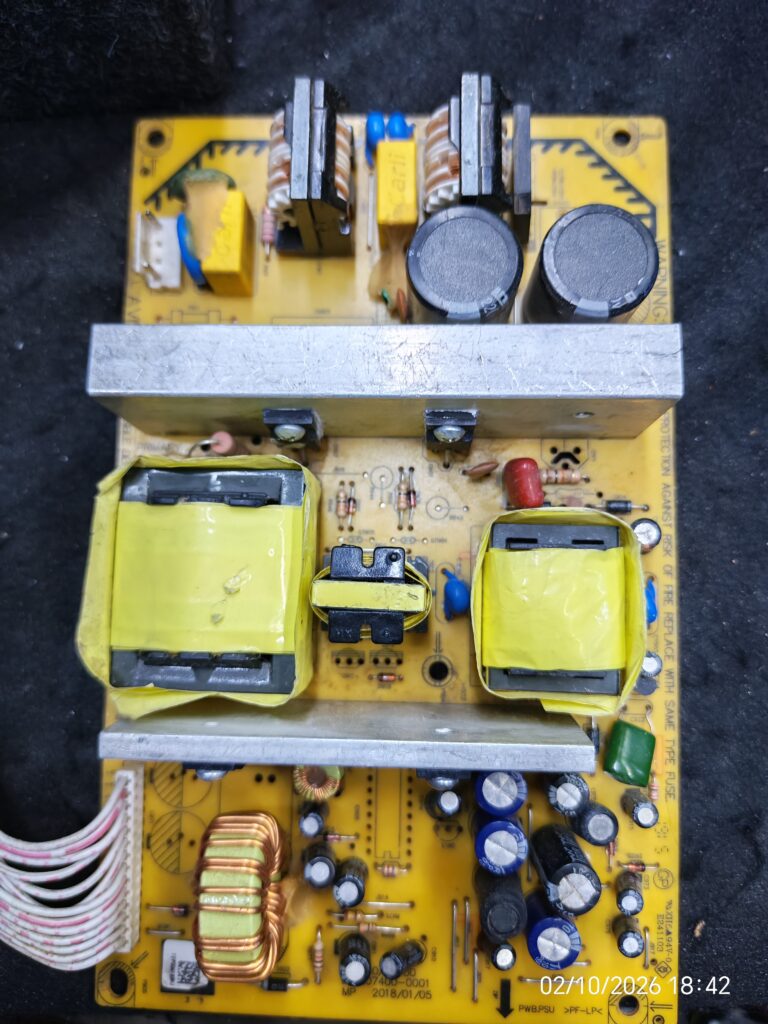
When an SMPS develops a fault, the entire equipment may stop working even though the rest of the electronic circuits are still functional. Some faults may cause complete loss of power, while others can result in intermittent operation, repeated restarting, clicking sounds, standby problems, overheating, blown fuses or unstable output voltages.
Pro-Logic Technologies Limited provides professional SMPS power supply board repair, testing, component replacement, troubleshooting and replacement services in Nairobi and across Kenya.
Our technicians work with electronic power supply boards at component level and can diagnose many faults involving primary-side and secondary-side circuits.
📞 CONTACT: 0723763173
📧 EMAIL: info@prologictechnologies.co.ke
🌐 WEBSITE: prologictecnologies.co.ke
📍 WORKSHOP: Luthuli Avenue, Kangari Building, 3rd Floor, KA7, Nairobi, Kenya
WHAT IS AN SMPS POWER SUPPLY?
An SMPS is an electronic power conversion circuit designed to convert electrical energy efficiently from one voltage level to another.
Unlike traditional linear power supplies that may use large transformers operating directly at mains frequency, an SMPS normally uses high-frequency switching circuitry. The incoming electrical supply is rectified, filtered, switched at high frequency and transferred through a high-frequency transformer or switching network before being rectified and regulated on the output side.
This arrangement allows manufacturers to design power supplies that are generally smaller, lighter and more efficient than equivalent conventional supplies.
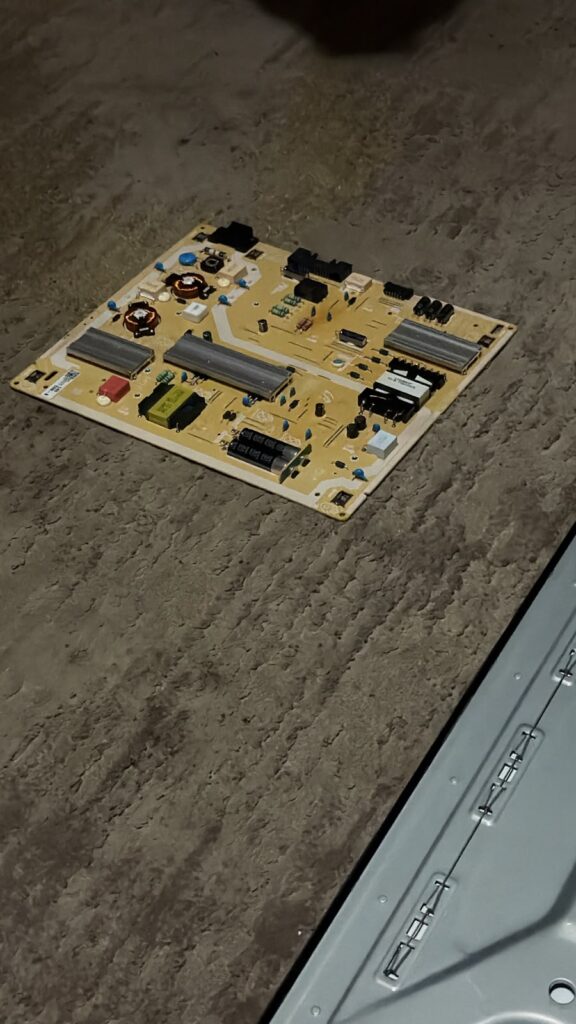
The board shown in the supplied image is a substantial switching power supply assembly containing components such as:
- Power transformers
- High-voltage capacitors
- Power switching devices
- Aluminium heatsinks
- Inductors
- Filtering components
- Rectification circuitry
- Electrolytic capacitors
- Resistors
- Protection components
- Secondary rectification components
- Output filtering circuitry
- Connectors
- Control circuitry
Because an SMPS operates with potentially dangerous mains voltages and high-energy capacitors, proper diagnosis requires appropriate electronic test equipment and qualified handling.
SMPS POWER SUPPLY BOARD REPAIR IN NAIROBI
If your electronic equipment has suddenly stopped powering on, the problem may originate from the power supply board.
A defective SMPS can produce different symptoms depending on the failed component and the section of the circuit affected.
At Pro-Logic Technologies Limited, we inspect the power supply systematically instead of replacing components randomly.
Our diagnostic process may include:
- Visual inspection
- Fuse testing
- Short-circuit testing
- Primary-side testing
- Secondary-side testing
- Capacitor testing
- MOSFET testing
- Diode testing
- Rectifier testing
- Resistance measurements
- Voltage measurements
- Startup circuit testing
- Feedback circuit testing
- Output voltage testing
- Load testing
- Component-level troubleshooting
The objective is to establish the actual cause of the failure before recommending repair or board replacement.
COMMON SMPS POWER SUPPLY FAULTS
1. SMPS COMPLETELY DEAD
One of the most common complaints is that the equipment does not power on at all.
A dead power supply may have a fault in the:
- Input fuse
- Bridge rectifier
- MOSFET
- Startup circuit
- PWM controller
- Switching transformer
- Primary capacitor
- Protection circuit
- Secondary rectifier
- Feedback circuit
- PCB tracks
- Power input section
A technician must determine whether the failure is on the primary side or secondary side before replacing parts.
2. BLOWN SMPS FUSE
A repeatedly blown fuse is usually an indication of a deeper fault.
The fuse itself may be functioning correctly by opening the circuit when excessive current is detected.
Possible causes include:
- Shorted MOSFET
- Shorted bridge rectifier
- Shorted primary capacitor
- Shorted snubber component
- Damaged switching controller
- Secondary-side short
- Surge damage
- Lightning-related damage
- Component failure
- PCB insulation failure
Simply replacing the fuse without investigating the underlying fault can result in another immediate failure.
3. FAILED POWER MOSFET
Power MOSFETs are commonly used as switching devices in SMPS circuits.
A failed MOSFET can cause:
- Blown input fuse
- Complete power failure
- Short circuit
- Burnt components
- Damaged gate resistor
- Failure of the PWM controller
- Repeated fuse failure
MOSFET testing should be performed carefully because surrounding components can influence resistance measurements.
A complete repair may require inspection of the MOSFET's associated gate-drive, snubber and protection circuitry.
4. BAD ELECTROLYTIC CAPACITORS
Electrolytic capacitors are critical components in both primary and secondary sections of an SMPS.
A capacitor can deteriorate because of:
- Age
- Heat
- Excessive ripple current
- Poor ventilation
- Electrical stress
- Incorrect voltage
- Component degradation
A capacitor may sometimes appear normal externally while having high ESR or reduced capacitance.
For this reason, professional diagnosis may require capacitance and ESR testing rather than relying only on visual inspection.
5. NO STANDBY VOLTAGE
Some electronic equipment has a standby power supply that remains active even when the main equipment appears to be switched off.
If the standby circuit fails, the equipment may show:
- No standby light
- No response from remote control
- No response from the power button
- No startup
- No communication with the main board
The standby supply must be tested before assuming that the main control board is defective.
6. REPEATED RESTARTING
An SMPS may start and then shut down repeatedly.
This can happen when:
- Output voltage is unstable
- Secondary circuit is overloaded
- Feedback circuit is faulty
- Capacitors have deteriorated
- Protection circuitry activates
- A downstream circuit is shorted
- Transformer or switching components are defective
The visible symptom may appear to be a problem with the main equipment, while the actual fault is located inside the power supply.
7. CLICKING OR TICKING SOUND
A clicking or ticking noise from an electronic device can sometimes originate from an SMPS entering a protection or restart cycle.
The switching circuit may attempt to start, detect an abnormal condition and shut down, then attempt to restart.
Possible causes include:
- Secondary short circuit
- Bad capacitor
- Overload
- Failed rectifier
- Feedback fault
- Damaged switching component
- Transformer problem
The sound itself is not enough to identify the failed component. Electrical testing is required.
8. OVERHEATING POWER SUPPLY
Excessive heating can indicate an electrical or thermal problem.
Common causes include:
- Overloaded circuit
- Failed cooling system
- High ESR capacitors
- Incorrect load
- Shorted semiconductor
- Poor ventilation
- Excessive switching losses
- Deteriorated components
- Incorrect replacement component
A component operating above its intended temperature can eventually cause additional failures.
PRIMARY SIDE AND SECONDARY SIDE OF AN SMPS
Understanding the difference between the primary and secondary sides is important during troubleshooting.
The primary side is associated with the incoming mains supply and high-voltage DC section.
It may include:
- Input fuse
- Surge protection
- EMI filter
- Bridge rectifier
- High-voltage capacitor
- Switching MOSFET
- PWM controller
- Startup components
- Primary transformer winding
- Snubber network
The secondary side is associated with the lower-voltage output section.
It may include:
- Secondary transformer windings
- Rectifier diodes
- Schottky diodes
- Synchronous rectifiers
- Output capacitors
- Inductors
- Feedback circuits
- Voltage regulation circuits
- Output connectors
These sections require different diagnostic approaches.
SMPS COMPONENT REPLACEMENT SERVICES
We provide component-level replacement where the condition of the PCB makes repair practical.
Components that may be replaced include:
- MOSFETs
- Diodes
- Rectifier bridges
- Electrolytic capacitors
- Ceramic capacitors
- Film capacitors
- Resistors
- Fusible resistors
- Thermistors
- Varistors
- PWM controllers
- Optocouplers
- Regulators
- Transistors
- Switching components
- Inductors
- Protection components
- Secondary rectifiers
The replacement component must be electrically suitable for the circuit.
SMPS BOARD REPLACEMENT
Not every power supply board should be repaired at component level.
Where a board is severely damaged, replacement may be more practical.
A replacement board should be matched according to relevant identification information such as:
- Board number
- Part number
- Revision
- Output specifications
- Connector configuration
- Equipment model
- Electrical ratings
- Physical dimensions
Using a visually similar board without confirming compatibility can damage the connected equipment.
TELEVISION SMPS POWER SUPPLY REPAIR
Modern televisions use sophisticated power supply systems to provide the different voltages required by the television.
An SMPS may provide power for:
- Main board
- Backlight system
- Audio amplifier
- T-Con-related circuits
- Standby circuit
- Control circuits
- LED driver section
A faulty television power supply may cause a completely dead television or may allow standby operation while preventing full startup.
We provide television power supply diagnosis and repair for various brands and models.
LED TV POWER SUPPLY REPAIR
LED televisions depend on regulated power supplies.
A power supply failure can present as:
- No power
- Standby only
- TV switching off
- TV restarting
- Backlight problems
- Clicking noise
- Blown fuse
- Burning smell
- Intermittent operation
A proper diagnosis distinguishes between an SMPS fault and faults in the main board or LED backlight system.
QLED AND OLED EQUIPMENT POWER SUPPLY
Advanced television technologies also use dedicated power management systems.
When a television does not start, the power supply should be tested alongside the control and display-related circuits.
A technician should avoid automatically condemning an expensive panel or main board before confirming the power rails.
AUDIO EQUIPMENT SMPS REPAIR
Many modern sound systems use switching power supplies.
These include:
- Home theatres
- Soundbars
- Amplifiers
- Hi-Fi systems
- Powered speakers
- Professional audio equipment
- Subwoofers
- DJ equipment
An SMPS fault can cause the entire audio system to become inactive or may cause protection-mode operation.
We can inspect the power supply and associated circuits to establish whether repair or replacement is appropriate.
INDUSTRIAL SMPS REPAIR
Industrial electronics often depend on stable DC power.
A faulty industrial power supply can affect:
- Control systems
- Sensors
- Relays
- PLC equipment
- Automation systems
- Displays
- Communication equipment
- Motor controllers
- Control panels
Unstable power can create secondary faults in sensitive electronic equipment.
For industrial applications, the diagnosis should consider both the power supply and the load connected to it.
WHY SMPS BOARDS FAIL
There is rarely one universal reason for SMPS failure.
Common causes include:
Electrical surges
Power surges can damage semiconductor components and protection devices.
Lightning
Lightning-related electrical events can cause extensive damage to electronic power supplies.
Heat
High operating temperatures accelerate component deterioration.
Age
Older capacitors and semiconductor components may eventually fail.
Overloading
A power supply operating beyond its designed load can overheat or enter protection mode.
Poor ventilation
Insufficient airflow increases internal temperature.
Component degradation
Capacitors, resistors and semiconductor components can change characteristics over time.
Downstream short circuits
A short circuit elsewhere in the equipment can overload the power supply.
SMPS DIAGNOSTIC PROCESS
Our technicians can follow a structured diagnostic procedure.
Step 1: Visual Inspection
The board is inspected for:
- Burn marks
- Cracked components
- Swollen capacitors
- Leakage
- Discoloured PCB areas
- Damaged connectors
- Broken tracks
- Burnt resistors
- Mechanical damage
Step 2: Fuse and Input Inspection
The incoming power path is checked.
Step 3: Short-Circuit Testing
Potential shorts are identified before applying power where appropriate.
Step 4: Primary Circuit Testing
The primary switching section is inspected.
Step 5: Secondary Circuit Testing
Output rectifiers and filtering circuits are checked.
Step 6: Control Circuit Testing
PWM and feedback circuits are evaluated.
Step 7: Output Voltage Verification
The expected output rails are measured.
Step 8: Load Testing
The supply may be evaluated under an appropriate load.
Step 9: Final Inspection
After repair, the board is inspected and tested before installation.
WHY PROFESSIONAL SMPS REPAIR MATTERS
An SMPS is not simply a collection of components that can be replaced randomly.
The circuit operates as an interconnected system.
For example, replacing a failed MOSFET without checking why it failed can result in another failure.
Similarly, replacing a blown fuse without checking the switching section can cause the new fuse to fail immediately.
Professional diagnosis therefore focuses on the cause of failure, not merely the component that appears damaged.
SMPS SAFETY
SMPS boards can contain dangerous voltages.
The large electrolytic capacitors on the primary side may retain electrical energy even after the equipment has been disconnected from the mains.
For this reason, customers should avoid opening or probing the board without appropriate technical knowledge and equipment.
Professional technicians use suitable measurement instruments and safe procedures when handling high-voltage power supply circuits.
SMPS REPAIR FOR BUSINESSES AND INSTITUTIONS
Businesses that depend on electronic equipment can experience operational interruptions when power supplies fail.
We can assist with power supply diagnosis for suitable equipment used in:
- Offices
- Shops
- Hotels
- Schools
- Workshops
- Restaurants
- Entertainment facilities
- Industrial premises
- Commercial installations
- Service centres
Where practical, power supply repair can help restore equipment without replacing the entire electronic system.
POWER SUPPLY BOARD TESTING
Testing is an important part of the repair process.
A technician may use equipment such as:
- Digital multimeter
- ESR meter
- Oscilloscope
- Component tester
- Insulation testing equipment
- Current-limited power source
- Electronic load
- Soldering and rework equipment
The exact instruments used depend on the design and fault condition of the board.
SMPS PCB REPAIR
Printed circuit boards can also suffer physical damage.
Examples include:
- Burnt tracks
- Cracked solder joints
- Broken connectors
- Lifted pads
- Carbonized PCB areas
- Corrosion
- Heat-damaged areas
Where technically feasible, damaged tracks and solder connections can be restored.
Severely carbonized or structurally damaged PCBs may require board replacement instead.
SMPS CAPACITOR REPLACEMENT
Capacitor replacement is one of the common operations performed during power supply repair.
The replacement must take into account:
- Capacitance
- Voltage rating
- Temperature rating
- Polarity
- Physical size
- Ripple-current capability
- ESR characteristics
Using an unsuitable capacitor can lead to premature failure.
SMPS MOSFET REPLACEMENT
MOSFET replacement requires careful selection.
Important characteristics can include:
- Drain-source voltage rating
- Current rating
- RDS(on)
- Gate characteristics
- Switching speed
- Package
- Thermal requirements
The correct replacement should be selected according to the circuit requirements rather than simply choosing a component with a similar physical appearance.
SMPS DIODE AND RECTIFIER REPAIR
Rectifier components convert switching waveforms into usable DC output.
A failed rectifier may produce:
- Short circuit
- Low output voltage
- Excessive ripple
- Overheating
- Power supply shutdown
Both primary and secondary rectification stages should be considered during diagnosis.
SMPS TRANSFORMER PROBLEMS
The transformers visible on many switching power supplies are high-frequency transformers.
They provide energy transfer and electrical isolation between sections of the circuit where applicable.
Transformer-related problems may include:
- Winding damage
- Overheating
- Shorted turns
- Physical damage
- Insulation problems
- Mechanical noise
Transformer faults require specialized testing and should not be confused with faults in surrounding components.
SMPS INDUCTORS AND FILTERING COMPONENTS
Inductors and coils are used extensively in power supplies.
They may perform functions such as:
- EMI filtering
- Energy storage
- Output filtering
- Noise reduction
- Current smoothing
A damaged inductor can affect output stability and power supply performance.
SMPS FEEDBACK CIRCUIT
Feedback is fundamental to regulated switching power supplies.
The feedback system monitors output conditions and communicates information to the control circuitry so that the switching stage can regulate output voltage.
Components such as:
- Optocouplers
- Reference devices
- Resistors
- Transistors
- Control ICs
may form part of this feedback system.
A feedback fault can cause abnormal output voltage or repeated shutdown.
SMPS STARTUP CIRCUIT
The startup circuit provides the initial operating conditions required for the switching controller.
A fault in this section may result in:
- No switching
- No startup
- Intermittent startup
- Repeated attempts to start
Startup components therefore deserve attention when an SMPS is completely dead but does not exhibit an obvious short circuit.
SMPS PROTECTION CIRCUITS
Modern power supplies commonly incorporate protection functions.
These can include protection against:
- Overcurrent
- Overvoltage
- Short circuit
- Excessive temperature
- Abnormal operating conditions
When protection activates, the power supply may shut down rather than continue operating under dangerous conditions.
SMPS POWER SUPPLY BOARD SERVICE IN NAIROBI CBD
Our workshop is located at:
Luthuli Avenue, Kangari Building, 3rd Floor, KA7, Nairobi.
Customers looking for electronic power supply repair services in Nairobi CBD can contact us before bringing a board or equipment for assessment.
We handle suitable repair work involving electronic power supply boards and related electronic equipment.
SMPS REPAIR SERVICES ACROSS KENYA
Although our main workshop is in Nairobi, we also serve customers requiring electronic repair services from different parts of Kenya.
Customers outside Nairobi can contact us to discuss:
- Board diagnosis
- Repair requirements
- Replacement boards
- Spare components
- Delivery arrangements
- Equipment assessment
Where possible, customers can provide clear photographs of the board, including the front, back, labels, part numbers and connectors, before arranging service.
WHAT INFORMATION SHOULD YOU PROVIDE WHEN REQUESTING SMPS REPAIR?
For faster assessment, provide:
- Equipment brand
- Equipment model
- Board number
- Clear photographs
- Description of the fault
- Whether the equipment has standby power
- Whether the fuse is blown
- Whether the equipment recently experienced a power surge
- Whether there was smoke or burning
- Any previous repair history
This information helps the technician understand the equipment before physical inspection.
SMPS BOARD IDENTIFICATION
Correct identification is essential when sourcing replacement boards.
A board can have multiple numbers, including:
- PCB number
- Assembly number
- Manufacturer number
- Revision number
- Model number
- Barcode
- Production code
A photograph alone may not always be sufficient for identifying an exact replacement.
REPAIR OR REPLACE THE SMPS?
The best option depends on the condition of the board.
Repair may be appropriate when:
- The PCB is structurally sound
- Components are available
- The fault is identifiable
- Repair is economically sensible
- The transformer and major components remain serviceable
Replacement may be preferable when:
- The PCB is severely burned
- Multiple sections are damaged
- Critical components are unavailable
- The board is extensively corroded
- Repair would be uneconomical
The final recommendation should be based on actual inspection.
SMPS POWER SUPPLY MAINTENANCE
Preventive maintenance can reduce unexpected failures in equipment that operates continuously.
Maintenance may include:
- Checking ventilation
- Cleaning accumulated dust
- Inspecting cooling systems
- Checking connectors
- Monitoring unusual heating
- Inspecting capacitors
- Checking output stability
- Investigating unusual sounds
- Checking for signs of overheating
Equipment operating in dusty environments may require more frequent inspection.
DUST AND SMPS FAILURE
Dust accumulation can contribute to overheating by restricting airflow and insulating heat-producing components.
Power supplies with heatsinks and cooling fans can be particularly affected by dust.
Keeping electronic equipment clean and properly ventilated can help maintain normal operating temperatures.
POWER SURGE DAMAGE
Electrical surges can cause significant damage to power supply circuits.
Protection components are intended to reduce the effect of abnormal electrical conditions, but severe events can exceed their protection capability.
After a major power event, a device that appears completely dead should be diagnosed rather than repeatedly powered on.
LIGHTNING DAMAGE TO POWER SUPPLIES
Lightning-related damage can affect multiple sections of an electronic device.
Depending on the path of the electrical event, damage may occur to:
- Input protection
- Rectifiers
- Switching components
- Controllers
- Transformers
- Secondary circuits
- Main boards
A complete inspection may therefore be necessary after severe electrical events.
SMPS POWER SUPPLY FOR HOME ELECTRONICS
Home electronics increasingly depend on switching power supplies.
These include:
- Televisions
- Sound systems
- Monitors
- Decoders
- Receivers
- Appliances
- LED equipment
- Chargers
- Networking equipment
- Entertainment systems
A power supply fault can make otherwise functional equipment unusable.
ELECTRONIC POWER SUPPLY SPARE PARTS
Depending on availability, we can assist with sourcing or supplying suitable electronic components and replacement boards.
Common components include:
- Capacitors
- Resistors
- Diodes
- MOSFETs
- Transistors
- Controllers
- Optocouplers
- Rectifiers
- Inductors
- Transformers
- Fuses
- Thermistors
- Varistors
Component availability varies according to model and specification.
SMPS REPAIR FOR TECHNICIANS AND SERVICE CENTRES
We can also handle suitable board-level repair requirements brought by technicians and service providers.
A technician may bring a board requiring:
- Fault diagnosis
- Component replacement
- Short-circuit tracing
- PCB repair
- Testing
- Power supply restoration
- Board evaluation
The board should be accompanied by its equipment model and fault description whenever possible.
WHY CHOOSE PRO-LOGIC TECHNOLOGIES LIMITED?
We focus on practical electronic diagnosis rather than unnecessary replacement.
Our service approach emphasizes:
- Technical inspection
- Component-level diagnosis
- Fault identification
- Proper component selection
- Electrical testing
- Board evaluation
- Repair where practical
- Replacement where appropriate
- Clear communication with customers
Our objective is to restore equipment safely and reliably where repair is technically and economically viable.
SMPS POWER SUPPLY REPAIR QUESTIONS
Can every SMPS board be repaired?
No. Some boards are too extensively damaged or have components that are no longer economically available. The board must be inspected.
Can a blown fuse simply be replaced?
A fuse should not automatically be replaced without investigating why it opened.
Why does an SMPS keep restarting?
Possible causes include overload, short circuit, defective capacitors, feedback faults, protection activation or secondary-side problems.
Can you replace individual SMPS components?
Yes, component-level repair may be possible depending on the board and fault.
Do you repair television power supply boards?
Yes. Suitable television SMPS boards can be diagnosed and repaired or replaced.
Do you sell replacement power supply boards?
Replacement availability depends on the exact board number, equipment model and market availability.
Can I send a photograph first?
Yes. Clear photographs of the board and its identification labels can help with preliminary assessment.
CONTACT PRO-LOGIC TECHNOLOGIES LIMITED
For SMPS power supply board repair, testing, troubleshooting, component replacement and replacement board enquiries, contact our technical team.
CONTACT INFORMATION
Company: Pro-Logic Technologies Limited
Phone: 0723763173
Email: info@prologictechnologies.co.ke
Website: prologictecnologies.co.ke
Workshop: Luthuli Avenue, Kangari Building, 3rd Floor, KA7, Nairobi, Kenya
Customers requiring service from outside Nairobi can contact us first to discuss the board, equipment model, fault symptoms and available repair options.
SMPS POWER SUPPLY BOARD REPAIR IN NAIROBI AND KENYA
A properly functioning power supply is essential for the reliability of electronic equipment. When an SMPS fails, replacing the entire device may not always be necessary. In many cases, professional diagnosis can identify the defective component or circuit section and determine whether the board can be restored.
From power MOSFETs and rectifiers to capacitors, transformers, inductors, PWM controllers and feedback circuits, an SMPS contains numerous interconnected stages. Proper diagnosis therefore requires understanding the complete power conversion process.
At Pro-Logic Technologies Limited, we provide technical assessment of suitable SMPS boards and electronic power supply systems. Our workshop at Luthuli Avenue, Kangari Building, 3rd Floor, KA7, Nairobi provides a point where customers can bring boards and equipment for assessment.
For enquiries, call 0723763173, email info@prologictechnologies.co.ke, or visit prologictecnologies.co.ke.
Pro-Logic Technologies Limited — SMPS POWER SUPPLY BOARD DIAGNOSTICS, REPAIR, COMPONENT REPLACEMENT AND ELECTRONIC POWER SUPPLY SERVICES IN NAIROBI, KENYA.