
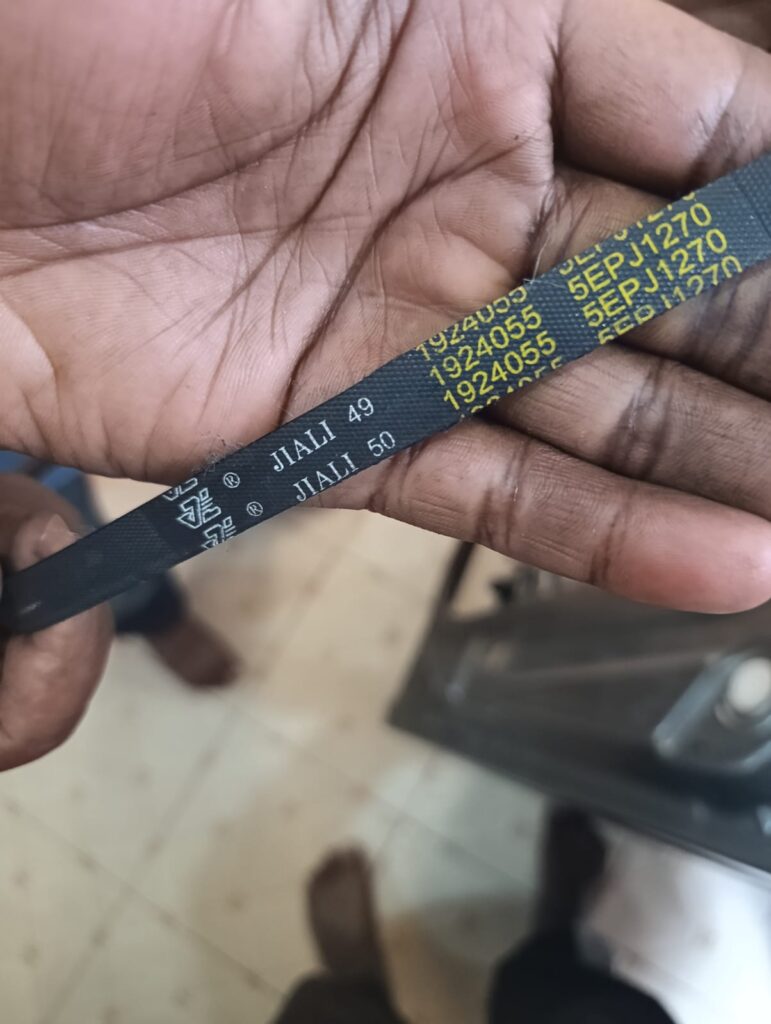
The JIALLI 5EPJ1270 is a multi-rib (call 0723763173) appliance drive belt identified from the markings visible on the belt shown in the supplied image. The belt carries the 5EPJ1270 marking, together with additional manufacturing or identification markings including 1924055 and JIALLI markings.
Drive belts are essential mechanical components in many appliances because they transfer rotational power from a motor to another rotating assembly. In washing machines, for example, the belt can transfer power from the electric motor to the drum pulley, allowing the drum to rotate during washing, rinsing and spinning.
When a washing-machine belt becomes stretched, cracked, worn, loose or broken, the appliance may develop symptoms such as a drum that does not rotate, weak spinning, unusual mechanical noise, intermittent drum movement or a motor that runs while the drum remains stationary.
For customers looking for a 5EPJ1270 replacement belt in Kenya, proper identification is important before purchasing or installing a replacement. A belt should not be selected based only on appearance. The belt profile, number of ribs, effective length, construction, pulley arrangement and appliance model should be considered.
Pro-Logic Technologies Limited supplies and deals in appliance spare parts and technical repair services, including replacement and installation of washing-machine drive belts. Our main workshop is located at Luthuli Avenue, Kangari Building, 3rd Floor, KA7, Nairobi.
For enquiries about the availability of the JIALLI 5EPJ1270 belt, customers can contact us using 0723763173.
JIALLI 5EPJ1270 BELT SPECIFICATION
The belt shown in the supplied photograph has several markings that can help technicians identify it.
The most important visible identification is:
5EPJ1270
The belt also visibly carries:
1924055
and:
JIALLI
The belt is a multi-ribbed EPJ-type drive belt. The designation 5EPJ1270 generally indicates a five-rib poly-V/serpentine-style appliance belt with a nominal designation associated with a 1270-size length.
However, appliance manufacturers can use different belt specifications, pulley dimensions and tension arrangements. Therefore, the printed number should always be compared with the original belt and the appliance's model information before ordering.
This is especially important when replacing belts on washing machines because two belts can look similar but have different lengths or profiles.
A belt that is too long can slip.
A belt that is too short can create excessive tension.
A belt with the wrong rib profile may not sit correctly inside the pulley.
A belt with an incorrect number of ribs may not engage the pulley properly.
For this reason, professional belt identification is recommended.
WHAT IS A WASHING MACHINE DRIVE BELT?
A washing-machine drive belt is a flexible mechanical transmission component used to transfer rotational movement from the washing-machine motor to the drum or other driven pulley.
The electric motor produces rotational motion. That motion must be transmitted to the drum. Depending on the design of the washing machine, this can be achieved through a belt-and-pulley system.
In a traditional belt-driven washing machine, the motor has a relatively small pulley. The drum shaft is connected to a larger pulley. The belt runs around both pulleys.
When the motor turns, the motor pulley turns.
The belt moves.
The movement of the belt rotates the larger drum pulley.
The drum then rotates.
This arrangement allows the manufacturer to use pulley ratios to control the relationship between motor speed and drum speed.
The belt therefore plays a fundamental role in the mechanical transmission system.
A washing machine may have an electrically functional motor, a working control board and a functioning power supply, but if the drive belt is broken or badly worn, the drum may still fail to rotate correctly.
WHY THE JIALLI 5EPJ1270 BELT IS IMPORTANT
The quality and condition of a drive belt can have a major effect on appliance operation.
A correctly fitted belt should maintain sufficient contact with the pulleys to transfer torque without excessive slipping.
During washing-machine operation, the belt may experience repeated acceleration and deceleration.
The drum can change direction.
The machine may move from washing to rinsing.
The machine may increase speed during spin.
These changes place mechanical demands on the belt.
A suitable replacement belt should therefore be capable of operating under the conditions for which it was designed.
The 5EPJ1270 marking provides an important starting point for identifying the belt, but professional verification remains advisable.
COMMON SIGNS OF A WORN WASHING MACHINE BELT
A defective belt can produce several symptoms.
1. THE MOTOR RUNS BUT THE DRUM DOES NOT TURN
This is one of the most important symptoms.
If the washing-machine motor can be heard running but the drum does not rotate, the belt should be inspected.
The belt may have:
- Broken completely
- Come off the pulley
- Become severely stretched
- Slipped because of wear
- Been damaged by a pulley problem
- Lost effective tension
However, the motor and drum system should also be inspected because a non-rotating drum is not automatically proof of a belt failure.
2. THE DRUM TURNS INTERMITTENTLY
A worn belt may sometimes grip correctly and sometimes slip.
The machine may appear to work during part of the cycle but fail during another stage.
For example, the drum may rotate during a light wash but struggle when the machine attempts a high-speed spin.
This can happen because high-speed operation places greater demands on the drive system.
3. THE DRUM DOES NOT SPIN PROPERLY
A washing machine may complete washing and rinsing but fail to reach its normal spin performance.
Possible causes include:
- Drive belt problems
- Motor problems
- Motor control faults
- Drum obstruction
- Bearing problems
- Pulley problems
- Control-board faults
- Drainage problems
- Incorrect load distribution
A technician should diagnose the complete system rather than automatically replacing the belt.
4. SQUEALING OR SQUEAKING
A worn or slipping belt may create a squealing sound.
The sound can become more noticeable when the motor starts or when the drum accelerates.
However, noises can also come from:
- Drum bearings
- Motor bearings
- Pulley bearings
- Foreign objects
- Loose mechanical components
- Damaged pulleys
The source should therefore be confirmed before purchasing parts.
WHY A WASHING MACHINE BELT BECOMES DAMAGED
Drive belts operate under continuous mechanical stress.
Several factors can contribute to deterioration.
AGE
Rubber and synthetic belt materials can deteriorate over time.
HEAVY LOADS
Repeatedly operating the machine with loads beyond the manufacturer's recommended capacity can increase mechanical stress.
INCORRECT TENSION
A belt that is too loose may slip.
A belt that is too tight may place excessive load on bearings, motor shafts and pulleys.
DAMAGED PULLEYS
A pulley with a damaged surface can rapidly damage a replacement belt.
BEARING FAILURE
A failing drum bearing can create resistance or misalignment, placing additional stress on the belt.
WATER OR CHEMICAL CONTAMINATION
Exposure to unsuitable substances can affect belt materials.
MISALIGNMENT
If the motor pulley and drum pulley are not properly aligned, the belt may track incorrectly.
JIALLI 5EPJ1270 BELT REPLACEMENT
Replacing a washing-machine belt may appear simple, but correct installation requires attention to mechanical alignment and safety.
The general process may involve:
- Disconnecting the appliance from electrical power.
- Moving the appliance into a suitable service position.
- Accessing the drive system.
- Inspecting the existing belt.
- Checking the motor pulley.
- Checking the drum pulley.
- Inspecting the belt path.
- Removing the old belt.
- Comparing the replacement belt.
- Installing the replacement.
- Checking belt alignment.
- Rotating the system manually where appropriate.
- Reassembling the appliance.
- Conducting a controlled test.
The exact procedure varies according to washing-machine design.
HOW TO IDENTIFY THE CORRECT BELT
The safest way to identify a washing-machine belt is to use multiple pieces of information.
BELT PRINTING
Read the complete code printed on the belt.
In this case, the visible marking includes:
5EPJ1270
NUMBER OF RIBS
The belt shown is identified as a five-rib belt.
ORIGINAL BELT
If possible, keep the old belt until the replacement has been verified.
APPLIANCE MODEL NUMBER
The model number is often found on a rating plate located on the rear, side, door frame or another area of the washing machine.
MANUFACTURER INFORMATION
The appliance brand and model can help determine the correct belt.
PHYSICAL DIMENSIONS
A technician can compare the replacement with the original belt.
DO NOT BUY A BELT BASED ONLY ON APPEARANCE
One of the most common mistakes when purchasing appliance spare parts is assuming that belts that look similar are interchangeable.
Two belts may have:
- Similar widths
- Similar rib patterns
- Similar lengths
- Similar appearance
yet still have different specifications.
The belt profile must match the pulley.
The rib count must be appropriate.
The effective length must be correct.
The construction must be suitable.
The appliance design must be compatible.
This is why providing the old belt marking and appliance model is useful when requesting a replacement.
JIALLI 5EPJ1270 FOR WASHING MACHINE REPAIR
For washing-machine repair technicians, appliance spare-parts shops and customers repairing domestic washing machines, a correctly identified replacement belt can restore mechanical drive operation.
A belt replacement may be required when a machine has stopped rotating the drum but the motor is still operating.
Before replacing it, however, the technician should investigate why the original belt failed.
Replacing the belt without addressing an underlying pulley, bearing or alignment problem can cause the new belt to fail prematurely.
For example, if a drum pulley is bent, damaged or loose, a new belt may not run correctly.
If a drum bearing is severely damaged, installing a new belt alone may not solve the problem.
If the motor mount is loose, belt alignment can be affected.
Professional diagnosis is therefore important.
WHAT DOES 5EPJ1270 MEAN?
The 5EPJ1270 designation is useful for belt identification.
The 5 is associated with the belt's rib configuration.
EPJ refers to the profile/type designation.
1270 is the nominal size designation associated with the belt's length.
Exact measurement conventions can vary depending on belt standards and manufacturer specifications, so the number should be treated as a belt identification code rather than assuming that a simple tape measurement will produce exactly 1270 mm under every measurement method.
When ordering, technicians should provide the full marking rather than simply saying "washing-machine belt."
JIALLI APPLIANCE BELTS
JIALLI-branded belts can be found with different identification numbers and configurations.
The marking on the belt is particularly important because belts can have different:
- Rib counts
- Profiles
- Lengths
- Widths
- Materials
- Construction
- Intended applications
The 5EPJ1270 should therefore be ordered by its complete designation.
BELT SLIPPING PROBLEMS
A belt can slip when it cannot maintain sufficient traction against the pulley.
Possible causes include:
- Belt wear
- Belt stretching
- Incorrect belt size
- Oil contamination
- Damaged pulley
- Excessive load
- Incorrect tension
- Misalignment
- Bearing resistance
A slipping belt may produce a squealing sound and may leave visible rubber dust around the drive area.
The technician should inspect the complete drive mechanism.
WHY BELT TENSION MATTERS
Belt tension is an important part of washing-machine mechanical design.
A belt must be sufficiently tensioned to transfer motor torque.
However, excessive tension is undesirable.
Too little tension can result in:
- Slipping
- Poor drum acceleration
- Reduced transmission efficiency
- Noise
- Belt overheating
- Premature wear
Too much tension can contribute to:
- Bearing loading
- Motor shaft loading
- Pulley stress
- Belt stress
- Premature component failure
The appropriate tension depends on the appliance design and belt system.
WASHING MACHINE BELT AND MOTOR RELATIONSHIP
The belt connects the mechanical output of the motor to the drum drive system.
The motor itself may be controlled by:
- A mechanical timer
- Electronic control board
- Motor controller
- Inverter system
- Variable-speed control
Modern washing machines can use sophisticated motor-control systems.
Some appliances use direct-drive motors without conventional belts.
Others continue to use belt-driven systems.
Therefore, a belt should only be ordered when the particular washing-machine design uses a compatible belt drive.
BELT FAILURE DOES NOT ALWAYS MEAN MOTOR FAILURE
Customers sometimes hear a motor running and assume that the motor has failed because the drum does not move.
The opposite can occur.
The motor may be operational while the belt is broken.
A basic diagnostic approach is to distinguish between:
Electrical motor operation
and
Mechanical power transmission
The motor can rotate without transferring its motion to the drum if the belt is missing or defective.
This is why technicians should inspect the drive system before condemning expensive electrical components.
WASHING MACHINE BELT INSTALLATION SERVICE IN NAIROBI
If you need a washing-machine belt replacement in Nairobi, professional inspection can help identify the correct part and determine whether the belt is actually responsible for the fault.
Pro-Logic Technologies Limited handles appliance repair and spare-parts requirements in Nairobi and surrounding areas.
Our workshop is located at:
LUTHULI AVENUE, KANGARI BUILDING, 3RD FLOOR, KA7, NAIROBI
Customers can bring the old belt or provide a clear photograph showing its complete printed code.
Providing the appliance brand and model is also recommended.
BUY 5EPJ1270 BELT IN NAIROBI
Customers looking for a 5EPJ1270 belt in Nairobi can enquire about availability before visiting the workshop.
When making an enquiry, provide:
- Belt number
- Appliance brand
- Appliance model
- Photograph of the old belt
- Photograph of the washing-machine rating plate if available
The photograph can help technicians read markings and compare the physical design.
For the belt shown in the supplied image, the principal visible identification is 5EPJ1270.
WASHING MACHINE SPARE PARTS IN KENYA
A washing machine consists of numerous mechanical and electrical components.
Common spare parts include:
- Drive belts
- Drain pumps
- Water inlet valves
- Door locks
- Door seals
- Bearings
- Drum spiders
- Motors
- Carbon brushes
- Capacitors
- Pressure switches
- Control boards
- Inverter boards
- Shock absorbers
- Suspension components
- Heating elements
- Temperature sensors
- Drain hoses
- Inlet hoses
- Pulleys
A belt is relatively simple compared with an electronic control board, but it is critical when the machine uses a belt-driven transmission.
COMMON WASHING MACHINE PROBLEMS RELATED TO DRIVE SYSTEMS
A technician may encounter complaints such as:
"The washing machine fills with water but the drum does not turn."
"The motor is making noise but the drum is stationary."
"The machine spins slowly."
"The washing machine makes a squealing sound."
"The drum moves sometimes and stops sometimes."
"The belt keeps coming off."
"The washing machine smells of burnt rubber."
"The machine stopped spinning suddenly."
Each complaint requires diagnosis.
A belt may be the cause, but it may also be a symptom of another mechanical fault.
BURNT RUBBER SMELL FROM A WASHING MACHINE
A burnt-rubber smell can indicate belt slipping or excessive friction.
When a belt slips against a pulley, friction converts mechanical energy into heat.
Repeated slipping can damage the belt.
Possible causes include:
- Incorrect belt size
- Belt deterioration
- Locked drum
- Bearing failure
- Pulley obstruction
- Excessive mechanical resistance
- Motor problems
The machine should be switched off and inspected rather than continuously operated.
WHY A NEW BELT MAY KEEP BREAKING
If a newly installed belt fails quickly, replacing it again without diagnosis may not solve the problem.
The technician should inspect:
DRUM BEARING
A seized or damaged bearing can create excessive resistance.
DRUM PULLEY
The pulley should be checked for damage, looseness and alignment.
MOTOR PULLEY
The motor pulley must be in suitable condition.
BELT ALIGNMENT
The belt should run correctly along the pulley grooves.
CORRECT BELT SIZE
The replacement must be appropriate for the appliance.
MOTOR MOUNTING
A loose motor can affect belt alignment and tension.
BELT COMPARISON BEFORE INSTALLATION
When customers bring an old belt to the workshop, technicians can compare:
- Printed identification
- Rib count
- Profile
- Overall construction
- Length
- Width
- Condition
- Pulley fit
The new belt should not simply be installed because it "looks close."
The comparison should be systematic.
5EPJ1270 BELT FOR APPLIANCE TECHNICIANS
For appliance repair professionals, accurate spare-part identification reduces unnecessary repeat visits.
A technician can record the belt number during servicing.
For example:
Old belt: 5EPJ1270
The technician can then verify whether the replacement carries the same specification.
If the original belt marking is unreadable, the appliance model can be used as an additional identification method.
HOW TO SEND A BELT PHOTO FOR IDENTIFICATION
A clear photograph should show the complete belt.
For best results:
- Place the belt in good lighting.
- Stretch it gently enough to make the printing visible.
- Photograph the printed code.
- Include the complete code.
- Photograph the appliance model plate if available.
- Avoid blurry images.
- Include the number of ribs if possible.
The supplied image is useful because the 5EPJ1270 marking is visible.
WASHING MACHINE BELT SALES IN KENYA
Customers throughout Kenya may require appliance belts for repair jobs.
A spare-parts supplier can assist with identification and availability.
Common customer requirements include:
- Washing-machine belt replacement
- Replacement belt for repair technicians
- Belt for customer-owned washing machine
- Emergency replacement after belt breakage
- Spare belt for appliance maintenance
- Belt identification from an old part
Customers outside Nairobi should confirm delivery options and provide complete identification information before ordering.
WASHING MACHINE BELT DELIVERY
For customers who cannot visit Nairobi, belt availability and delivery arrangements can be discussed during the enquiry.
Before dispatching a belt, the appliance model and belt marking should be verified as far as possible.
This reduces the possibility of sending an incorrect belt.
Customers should not assume that every 5EPJ belt is interchangeable.
PROFESSIONAL WASHING MACHINE REPAIR
A professional washing-machine repair service does more than replace individual components.
A proper repair process should establish:
- What failed
- Why it failed
- Whether other parts are damaged
- Whether the replacement part is correct
- Whether the appliance is safe to operate
- Whether the repair restores normal operation
When a belt has failed, the technician should inspect the complete drive assembly.
BELT MAINTENANCE
Most customers do not need to remove the washing-machine belt for routine maintenance.
However, several practices can reduce unnecessary stress on the machine.
Do not consistently overload the washing machine.
Use the appliance according to the manufacturer's instructions.
Pay attention to unusual noises.
Do not continue operating a machine that develops severe mechanical noise.
If the drum becomes difficult to turn, arrange inspection.
If a belt repeatedly comes off, investigate the cause instead of repeatedly reinstalling it.
OVERLOADING AND BELT WEAR
Washing-machine capacity is specified by the manufacturer.
Regular overloading can increase mechanical demand.
A heavier load can increase the torque required to start and accelerate the drum.
This can place additional stress on:
- Motor
- Belt
- Pulley
- Bearings
- Drum assembly
- Motor controller
Using the appliance within its intended capacity is therefore important for mechanical reliability.
BELT AND DRUM BEARING PROBLEMS
A washing machine can experience both belt and bearing problems.
A failing bearing may cause:
- Grinding noise
- Drum play
- Resistance
- Leakage
- Abnormal vibration
- Belt misalignment
If the bearing is badly damaged, fitting a new belt may provide only a temporary solution.
The complete mechanical system should be inspected.
BELT AND PULLEY PROBLEMS
The pulley provides the surface over which the belt operates.
A damaged pulley can have:
- Bent sections
- Damaged grooves
- Excessive rust
- Loose mounting
- Misalignment
- Physical deformation
If a belt repeatedly slips or comes off, pulley inspection is important.
WHAT HAPPENS WHEN THE BELT BREAKS?
When the drive belt breaks completely, the motor may still receive electrical power.
The control system may command the motor to run.
The motor can rotate.
But the drum may remain stationary because the mechanical connection between the motor and drum has been interrupted.
Depending on the washing-machine design, the machine may then display unusual behavior or fault indications.
The exact symptoms depend on the model.
SHOULD YOU REPLACE THE BELT YOURSELF?
Some experienced DIY users may be capable of replacing a belt.
However, washing machines contain electrical connections, moving components and heavy mechanical assemblies.
If you are unfamiliar with appliance repair, professional service is safer.
Before any internal inspection, the appliance must be disconnected from electrical power.
The exact disassembly procedure depends on the appliance.
IMPORTANCE OF ELECTRICAL SAFETY
A washing machine is an electrically powered appliance.
Before accessing internal components, electrical power must be disconnected.
Do not rely only on the control panel's OFF button.
A technician should follow appropriate electrical safety procedures.
The belt itself is a mechanical component, but access to it may require removing covers near electrical wiring, motors, capacitors, control components or other energized equipment.
JIALLI 5EPJ1270 BELT PRICE IN KENYA
The price of an appliance belt can vary depending on:
- Brand
- Specification
- Availability
- Genuine versus compatible replacement
- Supplier
- Quantity
- Location
- Delivery requirements
For this reason, customers should enquire for the current price and availability of the JIALLI 5EPJ1270 rather than relying on an outdated online price.
For a price quotation, provide the belt marking and appliance model.
Call or enquire: 0723763173.
WHY CUSTOMERS SHOULD CONFIRM AVAILABILITY
Spare-parts inventory changes.
A belt may be available at one time and temporarily unavailable later.
Customers should therefore confirm:
- Current stock
- Current price
- Compatibility
- Delivery options
- Collection location
This is particularly important for technicians who need a belt urgently for a customer repair.
BUY APPLIANCE BELTS FROM A SPECIALIST
Buying an appliance belt from a supplier familiar with repair work can make identification easier.
Instead of simply asking for "a washing-machine belt," provide the actual identification number.
For the belt shown:
JIALLI 5EPJ1270
This gives the supplier a much more useful starting point.
JIALLI 5EPJ1270 BELT IDENTIFICATION FROM PHOTOGRAPH
The photograph supplied for this article clearly shows the belt's printed markings.
The visible text includes:
5EPJ1270
1924055
JIALLI
These markings are useful for product identification.
The photograph should not, by itself, be used to claim that the belt fits every washing machine.
Compatibility must be verified.
BELT PROFILE AND RIBS
A multi-rib belt has longitudinal ribs that engage with corresponding grooves on a pulley.
The ribs increase the contact area between the belt and pulley.
This allows the belt to transmit rotational force efficiently while remaining relatively flexible.
The correct profile is essential.
If the belt profile does not correspond correctly to the pulley, the belt may not seat properly.
WHY THE NUMBER OF RIBS MATTERS
The belt shown is marked 5EPJ1270, indicating a five-rib configuration.
The number of ribs is an important identification characteristic.
Using a belt with an incorrect rib count may cause poor pulley engagement or incorrect tracking.
Therefore, technicians should check the rib count before installation.
BELT LENGTH MATTERS
A belt that is too long can fail to maintain sufficient tension.
A belt that is too short can be difficult or unsafe to install and may create excessive tension.
The specified length must correspond to the appliance's drive geometry.
The 1270 designation is therefore an important part of the belt identification.
HOW BELT WEAR CAN BE INSPECTED
Visible signs of belt deterioration may include:
- Cracking
- Fraying
- Rib damage
- Glossy or glazed surfaces
- Missing material
- Excessive stretching
- Edge damage
- Uneven wear
- Rubber dust
- Splitting
A belt that shows severe deterioration should be replaced with a properly matched part.
UNEVEN BELT WEAR
If one edge of the belt appears more damaged than the other, alignment should be investigated.
Possible causes include:
- Pulley misalignment
- Damaged pulley
- Loose mounting
- Bearing movement
- Incorrect installation
- Incorrect belt specification
A replacement belt may not last if the underlying cause remains.
BELT COMES OFF THE PULLEY
A belt that repeatedly comes off is not necessarily a defective belt.
Possible reasons include:
- Misaligned pulleys
- Loose drum pulley
- Incorrect belt length
- Damaged pulley
- Motor movement
- Bearing play
- Incorrect installation
The drive assembly should be checked carefully.
WASHING MACHINE NOT SPINNING
A washing machine that does not spin can have many causes.
Possible causes include:
- Drive belt failure
- Motor failure
- Motor-control fault
- Drainage problem
- Door-lock problem
- Control-board fault
- Bearing problem
- Drum obstruction
- Wiring problem
Therefore, belt replacement should follow diagnosis.
WASHING MACHINE MAKING NOISE
Mechanical noise can come from multiple sources.
A belt may squeal.
A bearing may grind.
A pulley may rattle.
A foreign object may scrape against the drum.
A loose component may vibrate.
Correct diagnosis requires listening to the appliance and inspecting the mechanical system.
BELT REPLACEMENT AS PART OF WASHING MACHINE SERVICE
Replacing a belt can be one component of a larger repair.
A technician may inspect:
- Belt
- Motor
- Drum pulley
- Motor pulley
- Bearings
- Suspension
- Wiring
- Control system
- Drain system
This approach helps prevent unnecessary parts replacement.
WASHING MACHINE BELT FOR REPAIR TECHNICIANS
Technicians should record belt information during appliance servicing.
A good repair record can include:
Appliance brand
Appliance model
Original belt marking
Replacement belt marking
Date of repair
Observed fault
Other components inspected
This information can help with future servicing.
WHY CORRECT PART IDENTIFICATION SAVES MONEY
Installing the wrong belt can result in:
- Repeat labour
- Delayed repair
- Belt slipping
- Premature failure
- Damage to mechanical components
- Customer dissatisfaction
Correct identification before installation is therefore economically sensible.
5EPJ1270 BELT FOR DOMESTIC APPLIANCE REPAIR
Domestic washing machines operate under demanding conditions.
The machine can perform multiple cycles every week.
The drum repeatedly changes direction.
During spin, the rotational speed can increase significantly.
The drive system must therefore handle repeated mechanical cycles.
A correctly specified belt is an essential part of that system.
APPLIANCE SPARE PARTS SUPPLIER IN NAIROBI
Pro-Logic Technologies Limited provides appliance repair and spare-parts support from its Nairobi workshop.
Our location is:
LUTHULI AVENUE, KANGARI BUILDING, 3RD FLOOR, KA7, NAIROBI
Customers can enquire about washing-machine belts, appliance repair and related spare parts.
For the JIALLI 5EPJ1270, provide the complete belt marking when making an enquiry.
SERVICES RELATED TO WASHING MACHINE BELTS
Our appliance repair services can include diagnosis and repair of washing-machine faults involving:
- Drive systems
- Motors
- Belts
- Drain pumps
- Water inlet systems
- Door locks
- Control boards
- Inverter systems
- Bearings
- Wiring
- Sensors
- Drainage
- Spinning faults
- Washing-cycle problems
The exact repair depends on the appliance fault.
WASHING MACHINE BELT REPLACEMENT PROCESS
A professional replacement normally starts with diagnosis.
The technician identifies the complaint.
The appliance is isolated from electrical power.
The appropriate access panel is removed according to the machine's design.
The belt and drive system are inspected.
The belt identification is checked.
The pulleys are inspected.
The old belt is removed.
The replacement belt is compared.
The replacement is installed correctly.
The alignment is checked.
The appliance is reassembled.
A controlled test is performed.
The customer is informed of any additional faults discovered.
DO NOT IGNORE A SLIPPING BELT
A belt that slips repeatedly should not be ignored.
Continued slipping can generate heat and accelerate deterioration.
Rubber particles can accumulate around the drive area.
The belt can eventually break.
If the underlying cause is a damaged pulley or bearing, continued operation may worsen the mechanical problem.
WHEN TO CALL A TECHNICIAN
Professional assistance is recommended when:
- The belt repeatedly comes off
- The machine makes grinding noises
- The drum is difficult to turn
- The motor runs but the drum does not move
- The belt breaks repeatedly
- The machine leaks
- There is an electrical fault
- The machine trips power
- The control board displays an unexplained fault
- You cannot identify the correct replacement belt
HOW TO ORDER A 5EPJ1270 BELT
To enquire about this belt, send:
1. Belt number: 5EPJ1270
2. Appliance brand
3. Appliance model
4. Photograph of the old belt
5. Photograph of the appliance model plate
This information helps with identification.
You can contact us at:
0723763173
Visit:
Pro-Logic Technologies Limited
Luthuli Avenue, Kangari Building, 3rd Floor, KA7, Nairobi.
5EPJ1270 BELT FOR WASHING MACHINE REPAIR IN KENYA
Customers in Nairobi and other parts of Kenya can enquire about the JIALLI 5EPJ1270 belt.
The most important step is to confirm compatibility before purchase.
Do not assume that a belt will fit merely because it has the same general appearance.
Use the belt code, rib configuration and appliance model together.
WASHING MACHINE BELT FAQ
WHAT IS THE JIALLI 5EPJ1270?
The JIALLI 5EPJ1270 is a multi-rib appliance drive belt identified by the printed designation 5EPJ1270.
WHAT DOES 5EPJ1270 MEAN?
It is the belt's identification designation, indicating its rib/profile and nominal size characteristics.
IS 5EPJ1270 A WASHING MACHINE BELT?
It can be used in appliance drive applications, including certain washing-machine designs, but compatibility must be confirmed for the specific appliance.
HOW MANY RIBS DOES IT HAVE?
The "5" designation indicates a five-rib configuration.
WHAT IS THE LENGTH?
The 1270 designation is associated with the nominal belt size/length designation. Exact measurement should be verified according to the relevant belt standard and manufacturer specification.
CAN I USE ANY 5EPJ BELT?
No. Rib count, profile and length must be appropriate for the appliance.
CAN A BELT CAUSE A WASHING MACHINE NOT TO SPIN?
Yes. A broken, severely worn, loose or incorrectly fitted belt can prevent a belt-driven washing machine from rotating the drum.
WHY DOES MY WASHING MACHINE MOTOR RUN BUT THE DRUM DOES NOT MOVE?
A broken or displaced drive belt is one possible cause, but the motor, pulley, bearings, wiring and control system should also be checked.
WHY DOES MY BELT KEEP COMING OFF?
Possible causes include incorrect belt size, pulley misalignment, damaged pulley, bearing movement, loose components or incorrect installation.
SHOULD I REPLACE THE PULLEY WHEN REPLACING THE BELT?
Not automatically. The pulley should be inspected. If it is damaged or improperly aligned, replacement or repair may be necessary.
CAN I INSTALL THE BELT MYSELF?
An experienced person may be able to, but internal washing-machine repairs involve electrical and mechanical hazards. Professional installation is recommended if you are not familiar with appliance servicing.
HOW DO I KNOW IF MY BELT IS WORN?
Look for cracks, fraying, glazing, rib damage, stretching, edge wear and other deterioration. Mechanical symptoms can also indicate belt problems.
CAN YOU IDENTIFY THE BELT FROM A PHOTO?
A clear photo showing the entire printed marking can help identify a belt. Appliance model information provides additional confirmation.
DO YOU SELL WASHING MACHINE SPARE PARTS?
Pro-Logic Technologies Limited deals with various appliance repair and spare-parts requirements. Availability of specific parts should be confirmed before purchase.
WHY BUY THE CORRECT BELT?
The drive belt is part of a mechanical system designed around specific dimensions.
A correctly matched belt helps maintain:
- Proper pulley engagement
- Correct mechanical transmission
- Appropriate tension
- Stable operation
- Reduced slipping
- Reliable drum movement
A wrong belt can create additional problems instead of solving the original fault.
JIALLI 5EPJ1270 BELT FOR PROFESSIONAL REPAIR WORK
For repair workshops, having correctly identified appliance belts can reduce repair turnaround time.
A technician who receives a machine with a broken belt can identify the printed specification and determine whether the required replacement is available.
The belt should still be checked against the appliance model.
This is particularly important when several appliances use similar-looking belts.
BUY 5EPJ1270 AND OTHER APPLIANCE SPARE PARTS
Pro-Logic Technologies Limited can assist customers looking for appliance components and repair services.
Depending on the appliance and fault, services may involve:
- Washing-machine repair
- Refrigerator repair
- Microwave repair
- Cooker repair
- Television repair
- Air-conditioner repair
- Appliance electrical diagnosis
- Spare-parts sourcing
- Component replacement
- Mechanical repair
For specific spare-part availability, customers should contact us before travelling.
THE IMPORTANCE OF PROFESSIONAL DIAGNOSIS
Modern appliances combine mechanical, electrical and electronic systems.
A washing machine can have a mechanical belt problem that initially appears to be an electronic fault.
It can also have an electronic control fault that appears to be a mechanical fault.
For example, if the control board does not command the motor to operate, replacing the belt will not solve the problem.
Likewise, if the motor operates but the belt is broken, replacing the control board would be unnecessary.
Good diagnosis identifies the actual failed component.
BELT REPLACEMENT AND PREVENTIVE MAINTENANCE
When a technician replaces a belt, it is useful to inspect the surrounding components.
This may reveal:
- Worn pulley
- Bearing noise
- Loose pulley bolt
- Motor mounting problem
- Damaged wiring
- Rubber contamination
- Mechanical obstruction
Finding these problems early can prevent another breakdown.
PROFESSIONAL APPLIANCE REPAIR WORKSHOP IN NAIROBI
For customers looking for appliance repair support in Nairobi, our workshop at Luthuli Avenue, Kangari Building, 3rd Floor, KA7 provides a central location for enquiries, inspection and spare-part requirements.
Customers are encouraged to bring the old part where practical.
A technician can inspect the physical part and compare identification markings.
JIALLI 5EPJ1270 – PRODUCT IDENTIFICATION SUMMARY
Product: Appliance drive belt
Brand marking: JIALLI
Primary marking: 5EPJ1270
Additional visible marking: 1924055
Configuration: 5-rib EPJ-type belt
Nominal size designation: 1270
Typical application: Appliance drive systems, including compatible belt-driven washing machines
Compatibility: Must be confirmed against the appliance model and original belt
ORDER YOUR 5EPJ1270 BELT
If your washing machine requires a belt marked 5EPJ1270, contact us with the complete information before ordering.
Send a photograph of the old belt.
Send the appliance model.
Tell us the appliance brand.
We can then help establish whether the belt specification corresponds to your machine.
For enquiries:
0723763173
Pro-Logic Technologies Limited
Luthuli Avenue, Kangari Building, 3rd Floor, KA7, Nairobi, Kenya
Email: info@prologictechnologies.co.ke
WASHING MACHINE BELT REPLACEMENT IN NAIROBI AND KENYA
A washing machine that suddenly stops rotating can be frustrating, particularly when the appliance still powers on.
Before replacing expensive components, the mechanical drive should be inspected.
The belt is one of the components that should be checked.
A properly identified 5EPJ1270 replacement may restore the mechanical connection in a compatible belt-driven appliance.
However, proper diagnosis remains essential.
CONCLUSION
The JIALLI 5EPJ1270 shown in the supplied photograph is a five-rib EPJ-type appliance drive belt with the prominent 5EPJ1270 identification marking and additional visible marking 1924055.
For washing-machine repair, belt identification should be based on more than appearance. The printed belt number, rib configuration, appliance model, pulley design and original belt should all be considered before installation.
A worn or broken belt can cause symptoms such as a non-rotating drum, poor spinning, belt slipping, unusual squealing and sudden loss of mechanical drive. At the same time, similar symptoms can result from motor faults, pulley problems, bearings, control boards, wiring or other mechanical issues.
For that reason, professional diagnosis is recommended when the cause of the problem is uncertain.
If you are looking for a JIALLI 5EPJ1270 belt in Nairobi, or you need help identifying a washing-machine drive belt from a photograph, contact Pro-Logic Technologies Limited.
MAIN WORKSHOP: LUTHULI AVENUE, KANGARI BUILDING, 3RD FLOOR, KA7, NAIROBI
PHONE: 0723763173
EMAIL: info@prologictechnologies.co.ke
Bring or send the old belt marking and, where possible, the appliance model number so that the correct replacement can be verified before purchase.