
Despite these technological improvements, televisions can develop display problems resulting from electrical faults, component deterioration, physical impact, overheating, manufacturing defects, poor connections and other technical failures.
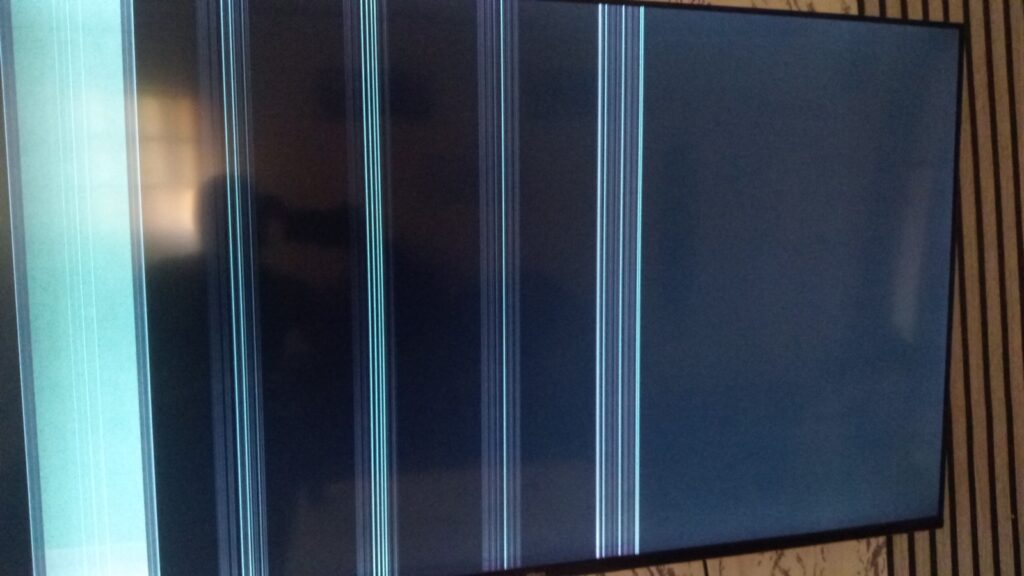
Some of the most common television display problems include vertical lines, horizontal lines, half-screen display, white screens, black screens, colour distortion, flickering pictures, double images, dark patches and intermittent display failures.
Pro-Logic Technologies Limited provides television diagnosis and repair services in Nairobi, Kenya. Our technical assessment covers television display systems, panel-related electronics, T-CON boards, backlight systems, flexible connections and associated electronic circuits.
Our workshop is located at Luthuli Avenue, Kangari Building, 3rd Floor, Room KA7, Nairobi CBD.
The purpose of professional television panel diagnosis is to establish the actual cause of a display fault before recommending repair or replacement. Not every television displaying lines has a permanently damaged screen. Some faults originate from electronic boards, panel connections, driver circuits or power-supply systems.
A proper technical assessment helps determine whether a particular television can be repaired economically and safely.
1. UNDERSTANDING TELEVISION DISPLAY PANEL TECHNOLOGY
A television display panel is an advanced electronic and optical assembly responsible for producing the images visible on the screen.
The display system receives processed image information from the television's main board. This information passes through timing-control and driver circuits before reaching individual pixels.
In LCD television technology, liquid-crystal cells regulate light passing through the display structure. These cells work together with colour filters, polarising layers, thin-film transistors and illumination systems to create images.
The display assembly contains several important structures:
-
LCD glass substrates.
-
Liquid-crystal material.
-
Thin-film transistor arrays.
-
Source driver circuits.
-
Gate driver circuits.
-
COF flexible film connections.
-
Panel ribbon connections.
-
Timing-control circuits.
-
Optical diffusion layers.
-
Polarising films.
-
Backlight illumination systems.
Each structure performs a specific function.
A failure affecting one part of the assembly can produce symptoms that appear to indicate complete screen damage.
For example, a defective source-driver connection may produce vertical lines, while a gate-driver problem may produce horizontal lines or missing rows.
A defective backlight system may cause a completely dark display even when the television continues producing sound.
This is why identifying the actual fault is important before replacing an expensive display assembly.
2. LCD TELEVISION SCREEN REPAIR
LCD stands for Liquid Crystal Display.
LCD technology uses liquid-crystal cells to control the amount of light passing through individual pixels.
Unlike OLED displays, LCD panels do not normally produce their own light. They require an illumination system, commonly using LED technology.
LCD television display faults can originate from several areas, including the panel glass, timing-control board, source drivers, gate drivers, flexible connections and backlight system.
Common LCD television problems include:
-
Vertical display lines.
-
Horizontal display lines.
-
White screen faults.
-
Half-screen display.
-
Flickering pictures.
-
Colour distortion.
-
Missing picture sections.
-
Dark screen problems.
-
Double images.
-
Panel communication faults.
Professional LCD diagnosis involves inspecting the display assembly, identifying the panel architecture and testing the relevant electronic circuits.
Where a fault originates from an external circuit or connection, repair may be possible without replacing the complete display panel.
However, internal glass damage and certain driver failures may require panel replacement.
3. LED TELEVISION SCREEN AND DISPLAY REPAIR
LED televisions are generally LCD televisions that use light-emitting diodes as their backlight illumination source.
The LEDs provide light behind or around the LCD display structure.
Modern LED televisions use different backlight arrangements, including direct-lit, edge-lit and full-array configurations.
A failure in the illumination system can produce:
-
Black screen with sound.
-
Dark sections of the picture.
-
Flickering brightness.
-
Uneven screen illumination.
-
Blue or purple colour tint.
-
Repeated picture disappearance.
-
Partial backlight failure.
LED backlight diagnosis involves examining the LED strips, driver circuits, power supply and associated connections.
The technician must also distinguish between a backlight fault and an actual LCD panel fault.
Replacing the complete television screen when the problem is only a failed backlight can result in unnecessary expenditure.
4. QLED TELEVISION DISPLAY PANEL REPAIR
QLED televisions use quantum-dot technology alongside LCD display technology to enhance colour performance.
They still rely on an LCD image-forming panel and a backlight system.
QLED television faults may include:
-
Vertical and horizontal lines.
-
Half-screen display.
-
Flickering.
-
Colour abnormalities.
-
Backlight failure.
-
T-CON board faults.
-
Panel driver problems.
-
Display communication errors.
Diagnosis must consider the actual television architecture rather than assuming that every QLED display problem originates from the quantum-dot layer.
Professional assessment helps establish whether the problem is associated with the backlight, LCD panel, timing-control system or another electronic component.
5. OLED TELEVISION SCREEN REPAIR
OLED stands for Organic Light-Emitting Diode.
Unlike LCD televisions, OLED displays use self-emissive pixels. Each pixel produces its own light, eliminating the need for a conventional LED backlight.
OLED technology provides excellent contrast, deep blacks and impressive colour performance.
However, OLED displays have specialised driving electronics and panel structures that require model-specific diagnosis.
Common OLED display problems include:
-
Vertical lines.
-
Horizontal lines.
-
Black display areas.
-
Uneven brightness.
-
Image retention.
-
Burn-in.
-
Colour distortion.
-
Intermittent picture.
-
Panel communication faults.
Some OLED faults originate from the panel itself, while others may involve power-management circuits or associated electronics.
Physical damage to an OLED panel generally requires replacement rather than conventional board-level repair.
6. TELEVISION VERTICAL LINES REPAIR
Vertical lines are among the most common television display complaints.
They may appear as thin coloured lines, black lines, white lines or wider vertical bands.
Some lines remain permanently visible, while others appear intermittently.
Vertical line faults can originate from:
-
Source-driver circuits.
-
COF connections.
-
Panel ribbon connections.
-
Timing-control circuitry.
-
Panel glass conductors.
-
Internal display connections.
The source-driver system controls column image information.
When a particular driver connection or signal path fails, the television may display an abnormal vertical line or section.
Professional diagnosis involves examining the fault pattern and identifying the affected circuit or connection.
Not every vertical line is repairable. If the internal panel conductor is physically damaged, replacement may be necessary.
7. TELEVISION HORIZONTAL LINES REPAIR
Horizontal lines may extend across the entire screen or appear in smaller groups.
They can be black, white, coloured or intermittently flashing.
Horizontal display faults may involve:
-
Gate-driver circuits.
-
Panel row connections.
-
Flexible bonded connections.
-
T-CON circuitry.
-
Panel glass conductors.
-
Display supply voltages.
The gate-driver system controls the selection of individual pixel rows.
A fault in this system may cause missing rows, horizontal lines or larger abnormal display sections.
Technicians must distinguish between a defective driver connection and internal panel damage before recommending a repair.
8. HALF-SCREEN TELEVISION DISPLAY REPAIR
A half-screen television problem occurs when one section displays correctly while another section is blank, distorted, flickering or showing incorrect colours.
The fault may affect the left or right side, or the upper or lower section.
Possible causes include:
-
T-CON board faults.
-
Panel driver problems.
-
Flexible ribbon connection faults.
-
Source-driver abnormalities.
-
Gate-driver problems.
-
Panel power-supply issues.
A half-screen problem does not automatically mean that the entire television panel must be replaced.
The technician must investigate the signal distribution and panel architecture to establish the actual cause.
9. WHITE SCREEN TELEVISION REPAIR
A television displaying a completely white screen may have a problem in its image-data or panel-control system.
Possible causes include:
-
T-CON board failure.
-
Panel supply voltage abnormalities.
-
Display ribbon connection faults.
-
Main-board signal problems.
-
Panel driver failures.
-
Internal panel damage.
A white screen should be properly diagnosed before any replacement parts are purchased.
10. BLACK SCREEN WITH SOUND REPAIR
A television that produces sound but has no visible picture may have a backlight problem or another display-related fault.
For LCD televisions, the backlight is responsible for illuminating the LCD panel.
If the LED strips or backlight driver fail, the picture may become invisible even though the television continues operating.
Other possible causes include:
-
Power supply faults.
-
LED driver faults.
-
Main-board problems.
-
T-CON failures.
-
Panel supply abnormalities.
OLED televisions require a different diagnostic approach because they do not use conventional LED backlighting.
11. TELEVISION FLICKERING AND FLASHING SCREEN REPAIR
Television flickering occurs when the displayed picture repeatedly changes brightness, flashes or temporarily disappears.
The problem may occur immediately after switching on the television or after the set has operated for several minutes.
Possible causes include:
-
Unstable power-supply output.
-
LED backlight driver failure.
-
Defective LED strips.
-
Loose display connections.
-
T-CON board abnormalities.
-
Main-board faults.
-
Temperature-sensitive electronic components.
Professional troubleshooting involves checking the television's power system, backlight operation, signal connections and display-control circuits.
A repair should address the underlying electrical or electronic fault rather than temporarily suppressing the symptom.
12. COF BONDING AND TELEVISION PANEL REPAIR
COF means Chip on Film.
It is a specialised display connection technology in which an integrated circuit is mounted on a flexible film that connects the driver electronics to the television panel.
COF technology is widely used in modern television display assemblies because it supports compact construction and high-density electrical connections.
COF-related faults may produce:
-
Vertical lines.
-
Horizontal lines.
-
Missing display sections.
-
Colour distortion.
-
Intermittent pictures.
-
Partial-screen display.
-
Abnormal pixel operation.
COF bonding repair requires specialised equipment, precise alignment and controlled bonding conditions.
The technician must first establish whether the fault is actually associated with the bonded connection. Similar symptoms can originate from the panel glass, driver IC, T-CON board or another signal path.
Not every COF fault is repairable. The condition of the panel and availability of compatible bonding materials must be considered.
13. TAB BONDING REPAIR
TAB stands for Tape Automated Bonding.
It is a technology used to connect electronic driver circuits to display assemblies through flexible tape structures.
In television repair, TAB-related faults may cause display lines, missing sections, abnormal colours and intermittent image problems.
TAB-related diagnosis involves examining:
-
Flexible film connections.
-
Driver IC connections.
-
Panel-edge bonding.
-
Fine-pitch electrical contacts.
-
Associated signal paths.
Specialised bonding procedures may be required where the fault is located at a serviceable bonded connection.
However, damage to internal glass conductors may not be repairable through TAB bonding.
14. ACF BONDING TECHNOLOGY
ACF means Anisotropic Conductive Film.
It is a specialised bonding material used in electronic display manufacturing and certain panel repair procedures.
ACF contains conductive particles that allow electrical connections between designated contact surfaces while limiting unwanted connections between adjacent conductors.
ACF bonding is important in fine-pitch display connections.
The process requires control of:
-
Temperature.
-
Pressure.
-
Alignment.
-
Bonding duration.
-
Surface preparation.
-
Material compatibility.
-
Equipment calibration.
Incorrect bonding conditions can damage the flexible film, glass substrate or electrical connection.
For this reason, ACF bonding should be performed using suitable specialised equipment and material specifications.
15. T-CON BOARD REPAIR AND TROUBLESHOOTING
The T-CON board is the timing-control board responsible for coordinating image information delivered to the display panel.
Depending on the television architecture, it may be a separate board or integrated into another electronic assembly.
Common symptoms associated with T-CON faults include:
-
White screen.
-
Half-screen display.
-
Flickering picture.
-
Distorted colours.
-
Missing image sections.
-
Abnormal display lines.
-
Complete loss of picture.
T-CON diagnosis involves examining the incoming signal, relevant supply rails, connectors, fuses and output conditions.
The technician must also establish whether the panel is placing an abnormal load on the circuit.
Replacing the T-CON board without checking the panel can result in unnecessary expenditure or repeat failure.
16. SOURCE DRIVER CIRCUIT REPAIR
Source-driver circuits control the column data used to generate images on the display.
They receive image information and provide the electrical signals needed to control pixel values.
A source-driver problem may cause:
-
Vertical lines.
-
Missing columns.
-
Incorrect colours.
-
Image distortion.
-
Partial-screen display.
Source-driver circuits may be mounted on flexible films or incorporated into panel-specific structures.
Diagnosis requires understanding the panel architecture and checking the relevant signal connections.
17. GATE DRIVER CIRCUIT DIAGNOSIS
Gate-driver circuits control the scanning of pixel rows.
They coordinate the selection of individual rows so that the display can reproduce the required image.
A gate-driver fault may cause:
-
Horizontal lines.
-
Missing rows.
-
Large horizontal bands.
-
Partial display failure.
-
Intermittent picture abnormalities.
The technician must establish whether the fault originates from the gate-driver system, panel connections, timing-control circuitry or internal panel damage.
18. TELEVISION PANEL VOLTAGE TESTING
Modern LCD television panels operate using several specialised electrical supply and reference voltages.
Common technical voltage designations include:
VGH: Positive gate-drive voltage.
VGL: Negative gate-drive voltage.
AVDD: Analogue supply voltage used by panel circuitry.
VCOM: Common voltage reference used in LCD operation.
These voltages are important for correct display operation.
Abnormal supply conditions may produce white screens, distorted images, lines, flickering or other display abnormalities.
Professional diagnosis involves checking the relevant voltage rails against model-specific technical information.
There are no universal voltage values suitable for every television panel. Applying arbitrary voltages can permanently damage the display assembly.
19. TELEVISION RIBBON CABLE AND FLEXIBLE CONNECTION REPAIR
Television display assemblies use flexible flat cables and ribbon connections to transfer image information and electrical signals.
These connections link various electronic assemblies, including:
-
Main board.
-
T-CON board.
-
Panel driver circuits.
-
Display assemblies.
-
Other model-specific control circuits.
Common ribbon connection problems include:
-
Loose connectors.
-
Torn flexible cables.
-
Damaged contact points.
-
Corrosion.
-
Contamination.
-
Broken connector locks.
-
Poor electrical contact.
A technician should distinguish between a removable ribbon cable and a flexible film permanently bonded to the panel.
These components require different repair procedures.
20. TELEVISION BACKLIGHT REPAIR AND REPLACEMENT
LED backlighting is responsible for illuminating LCD television displays.
A backlight failure can cause a television to produce sound without displaying a visible picture.
Common backlight problems include:
-
Burnt LED strips.
-
Open LED circuits.
-
Shorted LED components.
-
Weak illumination.
-
Uneven brightness.
-
Blue or purple screen tint.
-
Intermittent backlight operation.
Professional backlight repair involves testing the LED strings, examining the driver circuit and checking the power supply.
Replacing LED strips requires careful handling of the LCD panel and optical diffusion layers.
The technician must also ensure that the replacement strips are electrically and mechanically compatible.
21. OLED PANEL FAULT DIAGNOSIS
OLED television panels use individual light-emitting pixels.
This makes their construction different from conventional LCD and LED televisions.
Common OLED display complaints include:
-
Permanent image retention.
-
Burn-in.
-
Vertical lines.
-
Black patches.
-
Uneven brightness.
-
Abnormal colours.
-
Display failure.
Diagnosis requires consideration of the OLED panel, driving electronics, power-management circuits and manufacturer-specific compensation systems.
Permanent damage to the OLED display structure generally requires panel replacement.
22. QLED AND NANO CELL DISPLAY FAULTS
QLED and NanoCell televisions incorporate specialised colour technologies alongside LCD display systems.
Their display architecture may include different panel suppliers, backlight arrangements and electronic control systems.
Common faults include:
-
Screen flickering.
-
Vertical lines.
-
Horizontal lines.
-
Half-screen display.
-
Colour abnormalities.
-
Backlight failure.
-
Panel communication faults.
Accurate model identification is important because different televisions may use different internal assemblies even when they share similar screen sizes.
23. PHYSICAL TELEVISION SCREEN DAMAGE
Physical damage is one of the most difficult categories of television display failure.
It can result from:
-
Accidental impact.
-
Falling objects.
-
Pressure on the screen.
-
Incorrect transportation.
-
Improper wall mounting.
-
Excessive frame twisting.
Visible symptoms may include:
-
Spider-web cracks.
-
Black ink-like patches.
-
Coloured bleeding.
-
Broken glass.
-
Large black sections.
-
Distorted display areas.
A physically cracked LCD or OLED panel generally cannot be restored through electronic board repair.
Panel replacement may be the only practical solution, depending on parts availability and cost.
Customers should avoid pressing or rubbing damaged screens.
24. DEAD PIXELS AND STUCK PIXELS
Pixels are the individual picture elements that form television images.
A dead pixel may appear permanently black, while a stuck pixel may remain illuminated or display an incorrect colour.
Pixel defects can occur individually or in clusters.
Diagnosis involves examining the screen using suitable test patterns and determining whether the problem is isolated or part of a larger panel fault.
Software-based pixel recovery methods are not guaranteed and cannot repair broken internal conductors or physically damaged panel structures.
25. IMAGE RETENTION AND OLED BURN-IN
Image retention occurs when traces of previously displayed content remain visible.
In OLED televisions, prolonged display of static images can contribute to permanent burn-in.
Examples include:
-
News channel logos.
-
Gaming interface elements.
-
Fixed information banners.
-
Static computer desktop elements.
-
Repeatedly displayed logos.
Customers should follow the manufacturer's recommendations for brightness settings and panel maintenance.
Permanent burn-in is generally a panel-related condition and may require replacement rather than ordinary circuit repair.
26. MAIN BOARD FAULTS AFFECTING TELEVISION DISPLAY
The television main board processes incoming video signals and controls several television functions.
A main-board fault can affect picture generation, display communication, startup and smart-TV operation.
Possible symptoms include:
-
No picture.
-
Distorted picture.
-
Intermittent display.
-
Television restarting.
-
No HDMI picture.
-
Abnormal colours.
-
Complete startup failure.
Diagnosis should establish whether the main board is generating the correct signals and whether the display system receives the required information.
Replacing the main board requires checking hardware and software compatibility.
27. TELEVISION POWER SUPPLY FAULTS
The power supply distributes electrical energy to the television's electronic circuits.
A defective power supply can affect the main board, backlight system and display-control electronics.
Common symptoms include:
-
Television failing to start.
-
Repeated restarting.
-
Black screen.
-
Flickering.
-
Intermittent shutdown.
-
Unstable operation.
Power-supply diagnosis involves inspecting relevant circuits and checking the required output conditions.
Television power supplies can contain hazardous electrical voltages. Internal testing should be undertaken by trained technicians.
28. SOFTWARE AND FIRMWARE PROBLEMS AFFECTING TELEVISION DISPLAY
Not every television display problem is caused by physical panel damage.
Some problems originate from software configuration, firmware errors, incorrect picture settings or external signal sources.
Possible symptoms include:
-
Incorrect picture colours.
-
Display abnormalities.
-
Intermittent HDMI picture.
-
Screen freezing.
-
Picture distortion.
-
Television restarting.
-
Smart-TV interface problems.
Diagnosis should establish whether the problem appears on the television's internal menu and across different input sources.
Firmware updates should only be performed using the correct software for the specific television model.
A software update cannot repair physically cracked glass, failed panel drivers or broken internal display connections.
29. PROFESSIONAL TELEVISION PANEL DIAGNOSTIC PROCEDURES
A proper television panel repair begins with systematic fault diagnosis.
The technician should not immediately recommend replacing the screen simply because the television displays lines or has lost its picture.
A professional diagnostic process includes:
STEP 1: TELEVISION IDENTIFICATION
Record the television brand, complete model number, screen size and available panel identification information.
STEP 2: EXTERNAL INSPECTION
Inspect the screen, frame, ports, power cable and external condition.
STEP 3: FUNCTIONAL TESTING
Check startup, sound, remote-control response, internal menus and different input sources.
STEP 4: FAULT CLASSIFICATION
Determine whether the symptom is associated with the backlight, display panel, power supply, main board or another circuit.
STEP 5: INTERNAL INSPECTION
Where necessary, inspect the internal boards, connectors, cables and panel connections using appropriate safety procedures.
STEP 6: ELECTRICAL TESTING
Measure relevant supply voltages and inspect the signal path using suitable test equipment and model-specific information.
STEP 7: REPAIRABILITY ASSESSMENT
Establish whether the fault can be repaired, whether a component requires replacement or whether the entire panel is damaged.
STEP 8: CUSTOMER QUOTATION
Explain the diagnosis, repair options, estimated cost and parts availability before proceeding.
STEP 9: REPAIR AND QUALITY CONTROL
Perform the approved repair and test the television for proper operation.
This structured approach reduces unnecessary component replacement and helps improve repair reliability.
30. SPECIALISED EQUIPMENT USED IN TELEVISION PANEL REPAIR
Advanced television display repair requires specialised diagnostic and repair equipment.
Depending on the fault and panel technology, equipment may include:
-
Digital multimeters.
-
Oscilloscopes.
-
Adjustable DC power supplies.
-
LED backlight testers.
-
T-CON testing equipment.
-
COF bonding machines.
-
TAB bonding equipment.
-
ACF bonding materials.
-
Precision alignment tools.
-
Electronic microscopes.
-
Temperature-controlled bonding equipment.
-
ESD protection equipment.
-
Fine-pitch soldering equipment.
-
Electronic diagnostic instruments.
-
Panel handling and support equipment.
The equipment required depends on the television model and the nature of the fault.
A bonding machine, for example, is not a substitute for proper diagnosis. The technician must first determine whether the affected connection is suitable for a bonding procedure.
31. TELEVISION PANEL REPAIR VERSUS PANEL REPLACEMENT
One of the most important decisions in television repair is determining whether the display panel should be repaired or replaced.
Not every panel fault requires complete panel replacement.
Some problems may be associated with replaceable electronic components, external connections or repairable bonded connections.
Other problems originate from internal panel structures and may not be economically repairable.
The following considerations help determine the appropriate option:
-
Physical condition of the display.
-
Availability of compatible replacement panels.
-
Cost of the repair.
-
Television age.
-
Screen size.
-
Model specifications.
-
Availability of specialised components.
-
Expected reliability after repair.
A cracked screen generally requires panel replacement.
A defective backlight may require LED strip replacement.
A faulty T-CON board may require board-level repair or replacement.
A loose or damaged removable ribbon connection may require connection servicing or cable replacement.
The correct repair method depends on the actual fault.
32. SAMSUNG TELEVISION SCREEN AND PANEL REPAIR
Samsung televisions use different display technologies and panel architectures across their product ranges.
These include LED, QLED and OLED models.
Common Samsung television display problems include:
-
Vertical lines.
-
Horizontal lines.
-
Half-screen display.
-
Black screen with sound.
-
White screen.
-
Flickering.
-
Backlight failure.
-
Colour distortion.
-
T-CON board faults.
-
Panel connection problems.
Samsung television diagnosis should be based on the complete model number and panel construction.
The technician should check the display signal path, power supply, panel connections and associated electronic circuits before recommending replacement.
33. LG TELEVISION DISPLAY PANEL REPAIR
LG manufactures LCD, LED, NanoCell and OLED television models.
Different technologies require different diagnostic approaches.
Common LG television display complaints include:
-
Screen lines.
-
Half-screen display.
-
Flickering.
-
Black screen.
-
White screen.
-
Colour abnormalities.
-
Backlight faults.
-
Panel communication errors.
LG OLED and LCD models should not be diagnosed using identical procedures.
The technician must identify the television architecture and determine whether the fault originates from the panel, power system or control electronics.
34. SONY TELEVISION SCREEN REPAIR
Sony televisions incorporate different LCD and OLED display technologies.
Display problems can originate from the panel, timing-control system, main board, power supply or backlight.
Common symptoms include:
-
Vertical lines.
-
Horizontal lines.
-
No picture.
-
Distorted colours.
-
Flickering.
-
Half-screen display.
-
Intermittent picture.
Professional diagnosis helps determine the affected assembly and the most practical repair option.
35. TCL TELEVISION DISPLAY PANEL REPAIR
TCL televisions are available in several display technologies and screen sizes.
Common faults include:
-
LED backlight failure.
-
Vertical lines.
-
Horizontal lines.
-
Half-screen display.
-
T-CON problems.
-
Colour distortion.
-
Black screen.
-
Display flickering.
The repair procedure must consider the actual panel code, board configuration and television model.
36. HISENSE TELEVISION PANEL REPAIR
Hisense televisions use different LCD, LED, QLED and other display configurations.
Common display complaints include:
-
Screen flickering.
-
Vertical lines.
-
Half-screen display.
-
White screen.
-
Black screen.
-
Backlight failure.
-
Panel connection faults.
A proper diagnostic process should distinguish between electronic board faults and internal panel damage.
37. SKYWORTH TELEVISION SCREEN REPAIR
Skyworth television models may develop display faults associated with their panel assemblies, power supplies, backlights and control circuits.
Common symptoms include lines, abnormal colours, blank displays and intermittent picture.
The technician should identify the model and establish the exact fault before sourcing replacement components.
38. VITRON, VON AND VISION PLUS TELEVISION REPAIR
Vitron, Von and Vision Plus televisions are commonly encountered in the Kenyan consumer electronics market.
Their display faults may include:
-
Screen lines.
-
Backlight failure.
-
Half-screen display.
-
No picture.
-
Flickering.
-
Colour distortion.
-
Power-related display problems.
Correct component identification is important because different production batches may use different electronic assemblies.
39. TELEVISION REPAIR IN NAIROBI CBD
Pro-Logic Technologies Limited provides television diagnosis and repair services for customers in Nairobi CBD.
Our workshop is located at:
Luthuli Avenue, Kangari Building, 3rd Floor, Room KA7, Nairobi CBD.
Customers experiencing television display problems can contact the workshop for assessment and service arrangements.
We handle different television technologies, brands and display-related faults, subject to the availability of compatible components and the technical condition of the television.
40. TELEVISION PANEL REPAIR IN WESTLANDS
Television owners in Westlands may experience display problems involving LCD, LED, QLED and OLED television models.
Common complaints include broken screens, vertical lines, horizontal lines, black displays, flickering and backlight problems.
Pro-Logic Technologies Limited provides technical assessment for customers seeking television repair services in Westlands and surrounding areas.
41. TELEVISION SCREEN REPAIR IN LAVINGTON
Television display problems can affect both residential and commercial installations in Lavington.
Our diagnostic service covers common display complaints, including panel lines, half-screen faults, abnormal colours, backlight problems and electronic control faults.
Customers can contact our workshop to discuss their television model and arrange an assessment.
42. TELEVISION PANEL REPAIR IN KILIMANI
Kilimani residents and businesses can contact Pro-Logic Technologies Limited for television display diagnosis.
We assess television screen problems involving:
-
LCD display systems.
-
LED backlight systems.
-
QLED televisions.
-
OLED televisions.
-
T-CON boards.
-
Panel driver connections.
-
Display signal circuits.
The appropriate repair depends on the actual condition of the television.
43. TELEVISION REPAIR IN KILELESHWA AND PARKLANDS
Television faults can interrupt entertainment, business presentations and everyday viewing.
Customers in Kileleshwa and Parklands can enquire about television panel diagnosis and repair.
Our technical assessment covers panel-related faults, backlight problems, electronic board faults and associated display systems.
44. TELEVISION SCREEN REPAIR IN KAREN AND LANG'ATA
Customers in Karen and Lang'ata can contact our workshop for technical guidance regarding damaged television screens and display faults.
We assess different brands and television technologies and advise on whether the appropriate solution involves electronic repair, backlight replacement or complete panel replacement.
45. TELEVISION REPAIR IN KASARANI, ROYSAMBU AND EMBakASI
Television owners in Kasarani, Roysambu and Embakasi may encounter faults ranging from simple power problems to complex panel and display failures.
Pro-Logic Technologies Limited provides technical assessment for different television models.
Customers should provide the full model number and a description of the display problem when making an enquiry.
46. TELEVISION REPAIR IN DONHOLM, BURUBURU AND SOUTH B
Our television repair services are available to customers enquiring from Donholm, Buruburu and South B.
We assess common television faults involving screen lines, backlight failures, half-screen displays, colour abnormalities and electronic control systems.
Customers should confirm workshop arrangements before travelling with their televisions.
47. TELEVISION REPAIR SERVICES OUTSIDE NAIROBI
Television owners outside Nairobi can also contact Pro-Logic Technologies Limited to discuss display repair requirements.
Customers from other counties may enquire about technical assessment, compatible spare parts and transport arrangements.
Large televisions require careful transportation because their display panels can be damaged by twisting, vibration or impact.
Before transporting a television, confirm the workshop's arrangements and ensure that the equipment is appropriately protected.
48. TELEVISION PANEL REPAIR FOR OFFICES AND COMMERCIAL PREMISES
Televisions are widely used in offices, hotels, conference rooms, educational institutions, restaurants and commercial establishments.
A display failure can interfere with presentations, meetings, customer communication and business operations.
Commercial television repair may involve:
-
Large-format LCD displays.
-
Commercial LED televisions.
-
Smart television systems.
-
Conference-room displays.
-
Digital information screens.
-
Wall-mounted television installations.
-
Multiple television installations.
Businesses should maintain records of television models, reported faults, repair history and replacement components.
This information helps with maintenance planning and equipment management.
49. PREVENTIVE MAINTENANCE FOR TELEVISION DISPLAY PANELS
Preventive maintenance helps reduce avoidable television failures.
Although electronic components naturally deteriorate over time, proper handling and operating conditions can help extend equipment life.
Recommended practices include:
PROPER TELEVISION MOUNTING
Use suitable wall brackets and mounting hardware. Incorrect mounting can create pressure on the television frame and damage the display.
ADEQUATE VENTILATION
Ensure that the television has sufficient airflow around its ventilation openings.
PROTECTION FROM MOISTURE
Keep televisions away from leaking roofs, water spills and excessive humidity.
SAFE SCREEN CLEANING
Use a suitable microfibre cloth and follow the manufacturer's cleaning instructions. Avoid spraying cleaning liquids directly onto the screen.
ELECTRICAL PROTECTION
Use suitable electrical protection and ensure that the power installation is in good condition.
CAREFUL TRANSPORTATION
Protect the screen from impact, twisting and excessive pressure when moving the television.
AVOIDING PHYSICAL PRESSURE
Never press hard against the display or attempt to remove lines by rubbing or squeezing the screen.
50. WHY PROFESSIONAL TELEVISION PANEL DIAGNOSIS MATTERS
Modern television display assemblies are highly integrated electronic systems.
A technician requires an understanding of electronics, display architecture, power management, signal processing and precision connections.
Professional diagnosis offers several important advantages:
-
Identifies the actual source of the display fault.
-
Reduces unnecessary replacement of expensive components.
-
Helps determine whether a panel is economically repairable.
-
Establishes whether specialist bonding is appropriate.
-
Helps identify compatible replacement components.
-
Reduces the risk of additional damage from incorrect repair methods.
-
Provides customers with a clearer understanding of repair costs.
-
Supports proper testing after repair.
At Pro-Logic Technologies Limited, our approach is based on technical assessment and selecting an appropriate repair method for the specific television.
51. COMMON MISCONCEPTIONS ABOUT TELEVISION SCREEN REPAIR
MISCONCEPTION 1: EVERY VERTICAL LINE MEANS THE SCREEN IS BROKEN
Not necessarily. Vertical lines may originate from driver circuits, flexible connections, timing-control systems or internal panel damage.
MISCONCEPTION 2: EVERY BLACK SCREEN REQUIRES PANEL REPLACEMENT
A black screen may result from backlight failure, power problems or display-control faults.
MISCONCEPTION 3: PRESSING THE SCREEN CAN REMOVE LINES
Applying pressure can damage the panel and make the problem worse.
MISCONCEPTION 4: EVERY T-CON BOARD CAN BE INTERCHANGED
T-CON boards must be compatible with the particular panel and television configuration.
MISCONCEPTION 5: SOFTWARE CAN REPAIR A CRACKED SCREEN
Software cannot restore physically broken display glass or damaged internal conductors.
MISCONCEPTION 6: ALL 55-INCH TELEVISION PANELS ARE INTERCHANGEABLE
Screen size alone does not establish compatibility. Panel codes, connectors, resolution, revisions and electrical characteristics must be considered.
52. FREQUENTLY ASKED QUESTIONS ABOUT TELEVISION PANEL REPAIR
Can television vertical lines be repaired?
Some vertical line faults can be associated with repairable connections or electronic circuits. Others originate from internal panel damage and may require replacement.
Can a cracked television screen be repaired?
A physically cracked LCD or OLED panel generally requires replacement. Electronic board repair cannot restore shattered display glass.
Why does my television have sound but no picture?
Possible causes include LED backlight failure, power-supply problems, main-board faults and display-control failures.
What is COF bonding in television repair?
COF bonding is a specialised method of connecting driver integrated circuits to display assemblies through flexible film.
What causes half-screen display problems?
Possible causes include T-CON faults, panel driver problems, signal connections and internal display damage.
Can a television white screen be repaired?
Yes, depending on the cause. White-screen faults may originate from timing-control circuits, panel supplies, signal connections or the panel itself.
Can OLED television panels be repaired?
Some associated electronic faults may be repairable. Physical damage to the OLED panel generally requires replacement.
What causes horizontal lines on a television?
Possible causes include gate-driver faults, panel connections, timing-control problems and internal panel damage.
How do I know whether my television needs a new screen?
A proper diagnostic assessment is necessary. The technician must distinguish between panel damage and faults affecting other electronic assemblies.
Do you repair Samsung, LG, Sony, TCL and Hisense televisions?
Pro-Logic Technologies Limited assesses different television brands, including Samsung, LG, Sony, TCL, Hisense, Skyworth, Vitron, Von and Vision Plus, subject to technical requirements and parts availability.
Where is your television repair workshop located?
Our workshop is at Luthuli Avenue, Kangari Building, 3rd Floor, Room KA7, Nairobi CBD.
53. CUSTOMER PREPARATION BEFORE TELEVISION REPAIR
Customers can make the diagnostic process more efficient by providing accurate information before bringing a television for assessment.
Important information includes:
-
Television brand.
-
Complete model number.
-
Screen size.
-
Description of the problem.
-
Whether sound is available.
-
Whether the fault is permanent or intermittent.
-
Whether the television has physical damage.
-
Whether the television has previously been repaired.
-
Whether the problem started after a power interruption or electrical surge.
Photographs and short videos can also help explain the problem.
However, opening the television to obtain internal information is unnecessary. The external model label or television settings menu usually provides useful identification details.
54. TELEVISION REPAIR COST CONSIDERATIONS
The cost of television panel repair depends on several factors.
These include:
-
Television brand.
-
Screen size.
-
Panel technology.
-
Nature of the fault.
-
Availability of replacement components.
-
Labour requirements.
-
Specialised equipment required.
-
Whether the panel is physically damaged.
A T-CON repair, LED backlight replacement and complete panel replacement are different technical jobs with different cost structures.
Customers should obtain an assessment and quotation before approving major repair work.
Where panel replacement is required, the availability and cost of a compatible assembly should be considered against the value of the television.
55. REPAIR WARRANTY AND QUALITY CONTROL
Quality control is an important part of professional television repair.
After completing an approved repair, the television should be tested for:
-
Correct startup.
-
Picture stability.
-
Colour reproduction.
-
Brightness uniformity.
-
Sound operation.
-
Remote-control response.
-
Input functionality.
-
Display abnormalities.
-
Stability during operation.
Where applicable, the repair provider should explain the warranty coverage, its duration and any exclusions.
Customers should retain their service records and quotations.
A warranty should clearly identify the work and components covered rather than implying that unrelated future faults are automatically covered.
56. WHY CHOOSE PRO-LOGIC TECHNOLOGIES LIMITED FOR TELEVISION REPAIR?
Pro-Logic Technologies Limited provides technical assessment and repair services covering different television technologies and electronic systems.
Our television repair capabilities include:
-
Television screen and display diagnosis.
-
LCD and LED television repair.
-
QLED and OLED television assessment.
-
T-CON board diagnosis.
-
Panel driver troubleshooting.
-
COF and bonding-related assessment.
-
LED backlight replacement.
-
Television motherboard repair.
-
Power supply diagnosis.
-
Display signal troubleshooting.
-
Television spare parts and electronic component support.
We understand that television faults differ from one model to another. Our objective is to establish the cause of the problem and recommend a suitable repair option.
Customers are encouraged to provide their television model and fault description when contacting the workshop.
57. OUR TELEVISION REPAIR WORKSHOP IN NAIROBI
Pro-Logic Technologies Limited operates its main workshop at:
LUTHULI AVENUE, KANGARI BUILDING, 3RD FLOOR, ROOM KA7, NAIROBI CBD.
The workshop provides a point of contact for customers seeking television repair, electronic diagnosis and technical support.
Customers should contact us before travelling, particularly when bringing large-screen televisions that require careful handling.
We also encourage customers to discuss the television's model number and display symptoms before arranging an assessment.
58. FINAL SUMMARY: PROFESSIONAL TELEVISION SCREEN AND PANEL REPAIR
Television display repair requires a combination of electronic diagnostic skills, display technology knowledge, specialised equipment and careful component handling.
Modern televisions contain complex display assemblies involving timing-control systems, source drivers, gate drivers, flexible film connections, backlights and precision panel structures.
A problem that appears to be a damaged screen may originate from a different electronic assembly.
For this reason, proper diagnosis should always come before expensive panel replacement.
Whether a television displays vertical lines, horizontal lines, a white screen, half-screen images, flickering pictures, abnormal colours or a black screen with sound, the correct repair approach depends on identifying the actual fault.
Pro-Logic Technologies Limited provides television repair assessment and technical services in Nairobi, Kenya.
Contact our workshop to discuss your television display problem and determine the appropriate next step.
CONTACT PRO-LOGIC TECHNOLOGIES LIMITED
TELEVISION SCREEN REPAIR AND DISPLAY PANEL DIAGNOSIS – NAIROBI, KENYA
Telephone: 0723763173
Workshop: Luthuli Avenue, Kangari Building, 3rd Floor, Room KA7, Nairobi CBD.
Website: https://prologictecnologies.co.ke
Email: info@prologictechnologies.co.ke