
VFD INSTALLATION IN NAIVASHA – PROFESSIONAL VFD INSTALLATION, PROGRAMMING, REPAIR AND COMMISSIONING SERVICES
Pro-Logic Technologies Limited provides professional VFD installation in Naivasha for industrial, commercial, agricultural, water-pumping, irrigation, manufacturing and other motor-control applications. Variable Frequency Drives, commonly known as VFDs, are essential motor-control devices that allow businesses to control the speed, acceleration, deceleration, torque and operating performance of electric motors.
Modern industries increasingly depend on reliable motor-control systems. Pumps, fans, compressors, conveyors, processing machinery, irrigation equipment, production lines and many other machines use electric motors that may not always need to operate at full speed. Installing a properly selected and correctly programmed VFD can provide precise motor control while improving the way machinery responds to changing operating requirements.
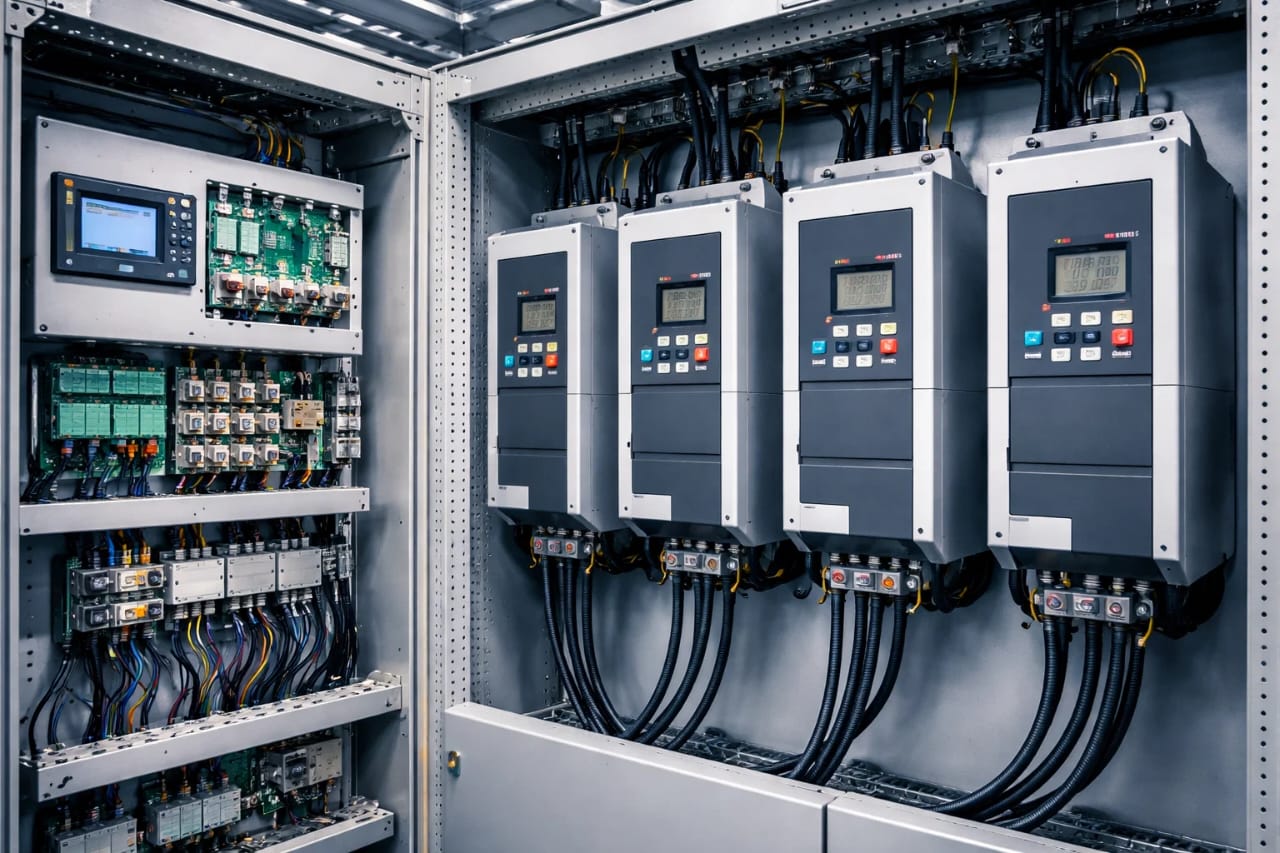
Pro-Logic Technologies Limited offers VFD installation, programming, commissioning, troubleshooting, maintenance and repair services for clients in Naivasha and surrounding areas. Our services are suitable for companies, factories, farms, flower farms, hotels, commercial buildings, water companies, borehole operators, agricultural businesses, workshops and industrial facilities requiring reliable variable-speed motor control.
Naivasha is an important agricultural, commercial, tourism and industrial location in Kenya. The area has extensive horticultural activities, greenhouses, irrigation systems, water-pumping installations, processing facilities, hotels, commercial developments and industrial operations. Many of these applications depend on electric motors, making VFD technology particularly valuable.
A VFD installation should not be treated as simply connecting three motor wires to a drive. Correct installation requires understanding the motor, electrical supply, application, load characteristics, control requirements, protection system, environmental conditions and required operating parameters. Incorrect installation or programming can result in nuisance trips, motor overheating, drive failure, unstable operation and premature equipment damage.
Pro-Logic Technologies Limited approaches VFD projects by first understanding the application and then selecting, installing, programming and commissioning the system according to the requirements of the machinery.
WHAT IS A VFD?
A Variable Frequency Drive is an electronic device used primarily to control the speed of an AC electric motor by varying the frequency and voltage supplied to the motor.
A conventional motor connected directly to a fixed-frequency electrical supply generally operates at a relatively fixed speed, depending on its design, frequency and load. A VFD introduces controlled variation into the electrical supply, allowing the motor speed to be adjusted according to the requirements of the application.
For example, a water pump may not need to operate at maximum speed throughout the day. When water demand is low, operating the pump at a lower speed can provide the required flow while reducing unnecessary motor operation. Similarly, a fan may require different speeds depending on ventilation requirements.
The VFD receives incoming electrical power, converts it internally and then produces a controlled output for the motor. Through its programming parameters, the drive can control starting, stopping, acceleration, deceleration, speed reference, current limits, protection settings and other operating functions.
WHY INSTALL A VFD IN NAIVASHA?
Businesses in Naivasha use motors in many different applications. A motor may drive a borehole pump, irrigation pump, conveyor, fan, compressor, mixer, processing machine or production system.
Without variable-speed control, many motors are either operated at full speed or controlled using mechanical or inefficient methods. A VFD provides a more flexible approach.
A properly installed VFD can provide:
- Adjustable motor speed
- Controlled acceleration
- Controlled deceleration
- Reduced mechanical shock during starting
- Improved process control
- Adjustable pump flow
- Adjustable fan speed
- Soft starting
- Motor protection functions
- Improved automation capabilities
- Better control of production machinery
- Integration with sensors and PLC systems
- Remote control capabilities
- Fault monitoring
- Process-specific control
However, the benefits depend heavily on correct sizing, installation and programming.
VFD INSTALLATION FOR WATER PUMPS IN NAIVASHA
Water pumping is one of the major applications where VFD technology can provide significant operational advantages.
Naivasha has many water-related applications involving boreholes, irrigation systems, agricultural farms, commercial premises, hotels and water distribution systems. Pump motors may need to operate at different speeds depending on water demand.
A VFD can be used to control the pump motor speed and maintain a desired pressure or flow level. With appropriate sensors and control programming, the system can automatically adjust motor speed according to changing demand.
For example, a pumping system supplying water to a commercial facility may experience high demand during certain periods and low demand at other times. Instead of running the motor continuously at maximum speed, a VFD-based control system can adjust the motor speed to suit the process.
Our VFD installation services can therefore be applied to:
- Borehole pumps
- Irrigation pumps
- Booster pumps
- Water transfer pumps
- Pressure pumps
- Process-water pumps
- Industrial pumping systems
- Agricultural pumping systems
- Water-treatment systems
- Storage-tank filling systems
VFD INSTALLATION FOR FLOWER FARMS IN NAIVASHA
Naivasha is widely associated with horticulture and flower farming. Modern flower farms depend on reliable irrigation, water distribution, ventilation, pumping and environmental-control systems.
VFDs can be incorporated into these systems to provide variable-speed control of pumps, fans and other motor-driven equipment.
An irrigation pump may require different flow rates depending on the irrigation zone. A greenhouse ventilation fan may require variable speed depending on environmental conditions. A water booster system may need to maintain a consistent pressure despite changing demand.
With appropriate automation, VFDs can become part of a larger control system involving pressure sensors, flow sensors, level sensors, PLCs, HMIs and other control equipment.
Pro-Logic Technologies Limited can assist with VFD installation and integration for agricultural and horticultural motor-control applications in Naivasha.
VFD INSTALLATION FOR GREENHOUSE APPLICATIONS
Greenhouses can contain multiple motor-driven systems. These may include ventilation fans, irrigation pumps, circulation equipment, dosing systems and other machinery.
VFDs can provide adjustable speed control for suitable motor loads.
For ventilation, variable-speed control can allow fans to operate at different speeds rather than switching between full-speed operation and complete shutdown. For irrigation, a VFD can help regulate pump operation according to the required pressure or flow.
The actual control strategy depends on the equipment and process requirements.
VFD INSTALLATION FOR INDUSTRIAL MACHINERY
Industrial machinery often requires precise control of motor speed.
Pro-Logic Technologies Limited provides VFD installation services for various industrial applications in Naivasha, including:
- Conveyors
- Processing machines
- Fans
- Blowers
- Pumps
- Compressors
- Mixers
- Production equipment
- Packaging machinery
- Material-handling systems
- Agricultural machinery
- Manufacturing equipment
Before installing a VFD, our technical approach considers the motor rating, load characteristics, starting requirements, running current, supply voltage, required speed range and control method.
MOTOR AND VFD SIZING
One of the most important parts of a VFD installation is correct sizing.
A VFD should not simply be selected based on the physical size of the motor or a rough estimate of horsepower. The motor nameplate and application characteristics must be considered.
Important information may include:
- Motor voltage
- Motor current
- Motor frequency
- Motor power
- Motor speed
- Motor connection
- Motor type
- Load type
- Starting requirements
- Required speed range
- Duty cycle
- Ambient conditions
The application also matters. A pump, conveyor and compressor can have very different load characteristics.
For example, a drive selected for a basic fan application may not necessarily be appropriate for a heavy-duty conveyor application. A high-inertia load may require different acceleration and braking considerations.
Correct sizing helps reduce nuisance trips and improves reliability.
CHECKING THE MOTOR NAMEPLATE
During VFD commissioning, the motor nameplate provides essential information.
Typical nameplate information includes:
- Rated voltage
- Rated current
- Frequency
- Rated power
- RPM
- Power factor
- Efficiency
- Connection information
These values can be entered into the VFD according to the manufacturer's programming structure.
Entering incorrect motor data can affect motor control and protection. For advanced drive systems, accurate motor parameters are particularly important for functions such as vector control and motor identification.
ELECTRICAL SUPPLY CHECK
Before connecting a VFD, the incoming electrical supply should be checked.
The installer may verify:
- Supply voltage
- Phase availability
- Frequency
- Voltage balance
- Protective devices
- Earthing
- Cable sizing
- Isolation arrangements
- Panel condition
A VFD connected to an unsuitable electrical supply can experience faults or damage.
The installation should therefore be assessed before commissioning.
VFD PANEL INSTALLATION
Many industrial VFD systems are installed inside electrical control panels.
A properly designed VFD panel may include:
- VFD
- Main isolator
- Circuit protection
- Contactors where appropriate
- Control relays
- Terminal blocks
- Cooling equipment
- Surge protection where appropriate
- Emergency-stop interface
- Control switches
- Indicator lamps
- PLC interface
- HMI interface
- Proper earthing arrangements
Panel design should also consider heat dissipation.
VFDs generate heat during operation, and poor ventilation can increase internal temperature. High temperatures can shorten electronic component life.
VFD PROGRAMMING IN NAIVASHA
Installing the VFD is only one part of the job. Programming is equally important.
Different VFD manufacturers use different parameter structures, but common programming requirements include:
- Motor voltage
- Motor current
- Motor frequency
- Motor power
- Motor speed
- Minimum frequency
- Maximum frequency
- Acceleration time
- Deceleration time
- Start command source
- Speed reference source
- Digital input configuration
- Analog input configuration
- Output relay configuration
- Fault behavior
- Motor protection settings
- Communication settings
The exact parameters depend on the VFD model and application.
VFD PROGRAMMING FOR PUMP APPLICATIONS
Pump applications often require specialized programming.
For a basic application, the operator may control speed using a keypad or external potentiometer. More advanced systems can use pressure or flow feedback.
A pressure sensor can provide an analog signal to the control system. The VFD can then adjust motor speed to maintain the desired pressure.
This type of arrangement can be implemented using PID control.
PID CONTROL WITH VFDs
PID control is commonly used in applications where a process variable must be maintained around a desired setpoint.
For example, a water booster system may have a desired pressure. The sensor measures actual pressure and sends feedback to the control system.
If pressure falls below the target, the drive can increase motor speed. If pressure rises above the target, the drive can reduce motor speed.
Proper PID configuration requires careful adjustment of:
- Setpoint
- Feedback signal
- Minimum speed
- Maximum speed
- Proportional gain
- Integral time
- Derivative settings where applicable
- Sleep and wake functions
- Sensor scaling
Poorly configured PID parameters can result in oscillation, unstable pressure or slow system response.
VFD COMMISSIONING
Commissioning is the process of verifying that the complete VFD system operates correctly after installation.
Our commissioning process can include:
- Visual inspection
- Electrical verification
- Motor verification
- Parameter configuration
- Control wiring verification
- Direction-of-rotation testing
- No-load testing where appropriate
- Loaded testing
- Fault testing
- Control-system testing
- Sensor verification
- Final operating checks
The objective is not merely to make the motor rotate. The complete machine must operate correctly according to its intended process.
MOTOR ROTATION CHECK
Motor direction is particularly important for pumps, fans, conveyors and other rotating equipment.
Incorrect rotation can result in poor pump performance, mechanical problems or process failure.
During commissioning, the motor direction should be checked carefully before placing the equipment into normal operation.
VFD ACCELERATION AND DECELERATION
Acceleration and deceleration parameters determine how quickly the motor changes speed.
If acceleration is too short, the motor may draw high current or cause an overcurrent fault.
If deceleration is too short, the drive may experience an overvoltage condition, particularly when the motor and load have significant inertia.
Appropriate acceleration and deceleration times should therefore be selected according to the application.
VFD FAULT DIAGNOSIS IN NAIVASHA
Pro-Logic Technologies Limited also provides VFD troubleshooting and fault-diagnosis services.
Common VFD problems include:
- Overcurrent
- Overvoltage
- Undervoltage
- Overload
- Overtemperature
- Earth faults
- Motor phase problems
- Input phase loss
- Output phase problems
- Communication faults
- Encoder faults
- Sensor faults
- Control-input problems
- Parameter errors
- Motor-starting failures
A displayed fault code is useful, but it should not automatically be interpreted as proof that the VFD itself is defective.
For example, an overcurrent fault could be caused by:
- Mechanical overload
- Incorrect motor parameters
- Motor winding problems
- Short circuit
- Acceleration time being too short
- Bearing problems
- Incorrect application settings
Professional diagnosis involves checking the complete system.
WHY A VFD MAY TRIP ON OVERCURRENT
An overcurrent trip occurs when the drive detects current above its permitted operating condition.
Possible causes include:
- Excessive mechanical load
- Jammed machinery
- Incorrect acceleration time
- Motor problems
- Incorrect parameter settings
- Short circuit
- Cable problems
- Incorrect motor connection
The correct solution depends on the actual cause.
Simply increasing the current limit without identifying the underlying problem can damage the motor or VFD.
VFD OVERVOLTAGE FAULTS
Overvoltage faults can occur when the DC bus voltage inside the drive rises above its permitted level.
One possible cause is rapid deceleration of a high-inertia load. During deceleration, the motor can return energy to the drive.
Other possible causes include unstable supply voltage and incorrect braking configuration.
The appropriate solution depends on the application and drive design.
VFD OVERHEATING
VFD overheating can result from:
- Poor ventilation
- Blocked cooling paths
- High ambient temperature
- Excessive load
- Dirty cooling fans
- Failed cooling fans
- Incorrect cabinet design
- High switching frequency
- Continuous operation beyond suitable conditions
Industrial VFD panels should be kept clean and adequately ventilated.
VFD MAINTENANCE IN NAIVASHA
Regular maintenance helps identify developing problems before they result in unexpected downtime.
Maintenance may include:
- Visual inspection
- Cleaning
- Cooling fan inspection
- Terminal inspection
- Cable inspection
- Panel inspection
- Parameter backup
- Fault-history review
- Motor current checks
- Temperature checks
- Ventilation inspection
- Control wiring inspection
Maintenance intervals depend on operating conditions.
A dusty agricultural environment may require more frequent cleaning than a clean office environment.
VFD REPAIR SERVICES
Not every VFD fault requires replacement.
Depending on the failure, a drive may have problems involving:
- Cooling fans
- Capacitors
- Power semiconductor devices
- Control boards
- Driver circuits
- Relays
- Communication interfaces
- Power supplies
- Terminal assemblies
Pro-Logic Technologies Limited can assist with VFD fault diagnosis and repair assessment.
Where repair is technically and economically practical, the faulty section can be investigated rather than automatically replacing the entire system.
VFD REPLACEMENT
In some cases, replacement is more practical than repair.
A replacement decision can depend on:
- Age of the VFD
- Availability of spare parts
- Extent of damage
- Cost of repair
- Application criticality
- Manufacturer support
- Drive efficiency
- Required features
When replacing a VFD, the replacement should be selected based on the motor and application rather than simply matching the old drive's physical dimensions.
VFD RETROFIT PROJECTS
Older industrial machinery may use direct-on-line starters or outdated speed-control methods.
A VFD retrofit can modernize such equipment.
A retrofit may involve:
- Existing motor assessment
- Control-panel modifications
- VFD installation
- New control wiring
- Speed-control interface
- Sensor installation
- PLC integration
- Safety interlocks
- Commissioning
Retrofitting can be particularly useful when an existing machine is mechanically sound but requires improved motor control.
VFD AND PLC INTEGRATION
VFDs can communicate with PLC-based automation systems.
A PLC may issue:
- Start commands
- Stop commands
- Speed references
- Direction commands
- Reset commands
The VFD can return:
- Running status
- Fault status
- Actual speed
- Current
- Frequency
- Alarm information
Communication may be implemented using digital signals, analog signals or industrial communication protocols depending on the equipment.
VFD AND HMI INTEGRATION
An HMI can provide an operator interface for controlling and monitoring VFD-driven machinery.
Depending on the system, an HMI may display:
- Motor speed
- Frequency
- Current
- Running status
- Fault status
- Pressure
- Flow
- Temperature
- Setpoints
Operators can also be provided with controlled access to selected parameters.
VFD INSTALLATION FOR CONVEYORS
Conveyor systems often require controlled starting and stopping.
A direct-on-line motor can produce high starting current and mechanical shock. A properly configured VFD can provide controlled acceleration.
Speed adjustment can also help production lines operate according to different processing requirements.
For conveyor systems, the VFD must be selected according to the motor and load characteristics, especially where conveyors carry heavy materials or experience high starting torque.
VFD INSTALLATION FOR FANS AND BLOWERS
Fans and blowers are common VFD applications.
Variable-speed control can allow airflow to be adjusted according to operational demand.
Applications can include:
- Industrial ventilation
- Greenhouse ventilation
- Air-handling systems
- Exhaust systems
- Cooling systems
- Processing equipment
The VFD programming should match the fan or blower application.
VFD INSTALLATION FOR COMPRESSORS
Compressors can have demanding operating characteristics.
Before installing a VFD on a compressor, the compressor manufacturer’s requirements and motor characteristics should be considered.
The control system may involve pressure feedback and automatic speed adjustment.
Professional assessment is important because compressor applications can require specialized control strategies.
VFD INSTALLATION FOR MIXERS AND PROCESSING MACHINES
Mixers and processing machinery may require different speeds during different production stages.
A VFD can provide controlled speed adjustment.
For example, a process may require slow speed during loading and higher speed during mixing. A properly designed control system can implement these requirements.
VFD INSTALLATION FOR MANUFACTURING COMPANIES
Manufacturing businesses around Naivasha can benefit from professional VFD installation for production machinery.
Reliable motor control can contribute to:
- Better process consistency
- Controlled machine operation
- Reduced mechanical shock
- Easier speed adjustment
- Improved automation
- Better monitoring
- Reduced unnecessary motor operation
The actual benefit depends on the machine and process.
VFD INSTALLATION FOR HOTELS AND COMMERCIAL BUILDINGS
Commercial buildings, hotels and institutions may use motor-driven pumps, fans and ventilation systems.
VFDs can be used for applications such as:
- Water booster pumps
- HVAC fans
- Ventilation fans
- Circulation pumps
- Cooling systems
For these systems, control requirements should be established before installation.
VFD INSTALLATION FOR BOREHOLE SYSTEMS
Borehole pumping systems can benefit from variable-speed control where the pump and application are suitable.
A VFD installation may be combined with:
- Pressure sensors
- Water-level monitoring
- Dry-run protection
- Tank-level control
- Automatic start/stop
- Flow monitoring
Pump protection is especially important in borehole applications.
The system should be designed to prevent inappropriate operation under conditions such as dry running or insufficient water availability.
VFD INSTALLATION AND DRY-RUN PROTECTION
Dry running can damage certain pumps.
A properly designed control system can use suitable sensors or monitoring methods to identify abnormal operating conditions and stop the pump.
The exact protection method depends on the pump, borehole and control system.
VFD INSTALLATION FOR IRRIGATION SYSTEMS
Agricultural irrigation requires controlled water delivery.
A VFD can be used to adjust pump speed according to the irrigation requirements.
Applications may include:
- Drip irrigation
- Sprinkler irrigation
- Greenhouse irrigation
- Open-field irrigation
- Water transfer
- Fertigation systems
Where automation is required, VFDs can work together with PLCs, sensors and irrigation controllers.
VFD INSTALLATION SAFETY
VFD installation involves hazardous electrical energy.
Only suitably qualified personnel should work on electrical equipment.
Important safety considerations include:
- Correct isolation
- Lockout/tagout procedures
- Verification of absence of voltage
- Proper earthing
- Appropriate protective devices
- Correct cable termination
- Manufacturer instructions
- Adequate enclosure
- Correct environmental protection
VFDs can retain dangerous electrical energy after incoming power is disconnected because of their internal DC-bus capacitors. Appropriate waiting and verification procedures specified by the manufacturer must therefore be followed before servicing.
CABLE SELECTION FOR VFD INSTALLATION
Motor cables should be selected according to the electrical and installation requirements.
Important considerations include:
- Motor current
- Cable length
- Installation method
- Voltage rating
- Environmental conditions
- Electromagnetic compatibility
- Earthing requirements
Long motor cable runs can introduce additional electrical considerations, including reflected-wave effects and electromagnetic interference.
Where necessary, additional equipment such as output reactors or filters may be considered.
EARTHING AND VFD INSTALLATION
Proper earthing is a critical component of an industrial VFD installation.
The earthing arrangement should be designed and installed according to applicable electrical standards and manufacturer requirements.
Poor earthing can contribute to:
- Electrical safety hazards
- Interference
- Communication problems
- Drive faults
- Equipment damage
VFD ENVIRONMENTAL CONDITIONS
The installation environment matters.
Naivasha has agricultural, industrial and commercial environments with different conditions.
Potential environmental factors include:
- Dust
- Moisture
- Heat
- Chemicals
- Vibration
- Poor ventilation
- Outdoor exposure
The VFD enclosure and installation method should be appropriate for the environment.
OUTDOOR VFD INSTALLATION
Outdoor installations require additional consideration.
A VFD installed outdoors may require an appropriate enclosure, ventilation arrangement and environmental protection.
Direct exposure to rain, excessive dust and heat can affect the equipment.
Where the VFD is installed inside a panel, the panel itself must be designed to manage heat while providing suitable environmental protection.
VFD TROUBLESHOOTING FOR MOTOR NOT STARTING
When a VFD motor does not start, the fault may originate from several areas.
Checks may include:
- Incoming power
- Drive status
- Emergency-stop circuit
- Start command
- Run enable
- Digital input configuration
- Frequency reference
- Motor connection
- Fault history
- Interlocks
- PLC command
- Parameter settings
A motor that does not rotate does not necessarily mean the VFD is faulty.
VFD TROUBLESHOOTING FOR MOTOR RUNNING SLOWLY
If a motor runs slower than expected, possible causes include:
- Incorrect frequency reference
- Maximum-frequency setting
- Minimum-frequency setting
- Analog signal scaling
- PLC speed reference
- PID configuration
- Mechanical loading
- Incorrect motor parameters
The entire control chain should be checked.
VFD TROUBLESHOOTING FOR MOTOR RUNNING TOO FAST
An unexpectedly high motor speed can be caused by incorrect speed-reference settings, programming errors, analog-signal problems or control-system configuration.
Maximum-speed limits should be configured appropriately for the motor and machine.
VFD TROUBLESHOOTING FOR FREQUENT TRIPPING
Repeated trips should never simply be reset continuously without investigation.
The fault history should be reviewed.
The technician should determine:
- Which fault occurs
- When the fault occurs
- Whether the fault occurs during starting
- Whether it occurs during acceleration
- Whether it occurs under load
- Whether temperature is involved
- Whether supply voltage is stable
- Whether the motor is mechanically healthy
This information helps identify the underlying problem.
VFD INSTALLATION FOR WATER BOOSTER SYSTEMS
Water booster systems are an important application for VFDs.
A pressure sensor can provide feedback while the VFD adjusts motor speed.
This arrangement can be used in:
- Hotels
- Apartments
- Commercial buildings
- Farms
- Institutions
- Industrial facilities
The objective is to maintain the desired water pressure while responding to changing demand.
MULTIPLE-PUMP VFD SYSTEMS
Some installations use multiple pumps.
Depending on the design, one or more VFDs can be used to manage the pumps.
The control system may determine when additional pumps should start according to pressure or demand.
Such systems require careful control logic and pump sequencing.
VFD INSTALLATION FOR INDUSTRIAL WATER TREATMENT
Water-treatment facilities may use pumps, mixers, blowers and other motor-driven equipment.
VFDs can provide adjustable speed control for suitable equipment.
Integration with PLC and SCADA systems can provide centralized monitoring and control.
VFD AND SCADA SYSTEMS
SCADA systems can monitor industrial equipment and processes from a central interface.
A VFD can provide useful information to a SCADA system, including:
- Frequency
- Current
- Motor status
- Fault status
- Speed
- Alarms
- Energy-related parameters where supported
This can help operators identify problems and monitor equipment performance.
VFD ENERGY MANAGEMENT
One of the reasons businesses consider VFDs is the possibility of reducing unnecessary energy consumption in variable-torque applications such as certain pumps and fans.
However, energy savings are application-dependent.
A VFD does not automatically guarantee energy savings in every application. Savings depend on the load profile, operating hours, speed requirements and system characteristics.
A professional assessment should therefore be carried out before making energy-saving claims.
VFD INSTALLATION AND POWER QUALITY
Industrial electrical systems can experience power-quality issues.
Potential issues include:
- Voltage fluctuations
- Harmonics
- Phase imbalance
- Transients
VFD installations can also introduce harmonic currents on the supply side.
Depending on the size and sensitivity of the installation, appropriate mitigation may be required.
VFD INSTALLATION FOR THREE-PHASE MOTORS
Most industrial VFD applications involve three-phase AC motors.
Before installation, the technician should verify that the VFD output is compatible with the motor.
The motor connection must also be configured correctly according to the rated voltage and manufacturer specifications.
VFD INSTALLATION FOR SINGLE-PHASE APPLICATIONS
Some VFDs are designed to accept single-phase input while providing a suitable output configuration, but this depends entirely on the specific drive.
A drive should never be selected solely on the assumption that any VFD can operate with any single-phase supply.
The manufacturer's specifications must be checked.
VFD INSTALLATION FOR AGRICULTURAL MACHINERY
Agricultural businesses around Naivasha use pumps, fans, conveyors and processing equipment.
VFD technology can be applied to many of these systems where variable-speed control is technically appropriate.
Agricultural installations may also require special attention to dust, moisture, voltage fluctuations and long cable runs.
VFD INSTALLATION FOR PROCESSING PLANTS
Processing plants may have several motors operating simultaneously.
VFDs can provide individual speed control for selected machines.
When integrated with a PLC, multiple drives can be coordinated to create an automated production process.
VFD INSTALLATION FOR PACKAGING MACHINES
Packaging machines often require controlled speed and synchronized operation.
A VFD can control certain conveyor or motor functions.
Depending on the machine, additional control components such as sensors, PLCs, encoders and HMIs may be required.
VFD INSTALLATION FOR CRUSHERS AND HEAVY MACHINERY
Heavy-duty machinery requires careful VFD selection.
High starting torque and heavy mechanical loads can place significant demands on the drive.
The VFD must be selected according to the actual application and duty requirements.
For demanding machinery, the drive's overload capacity and control method are particularly important.
VFD INSTALLATION CONSULTATION IN NAIVASHA
Before purchasing a VFD, businesses can benefit from technical consultation.
Providing the following information can help determine the appropriate solution:
- Motor nameplate photograph
- Motor power
- Motor voltage
- Motor current
- Application
- Existing control panel
- Required speed range
- Available electrical supply
- Cable length
- Control requirements
Photographs of the existing equipment can also help during preliminary assessment.
WHY PROFESSIONAL VFD INSTALLATION MATTERS
A VFD is a sophisticated electronic control device. Poor installation can result in unreliable operation.
Common installation mistakes can include:
- Incorrect motor wiring
- Incorrect parameter settings
- Poor earthing
- Undersized cables
- Poor ventilation
- Incorrect protection
- Incorrect control wiring
- Incorrect motor data
- Improper panel arrangement
Professional installation helps reduce these risks.
VFD COMMISSIONING AND CUSTOMER HANDOVER
After commissioning, the customer should understand the basic operation of the system.
Depending on the project, handover may include information about:
- Start and stop controls
- Speed adjustment
- Fault reset
- Basic alarm interpretation
- Emergency procedures
- Maintenance requirements
Important VFD parameters can also be documented or backed up where supported.
VFD PARAMETER BACKUP
Parameter backup can be extremely useful.
If a VFD needs replacement or its settings are lost, a documented parameter list can make recommissioning easier.
The backup should include relevant application settings and motor data.
VFD PREVENTIVE MAINTENANCE CONTRACTS
Businesses that depend heavily on motor-driven machinery may consider scheduled VFD maintenance.
Preventive maintenance can help identify:
- Overheating
- Loose terminals
- Cooling problems
- Dust accumulation
- Electrical abnormalities
- Repeated fault conditions
The maintenance schedule should reflect the importance of the equipment and the operating environment.
VFD INSTALLATION IN NAIVASHA TOWN
Pro-Logic Technologies Limited provides VFD-related technical services for businesses operating in and around Naivasha town.
Our services can support commercial premises, workshops, farms, hotels, institutions, pumping stations and industrial installations.
VFD SERVICES IN KARAGITA
Karagita and surrounding areas contain residential, commercial and agricultural activities where pumps and other motor-driven equipment may require variable-speed control.
We can assist with suitable VFD installation, programming and troubleshooting requirements.
VFD SERVICES IN MAI MAHIU
Businesses and industrial operators around Mai Mahiu may require motor-control services for pumping, processing and other applications.
VFD systems can be assessed, installed and commissioned according to the requirements of the equipment.
VFD SERVICES IN GILGIL
Pro-Logic Technologies Limited can provide VFD-related technical support to businesses and industrial users in Gilgil and surrounding areas.
Applications may include pumps, fans, conveyors and other motor-driven equipment.
VFD SERVICES IN LONGONOT
Industrial, agricultural and water-related applications around Longonot can also require variable-speed motor control.
VFD installation should be based on the actual electrical and mechanical requirements of the equipment.
VFD SERVICES IN OLKARIA
Industrial and energy-related operations around Olkaria may involve pumps, fans, compressors and other motor-driven machinery.
For critical industrial applications, VFD installation requires careful consideration of reliability, protection, control and commissioning requirements.
VFD SERVICES FOR COMPANIES IN NAIVASHA
Companies operating in Naivasha can engage Pro-Logic Technologies Limited for VFD installation and related industrial automation services.
Our objective is to provide practical motor-control solutions based on the customer's actual machinery and operating requirements.
COMMON QUESTIONS ABOUT VFD INSTALLATION
Can you install a VFD on an existing motor?
In many cases, a suitable VFD can be installed on an existing motor, provided the motor, drive, application and electrical system are compatible.
Can a VFD control a borehole pump?
A suitable VFD can be used for certain borehole pump applications. The pump motor, pump characteristics, control requirements and protection system must be assessed first.
Can a VFD control water pressure?
Yes. With suitable feedback equipment and appropriate programming, a VFD can participate in a pressure-control system.
Can you program a VFD?
Yes. VFD programming is part of the installation and commissioning process.
Why does my VFD keep tripping?
The cause may be electrical, mechanical, programming-related or environmental. The exact fault code and operating conditions should be checked.
Can you repair a faulty VFD?
Depending on the fault, repair may be possible. The drive should first be diagnosed to determine whether repair is technically and economically practical.
Can a VFD be connected to a PLC?
Yes. Many VFDs can be integrated with PLC systems using digital, analog or communication interfaces depending on the equipment.
Can a VFD work with an HMI?
Yes. An HMI can be used to monitor and control suitable VFD applications.
Does every motor require a VFD?
No. A VFD is useful where variable-speed control, controlled starting or automation is required. Not every motor application needs one.
Does a VFD automatically save electricity?
Not necessarily. Energy savings depend on the motor application, load profile and operating conditions.
CHOOSING THE RIGHT VFD FOR YOUR APPLICATION
Selecting the right VFD requires more than matching horsepower.
Considerations include:
- Motor voltage
- Motor current
- Motor power
- Application type
- Load characteristics
- Required speed range
- Overload requirements
- Control method
- Environmental conditions
- Communication requirements
- Braking requirements
- Installation location
A technically appropriate VFD should be selected based on these factors.
VFD INSTALLATION FOR PUMPING CONTRACTORS
Pump contractors working in Naivasha can benefit from professional VFD support when installing variable-speed pumping systems.
We can assist with drive installation, programming, control-panel integration and commissioning.
VFD INSTALLATION FOR ELECTRICAL CONTRACTORS
Electrical contractors may also require specialist VFD support for industrial projects.
Where a project involves motor control, automation or commissioning, specialist VFD knowledge can help ensure the system operates correctly.
VFD INSTALLATION FOR FACTORIES
Factories often have multiple motors with different operating requirements.
VFDs can be applied to selected machines to provide variable-speed control and integration with factory automation.
A site assessment can identify which motors are suitable for VFD control.
VFD INSTALLATION FOR WATER COMPANIES
Water companies and pumping operators depend on reliable motor-control systems.
VFDs can be incorporated into pumping and pressure-control systems where appropriate.
Reliability is especially important where pump downtime can interrupt water supply.
VFD INSTALLATION FOR HOTELS
Hotels may use water pumps, booster pumps, ventilation equipment and other motor-driven systems.
VFD installation can provide controlled operation where variable speed is required.
VFD INSTALLATION FOR INSTITUTIONS
Schools, hospitals, offices and other institutions can have motor-driven water and ventilation systems.
Where suitable, VFDs can be incorporated into these systems for controlled operation.
INDUSTRIAL AUTOMATION AND VFD SERVICES
VFDs are an important part of industrial automation.
Pro-Logic Technologies Limited can support projects involving:
- VFDs
- PLCs
- HMIs
- Sensors
- Control panels
- Motor starters
- Industrial electrical systems
- SCADA
- Process automation
This allows a VFD installation to become part of a complete automated control solution rather than an isolated motor controller.
VFD INSTALLATION PROJECT ASSESSMENT
Before starting a major VFD project, a site assessment can establish:
- Existing electrical supply
- Motor condition
- Existing starter
- Control requirements
- Machine condition
- Cable routing
- Panel space
- Environmental conditions
- Safety requirements
- Automation requirements
The information can then be used to develop an appropriate installation approach.
VFD INSTALLATION AND EXISTING STARTER PANELS
Existing motor-control panels can sometimes be modified to accommodate a VFD.
However, the existing panel should be assessed carefully.
Components that may require modification include:
- Motor starter
- Contactors
- Protection devices
- Control relays
- Terminal blocks
- Wiring
- Ventilation
- Enclosure
The final arrangement should comply with the drive manufacturer's requirements and applicable electrical standards.
VFD INSTALLATION AND BYPASS SYSTEMS
Some critical applications may require a bypass arrangement that allows the motor to operate through an alternative control path if the VFD is unavailable.
Bypass arrangements must be engineered carefully to avoid unsafe switching or incorrect electrical connections.
VFD INSTALLATION AND EMERGENCY STOP
Emergency-stop arrangements must be considered during VFD system design.
The appropriate method depends on the machinery, safety requirements and VFD capabilities.
A standard software stop command should not automatically be treated as a complete safety function.
VFD INSTALLATION AND MOTOR PROTECTION
Motor protection remains important when using a VFD.
Depending on the application, protection considerations may include:
- Overload
- Overcurrent
- Overtemperature
- Phase faults
- Ground faults
- Dry running for pumps
- Mechanical overload
The drive's protection functions should be configured appropriately.
VFD INSTALLATION FOR VARIABLE-TORQUE APPLICATIONS
Pumps and fans often have variable-torque characteristics.
These applications can be well suited to VFD control because reducing motor speed can substantially reduce the power required under suitable operating conditions.
However, the actual system should be evaluated rather than assuming savings.
VFD INSTALLATION FOR CONSTANT-TORQUE APPLICATIONS
Conveyors, mixers and certain processing machines can have constant-torque requirements.
Such applications may require a drive with appropriate overload capability.
Correct application classification is therefore essential when selecting a VFD.
VFD INSTALLATION FOR HIGH-INERTIA LOADS
Large fans, flywheels and certain machines can have high inertia.
These loads may require longer acceleration and deceleration times or additional braking arrangements.
The drive should be selected and programmed accordingly.
VFD BRAKING
Some applications require controlled stopping.
Depending on the application, braking may involve:
- Longer deceleration
- DC injection
- Dynamic braking
- Braking resistors
- Mechanical braking
The appropriate method depends on the drive and machinery.
VFD INSTALLATION AND MOTOR CABLE LENGTH
Long cable runs between the VFD and motor can introduce additional considerations.
These can include:
- Voltage drop
- Reflected-wave effects
- Electromagnetic interference
- Bearing-current concerns
- Cable capacitance
The appropriate mitigation depends on the drive, motor, cable length and application.
VFD INSTALLATION FOR REMOTE CONTROL
A VFD can often be controlled remotely.
Control may be provided from:
- Push buttons
- Selector switches
- Potentiometers
- PLCs
- HMIs
- SCADA systems
- Industrial networks
The control architecture should be designed according to the operational requirements.
WHY PRO-LOGIC TECHNOLOGIES LIMITED FOR VFD SERVICES IN NAIVASHA?
Pro-Logic Technologies Limited provides technical services covering VFD installation, programming, commissioning, troubleshooting, repair and industrial automation.
Our approach focuses on understanding the complete system rather than treating the VFD as an isolated component.
We can work with applications involving pumps, irrigation, agricultural equipment, industrial machinery, conveyors, fans, compressors and other suitable motor-driven equipment.
Our technical service coverage extends beyond Naivasha to other parts of Kenya, making us suitable for companies operating equipment across multiple locations.
WHEN SHOULD YOU CALL A VFD TECHNICIAN?
Professional assistance is recommended when:
- The VFD will not start
- The motor will not run
- The VFD trips repeatedly
- The motor overheats
- The motor runs in the wrong direction
- The speed is unstable
- The VFD displays repeated faults
- A pump does not maintain pressure
- The drive overheats
- A new motor requires VFD commissioning
- An old starter is being replaced with a VFD
- A machine needs variable-speed control
- A VFD needs integration with a PLC
- A VFD needs replacement
- The control panel requires modification
Early diagnosis can help prevent unnecessary downtime.
VFD INSTALLATION IN NAIVASHA FOR BUSINESS CONTINUITY
For businesses depending on pumps and production machinery, unexpected motor downtime can interrupt operations.
A properly installed and maintained VFD system can support reliable machine operation.
Preventive maintenance, parameter backups and proper fault diagnosis can also help reduce unnecessary downtime.
OUR VFD SERVICE COVERAGE AROUND NAIVASHA
Our VFD-related services can be requested in and around:
Naivasha, Karagita, Mai Mahiu, Gilgil, Longonot, Kongoni, Kinungi, Mirera, Olkaria, South Lake, North Lake, Kedong and surrounding agricultural, commercial and industrial areas.
We also support customers requiring industrial electrical and automation services in other parts of Kenya.
GET PROFESSIONAL VFD INSTALLATION IN NAIVASHA
If your company needs VFD installation in Naivasha, Pro-Logic Technologies Limited can assist with assessment, drive selection, installation, programming, commissioning, troubleshooting and maintenance.
Whether you are installing a new pump, upgrading an existing motor-control system, automating agricultural equipment, controlling an industrial conveyor or troubleshooting a VFD that repeatedly trips, the correct technical assessment is important.
A VFD should be installed according to the motor manufacturer's information, the drive manufacturer's instructions, the machine requirements and applicable electrical and safety requirements.
For businesses in Naivasha, professional VFD installation can provide a practical route to improved motor control and better integration with modern automation systems.
Pro-Logic Technologies Limited provides VFD installation, VFD programming, VFD commissioning, VFD repair, industrial electrical services, PLC programming, SCADA integration, motor-control systems and industrial automation services.
Our main workshop is located at Luthuli Avenue, Kangari Building, 3rd Floor, Room KA7, Nairobi, with services available to clients in Naivasha and other parts of Kenya.
FINAL WORD ON VFD INSTALLATION IN NAIVASHA
Variable Frequency Drives have become an important technology for modern motor-control applications. From irrigation pumps and borehole systems to factory conveyors, greenhouse fans, compressors, water boosters and industrial processing machinery, VFDs can provide flexible and precise control when correctly selected and installed.
However, reliable VFD operation depends on the entire system. The electrical supply, motor, cables, protection, control panel, programming, sensors, mechanical load and operating environment must all be considered.
Pro-Logic Technologies Limited offers professional VFD installation and related industrial automation services for companies and organizations in Naivasha.
For reliable VFD installation in Naivasha, VFD programming, VFD commissioning, VFD troubleshooting, VFD repair, pump VFD installation, industrial motor control and automation, contact Pro-Logic Technologies Limited for technical assessment and service support.
PRO-LOGIC TECHNOLOGIES LIMITED – VFD INSTALLATION, PROGRAMMING, COMMISSIONING AND INDUSTRIAL AUTOMATION SERVICES IN NAIVASHA AND ACROSS KENYA.