
Finding a dependable (call 0723763173)television repair service near Ambassador Nairobi CBD is important when your TV suddenly stops working, develops a dark screen, loses sound, shows lines, switches off repeatedly, or develops another electronic fault. Television sets have become an important part of homes, offices, hotels, restaurants, entertainment centres, waiting rooms and businesses throughout Nairobi. When a television develops a problem, replacing the entire unit is not always necessary. In many cases, the fault can be diagnosed and repaired by a qualified television technician.
Pro-Logic Technologies Limited provides television diagnostics and repair services for customers around Ambassador, Nairobi CBD, with the main workshop located at Luthuli Avenue, Kangari Building, 3rd Floor KA7.
The workshop serves customers from Ambassador and surrounding parts of Nairobi CBD, including areas around Kenyatta Avenue, Moi Avenue, Tom Mboya Street, River Road, Ronald Ngala Street, Luthuli Avenue, OTC, City Market, Kimathi Street, Haile Selassie Avenue and other nearby commercial areas.
The service covers a wide range of television problems, from simple power faults to complicated motherboard, display, backlight, T-Con and audio-related problems.
If your television is not working correctly, professional diagnosis can help determine what has actually failed before money is spent on replacement parts.
Television Repair Around Ambassador
Ambassador is one of the recognisable areas within Nairobi's central business district. Because of the high concentration of offices, shops, hotels, apartments, businesses and transport connections around the CBD, customers frequently need electronic repair services that are accessible from the city centre.
A television may fail for many different reasons. Sometimes the problem is obvious, such as a completely dead television. Other times the television appears to be working normally but produces no picture. It may have sound without an image, a picture without sound, a dim display, flashing backlights, lines across the screen or intermittent shutdowns.
These symptoms can originate from completely different components.
For example, a television with sound but no picture may have a backlight problem, while another television with exactly the same symptom may have a power supply, main board, T-Con or panel-related fault.
That is why replacing parts without diagnosis can become expensive.
A proper television repair process starts by identifying the symptom, testing the relevant circuits and determining which component or section is responsible.
Customers near Ambassador can therefore bring their televisions to the Luthuli Avenue workshop for assessment and repair.
Main Workshop Near Nairobi CBD
The main workshop is located at:
Luthuli Avenue, Kangari Building, 3rd Floor KA7, Nairobi CBD
This location is convenient for customers travelling from Ambassador and surrounding parts of the central business district.
Customers can bring televisions of different sizes for assessment, depending on transportation requirements. Smaller televisions can generally be carried to the workshop more easily, while large-screen televisions require greater care during transportation.
Large televisions should preferably be transported upright and protected against impact. OLED, QLED and other thin-screen televisions can be particularly sensitive to physical pressure because their display panels are delicate.
A television that has been transported incorrectly can develop additional damage, so proper handling is important.
What Television Problems Do We Repair?
Television faults vary considerably. Some are caused by individual replaceable components, while others involve circuit boards or display assemblies.
Common problems include:
- Television completely dead
- TV not powering on
- Standby light not coming on
- Standby light blinking
- TV clicking but not starting
- TV switches off after a few seconds
- TV keeps restarting
- TV turns on but screen remains black
- Sound but no picture
- Picture but no sound
- Very dim picture
- Flashing screen
- Flickering display
- Lines across the screen
- Vertical lines
- Horizontal lines
- Half-screen display
- Dark sections of the screen
- Backlight failure
- Uneven backlighting
- Blue or purple picture
- White screen
- Negative-looking picture
- Distorted colours
- No HDMI signal
- HDMI port problems
- USB problems
- Smart TV software problems
- Wi-Fi-related television problems
- Television freezing
- Television stuck on logo
- Remote-control-related issues
- Audio distortion
- No audio from internal speakers
- Headphone or audio output problems
- Main board faults
- Power supply faults
- T-Con faults
- Backlight circuit faults
- Overheating
- Burnt components
- Damaged connectors
- Loose internal connections
- Power surge damage
- Lightning-related electronic damage
Each symptom requires a different diagnostic approach.
TV Not Turning On
One of the most common television repair requests is a TV that refuses to power on.
A customer may press the remote-control power button repeatedly without any response. Sometimes the standby indicator remains off. In other cases, the standby indicator is present but the television does not start.
The first step is not automatically replacing the power board.
The technician needs to establish whether the television is receiving the correct mains supply and whether power is reaching the internal power supply section.
Possible causes include a faulty power supply board, damaged fuse, failed power component, standby circuit fault, damaged main board, defective power switch circuitry or damage caused by an electrical surge.
In some cases, an external power problem may also be involved.
A professional diagnostic procedure separates the external supply problem from the internal television fault.
TV Has Standby Light But Does Not Start
Another common problem occurs when the standby light is visible but pressing the power button does not make the television start.
This can indicate several different problems.
The standby circuit may be operating while another section of the television has failed. The main board may not be sending the correct control signal. The power supply may not be producing the required operating voltages. The television may also have protection circuitry that prevents startup because another section has detected an abnormal condition.
Testing is necessary to identify the cause.
A standby light therefore does not automatically mean that the power board is fully healthy.
TV Turns On Then Goes Off
Some televisions start normally but switch off after several seconds or minutes.
This type of fault can be particularly frustrating because the television may appear functional during initial testing.
Possible causes include:
- Backlight protection
- Power supply instability
- Overheating
- Main board faults
- Shorted components
- Voltage regulation problems
- Protection circuitry
- Faulty LED strips
- Software or firmware-related problems
The technician needs to observe the sequence carefully.
Does the picture appear before the TV switches off?
Does sound continue?
Does the standby indicator change?
Does the backlight flash?
Does the television restart automatically?
These observations help narrow down the fault.
Sound But No Picture
A television with sound but no visible picture is one of the most frequently reported display problems.
However, there are several possible causes.
A common cause is failed LED backlighting. In this situation, the television may still be processing video and producing sound, but the LEDs illuminating the LCD panel are no longer operating correctly.
A technician can perform controlled tests to determine whether the display is producing an image without illumination.
Other causes can include T-Con problems, main board faults, panel-related issues or power problems affecting the display circuitry.
It is therefore important to distinguish a backlight fault from a panel fault.
The two can have similar symptoms but very different repair implications.
LED Backlight Replacement
LED backlights are responsible for illuminating many modern LCD televisions.
When the LEDs fail, the screen can become completely dark even though other television functions continue operating.
Backlight problems may appear in different forms.
The television may:
- Have a completely black screen
- Flash briefly and then go dark
- Show a very dim picture
- Have dark areas
- Display bright spots
- Have uneven illumination
- Switch off because the backlight protection circuit detects a problem
Replacing LED strips requires care because the display panel must often be removed.
The panel is one of the most fragile parts of a television.
During backlight replacement, improper handling can result in cracked glass, damaged panel connections or other display damage.
This is why backlight work should be handled carefully.
Television Screen With Lines
Customers frequently bring televisions with lines running across the screen.
Lines may be vertical or horizontal.
However, not every line is caused by the same component.
A line may originate from:
- T-Con circuitry
- Panel connections
- COF connections
- Display drivers
- Main board signals
- Internal panel damage
- Physical panel damage
If a line is caused by a loose or defective connection in a repairable section, service may be possible.
If the actual LCD/OLED panel has internal damage, the situation can be considerably different.
This distinction is important because replacing a board will not repair a physically damaged display panel.
Vertical Lines on a Television
Vertical lines can appear as one line, several lines or a large section of vertical distortion.
The location, colour and behaviour of the lines provide useful diagnostic information.
For example, a line that changes when the television warms up may indicate a connection or display-driver issue. A permanent line can indicate a panel-related problem.
Technicians therefore inspect the display behaviour before recommending a repair.
Horizontal Lines on a Television
Horizontal lines can also originate from several areas.
A television may develop a single horizontal line, multiple lines, intermittent lines or a large distorted section.
The technician may need to examine the T-Con section, panel connections and display-driving circuits.
If the television has recently suffered physical impact, the panel itself may also need to be assessed.
Half Screen Display
A television displaying only half of the picture is another common complaint.
The screen might show a normal picture on one side and a distorted, white, dark or frozen image on the other side.
Potential causes include:
- T-Con problems
- Display signal problems
- Panel connections
- Main board faults
- Panel driver faults
The correct diagnosis depends on the television model and exact behaviour.
T-Con Board Repair
The T-Con, or timing controller, plays an important role in controlling image timing between the television's processing electronics and display panel.
A faulty T-Con can cause display abnormalities such as:
- No picture
- Flickering
- Lines
- Colour problems
- Half-screen display
- Distorted image
- White screen
- Intermittent display
Not every modern television has a conventional replaceable T-Con board in the same form. Some models integrate display-control circuitry differently.
For this reason, diagnosis must be based on the actual television design.
Main Board Repair
The main board is effectively one of the central electronic control sections of a modern television.
It can handle functions involving:
- Video processing
- Audio processing
- HDMI
- USB
- Network connectivity
- Smart TV functions
- Remote control communication
- System software
- Control signals
- Display communication
A main board fault can therefore produce a wide variety of symptoms.
A television may fail to boot, repeatedly restart, lose HDMI functionality, freeze on the logo, lose sound or develop other operational problems.
Sometimes the board can be repaired at component level. In other cases, replacement may be more practical depending on the fault, model and availability of parts.
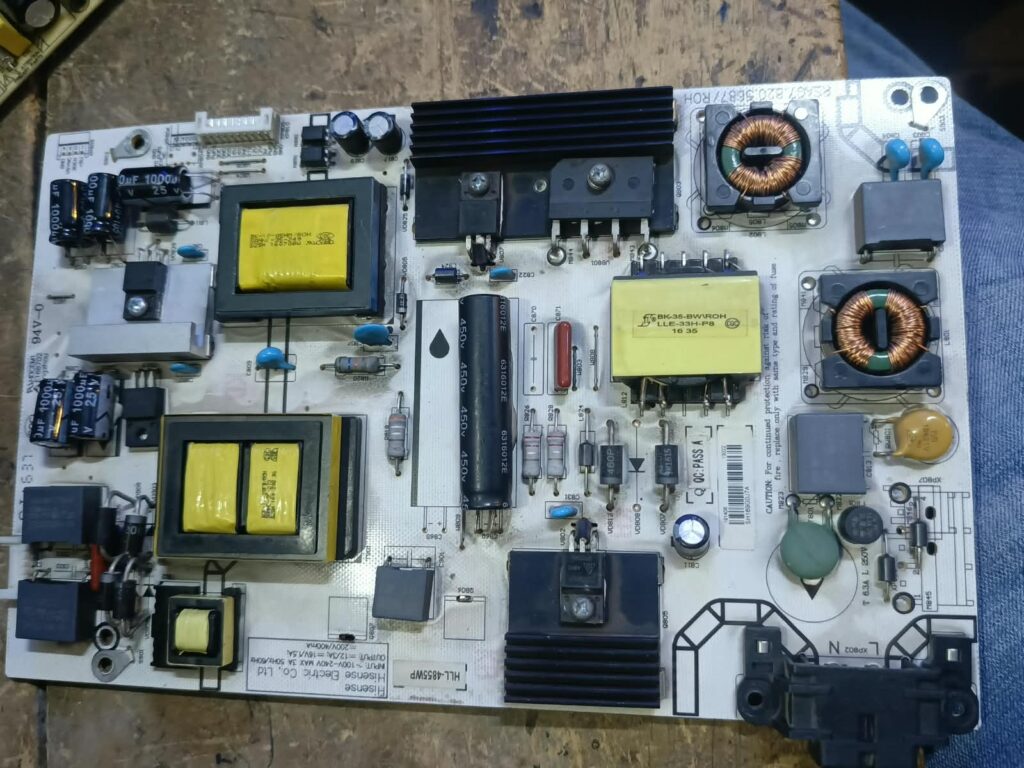
Power Supply Board Repair
The power supply converts and regulates incoming electrical power into the different voltages required by the television.
A damaged power supply can cause complete failure or intermittent operation.
Power supply faults can involve:
- Capacitors
- Diodes
- MOSFETs
- Regulators
- Transformers
- Fuses
- Resistors
- Switching components
- Feedback circuits
- Connectors
- Protection circuits
A qualified technician must use appropriate testing procedures because power supply boards can contain high-voltage sections.
TV Power Surge Damage
Nairobi televisions can experience electrical problems caused by unstable supply, surges, lightning and other electrical events.
A surge can damage sensitive semiconductor components on a television's power supply or main board.
Sometimes the damage is obvious, with burnt components.
In other situations, a component may fail electrically without visible physical damage.
Therefore, visual inspection alone is not enough.
Electrical measurements and circuit testing are often required.
Lightning Damage
Lightning-related damage can affect multiple sections of a television.
A television connected to an antenna, decoder, HDMI equipment or other external devices may also be exposed through signal connections.
Lightning can damage:
- Power supply
- Main board
- HDMI circuitry
- Antenna input
- Network circuitry
- Audio circuits
- USB-related circuitry
If several functions stop working immediately following a lightning event, the technician should investigate possible surge damage across multiple sections.
Smart TV Repair
Modern televisions are increasingly sophisticated computers with displays.
Smart TVs may include:
- Wi-Fi
- Bluetooth
- Streaming applications
- Ethernet
- USB
- HDMI
- App stores
- Voice-control features
- Internal operating systems
As a result, some television problems are not purely hardware-related.
A Smart TV may freeze, restart, fail to connect to Wi-Fi or remain stuck on its logo.
Software troubleshooting can sometimes resolve these issues.
However, if the problem is caused by damaged memory, power instability or a defective main board, hardware repair may still be necessary.
TV Stuck on Logo
A television that displays the manufacturer's logo and then stops can have several possible causes.
Potential causes include:
- Software corruption
- Memory problems
- Main board faults
- Power instability
- Boot-related hardware problems
The correct approach depends on the model.
A reset may sometimes resolve software problems, but repeatedly resetting a television without diagnosis is not always useful.
If the television cannot complete its startup process, the main board and power sections may need to be tested.
Television Restarting Repeatedly
A TV that keeps restarting can have a software, power or hardware problem.
The restart cycle may happen:
- Immediately after power-on
- After the logo appears
- After several minutes
- When an application starts
- When an external HDMI device is connected
- When the television becomes warm
The timing of the restart provides useful information.
A technician can reproduce the fault and inspect the relevant sections.
HDMI Port Repair
HDMI is one of the most important connectivity features on modern televisions.
Customers use HDMI ports for:
- Decoders
- Gaming consoles
- Computers
- Streaming devices
- Blu-ray players
- Sound systems
- Home theatre equipment
A damaged HDMI port can prevent external devices from displaying correctly.
Physical damage is common when cables are inserted or removed forcefully.
Some HDMI problems are caused by the port itself, while others may involve HDMI processing circuitry on the main board.
USB Problems
USB ports on Smart TVs may be used for media playback, firmware updates and external storage.
A faulty USB port may fail to detect a flash disk or other supported device.
The problem can be caused by the physical connector, board circuitry, power supply to the port or software.
TV Sound Problems
Television audio faults can include:
- No sound
- Low sound
- Distorted sound
- Crackling
- Intermittent audio
- Sound from one speaker only
- Audio cutting out
- External audio output problems
Possible causes include speakers, audio amplifiers, main board circuitry, connectors and software settings.
A diagnostic process helps determine whether the problem is inside the television or caused by an external audio configuration.
TV Speaker Repair
Television speakers can become damaged over time.
Symptoms can include buzzing, distortion, crackling or very low sound.
However, before replacing the speaker, the audio amplifier and signal path should be checked.
A damaged speaker and a damaged amplifier can sometimes produce similar symptoms.
Samsung TV Repair
Samsung televisions are among the common brands brought for repair.
Common Samsung TV faults include:
- Backlight failure
- Power problems
- Main board faults
- T-Con problems
- HDMI issues
- Sound problems
- Smart TV problems
- Display lines
- Restarting
- No-picture faults
Different Samsung models use different board configurations and display technologies, so the exact model number is important when sourcing components.
LG TV Repair
LG televisions also come in many configurations, including LED, NanoCell, OLED and Smart TV models.
Possible faults include:
- Backlight problems
- Main board faults
- Power board problems
- Display issues
- Audio faults
- HDMI problems
- Smart TV problems
- Screen-related faults
OLED televisions require particularly careful handling because the display technology differs significantly from conventional LED-backlit LCD televisions.
Sony TV Repair
Sony televisions can experience power, backlight, main board, audio, HDMI and display faults.
Some models also have sophisticated software and network functions.
A television that appears to have a hardware problem may occasionally have a software or configuration issue, so technicians should test both aspects when appropriate.
TCL TV Repair
TCL televisions are widely used in Kenya.
Common service requests can involve:
- Backlight replacement
- Power supply faults
- Main board problems
- Display problems
- HDMI faults
- Smart TV issues
- Audio faults
- Restarting
- No-picture conditions
Model identification is important because replacement boards and LED strips vary between models.
Hisense TV Repair
Hisense televisions can also develop power, display, backlight, audio and Smart TV problems.
A customer should provide the model number whenever possible.
The model number helps technicians identify the correct circuit configuration and possible replacement components.
Skyworth TV Repair
Skyworth televisions can experience faults involving power, backlights, main boards, display circuits and audio.
A proper diagnosis is necessary before deciding whether to repair or replace a board.
Vitron TV Repair
Vitron televisions are common in the Kenyan market and may require different types of service depending on model and screen size.
Common complaints include no power, backlight failure, sound problems, lines, Smart TV problems and display faults.
Sayona TV Repair
Sayona televisions can also be diagnosed and repaired depending on the model and availability of suitable components.
The same visible symptom can have different causes across different television designs, so model-specific diagnosis is important.
Von TV Repair
Von televisions can develop power supply, backlight, main board, audio and display problems.
Customers can bring the television for assessment to determine whether the fault is repairable and which components are required.
JVC TV Repair
JVC televisions can also require servicing for power, display, sound, connectivity and Smart TV problems.
Technicians assess the exact model before deciding on the repair method.
Vision Plus TV Repair
Vision Plus televisions can develop common LED and Smart TV faults.
Backlight, power, display and motherboard problems should be diagnosed individually rather than assuming that one particular component is responsible.
OLED Television Repair
OLED televisions differ from conventional LED televisions.
An OLED television does not use a traditional LED backlight in the same way as an LCD television.
This means that a black screen on an OLED cannot automatically be treated as a conventional backlight replacement job.
OLED televisions require careful diagnosis because the display panel itself is a major component.
Physical pressure can also cause serious damage.
QLED Television Repair
QLED televisions are generally based on LCD technology with additional quantum-dot technology.
They may therefore still use LED backlighting.
Backlight-related symptoms can consequently occur, but the exact construction varies by manufacturer and model.
NanoCell Television Repair
NanoCell televisions use LCD-based display technology.
Depending on the model, problems can involve the backlight, power supply, main board, T-Con or panel.
Correct identification of the television model is important when diagnosing the problem.
Television Panel Damage
The display panel is one of the most expensive and delicate parts of many televisions.
Panel damage can occur through:
- Physical impact
- Pressure
- Falling objects
- Incorrect transportation
- Children hitting the screen
- Moving furniture
- Installation accidents
Panel damage can produce cracks, black patches, coloured lines, ink-like areas or permanent distortion.
Unfortunately, not every panel fault is economically practical to repair.
In some situations, panel replacement may cost close to or more than purchasing another television.
A technician should therefore assess the condition before recommending any major expenditure.
Cracked Television Screen
A cracked TV screen is different from a simple electronic fault.
A cracked LCD or OLED panel is physically damaged.
If the panel is cracked, replacing a power board, main board or backlight will not restore the display.
The customer may need to compare the cost and availability of a replacement panel against purchasing another television.
Television With Black Spots
Black spots may be caused by physical damage to the display or other display-related issues.
If a black patch appears after the television has been hit, pressed or dropped, panel damage should be suspected.
If the dark area gradually developed without physical impact, further diagnosis is necessary.
TV Screen Flickering
Flickering can be caused by:
- LED backlight problems
- Power supply instability
- Loose connections
- Main board issues
- T-Con problems
- Software problems
- External signal issues
The frequency and circumstances of the flickering can help identify the cause.
TV Colours Are Wrong
A television may suddenly develop incorrect colours.
The picture could appear:
- Blue
- Green
- Red
- Purple
- Washed out
- Negative
- Too dark
- Too bright
Possible causes include display signal problems, T-Con faults, main board processing issues, panel connections and incorrect settings.
Before opening the television, basic picture settings and external source issues should be eliminated.
Television Diagnosis Before Repair
Diagnosis is one of the most important parts of professional television repair.
A proper diagnostic process may include:
- Identifying the television brand.
- Recording the model number.
- Checking the reported symptom.
- Testing the external power supply.
- Inspecting visible physical damage.
- Testing startup behaviour.
- Checking standby operation.
- Observing the display.
- Testing audio.
- Checking external inputs.
- Testing relevant internal voltages.
- Inspecting circuit boards.
- Checking connectors.
- Testing backlight operation where applicable.
- Evaluating display circuitry.
- Identifying the failed section.
- Determining the appropriate repair method.
This process reduces unnecessary part replacement.
Why Model Numbers Matter
Customers often describe their television simply as a Samsung, LG, Sony, TCL or Hisense.
The brand is useful, but it is not enough.
A single manufacturer can produce hundreds of television models with different boards, panels, LED strips and circuit configurations.
The exact model number is therefore extremely useful.
When contacting a repair technician, customers should provide:
- Brand
- Model number
- Screen size
- Main symptom
- Whether the TV powers on
- Whether sound works
- Whether the screen lights up
- Whether the problem happened suddenly
- Whether the TV experienced a power surge
- Whether the television was dropped or hit
Photographs can also help with initial identification.
TV Repair and Spare Parts
Television repair often requires components or replacement assemblies.
Possible parts include:
- LED strips
- Power supply boards
- Main boards
- T-Con boards
- Speakers
- Connectors
- Fuses
- Capacitors
- Regulators
- Integrated circuits
- Remote controls
- HDMI connectors
- Power components
- Backlight components
Not every part is available for every model.
Older televisions may also present a parts-availability challenge.
A technician can determine whether the required component can be repaired, sourced or replaced.
Television Spare Parts in Nairobi CBD
Customers looking for television spare parts around Nairobi CBD can benefit from visiting the electronics repair area around Luthuli Avenue.
Some television parts are model-specific.
For example, an LED strip designed for one 55-inch television may not work correctly in another 55-inch television.
Similarly, a main board may look physically similar to another board but use different firmware or connector arrangements.
Correct part identification is therefore important.
Repair or Replace the Television?
One of the most common questions customers ask is whether they should repair a television or purchase another one.
There is no single answer.
The decision depends on:
- Television age
- Screen size
- Brand
- Original purchase value
- Type of fault
- Parts availability
- Repair cost
- Condition of the panel
- Availability of a replacement television
A minor power or backlight fault may make repair worthwhile.
A severely cracked panel may make replacement more practical.
Professional assessment helps the customer make an informed decision.
How Much Does TV Repair Cost?
Television repair prices vary according to the fault.
There is no responsible way to provide one fixed price for every television because a power supply repair is different from a complete panel replacement, and a 32-inch television is different from a large premium OLED model.
The final cost can depend on:
- Television brand
- Model
- Screen size
- Fault
- Required parts
- Labour
- Availability of components
- Extent of damage
A proper diagnosis is therefore the best starting point.
Do Not Replace Parts Without Diagnosis
Customers sometimes purchase a board online because the television displays a particular symptom.
This can be risky.
Two televisions with identical symptoms may have different faults.
For example, two televisions may both have a black screen.
One may need backlight repair.
Another may have a main board fault.
Another may have a T-Con problem.
Another may have panel damage.
Replacing the wrong board wastes money and may introduce additional problems.
TV Repair for Homes
Residential television repair is common around Nairobi.
A family television may be used for entertainment, news, streaming, gaming and educational content.
When it stops working, customers often want a quick and dependable diagnosis.
Customers around Ambassador and Nairobi CBD can bring the television to the workshop for assessment.
TV Repair for Offices
Offices may use televisions for:
- Presentations
- Meeting rooms
- Digital information
- Video conferencing
- Advertising
- Customer information
- Monitoring
A faulty office television can interfere with meetings and daily operations.
Commercial users may therefore need efficient diagnosis and repair.
Hotel Television Repair
Hotels can have many televisions operating simultaneously.
A hotel television problem may involve:
- No power
- No picture
- No sound
- HDMI problems
- Remote-control problems
- Display faults
- Network connectivity
- Software problems
A hotel may also need multiple units serviced.
Restaurant Television Repair
Restaurants, bars and entertainment venues use televisions to display sports, news, music and other programming.
A television failure can affect the customer experience.
Common problems include no signal, no picture, sound faults and HDMI issues.
The underlying problem may be with the television itself or an external decoder, amplifier or signal source.
Television Repair for Shops
Retail shops and businesses may use televisions for advertising and customer entertainment.
A TV that repeatedly switches off, develops a dark screen or loses its display can reduce the effectiveness of the business's visual communication.
Professional diagnosis can determine whether the television can be restored.
Television Installation and Wall Mounting
Television repair can sometimes overlap with installation problems.
A wall-mounted television may experience:
- Loose cables
- Damaged connectors
- Poor ventilation
- Incorrect mounting
- Cable strain
- External device connection problems
If a television is being installed after repair, proper mounting and cable management are important.
Large televisions should be mounted using suitable brackets and appropriate wall anchors.
TV Ventilation
Modern televisions generate heat.
Blocked ventilation can contribute to overheating.
A television should have adequate airflow around the relevant ventilation areas.
Do not place objects over ventilation openings.
Excessive heat can shorten the life of electronic components.
Preventing Television Damage
Several simple practices can help reduce the likelihood of television faults.
Use a good-quality power protection solution where appropriate.
Avoid switching the television on and off repeatedly within very short periods.
Keep liquids away from the television.
Do not press or clean the screen aggressively.
Avoid placing heavy objects near the display.
Keep the television properly ventilated.
Handle large screens carefully during transportation.
Disconnect sensitive equipment appropriately during severe electrical storms where practical.
Cleaning a Television Screen
The display surface should be cleaned carefully.
Aggressive chemicals or excessive moisture can damage the screen coating or allow liquid to enter the television.
Use appropriate screen-cleaning methods and a soft suitable cloth.
Never spray liquid directly onto the television screen.
Television Repair After a Power Outage
A power outage does not always damage a television, but voltage fluctuations associated with power restoration can sometimes affect electronic equipment.
If the TV fails immediately after an electrical event, the power supply and related circuits should be inspected.
Do not repeatedly attempt to power on a television that is making unusual sounds, smells burnt or shows obvious electrical damage.
Burnt Smell From a Television
A burnt electrical smell can indicate component failure.
Possible sources include:
- Power supply
- Main board
- Connectors
- Wiring
- Backlight circuitry
- Other electronic components
If a television develops a strong burning smell, unplugging it and arranging professional assessment is safer than continuing to operate it.
TV Making Clicking Sounds
A clicking television may have a power supply or protection-related problem.
Sometimes the television attempts to start but immediately enters protection mode.
The sound may repeat in a cycle.
Technicians can inspect the startup sequence and relevant power circuits.
TV Standby Light Blinking
Some television models use blinking indicator patterns to communicate diagnostic information.
The meaning differs between brands and models.
A blinking light should therefore not automatically be interpreted using a generic code from another television.
The model number is important.
Remote Control Problems
Sometimes a television appears faulty when the actual problem is related to the remote.
Before bringing a television for electronic repair, customers can check:
- Remote batteries
- Whether the remote emits an infrared signal
- Physical damage
- Whether the TV responds to its buttons
- Whether another compatible remote works
If the television responds to its own buttons but not the remote, the fault may be related to the remote or infrared receiver.
TV Software Updates
Smart televisions sometimes require software updates.
Software updates can improve compatibility and fix certain bugs.
However, an update should not be interrupted unnecessarily.
If a television becomes stuck during startup following a failed update, specialised troubleshooting may be required.
Factory Reset
A factory reset can resolve some software or configuration problems.
However, it also removes saved settings and may require applications and network connections to be configured again.
A factory reset is not a universal solution for hardware faults.
A dead backlight will not be repaired by resetting the television.
A damaged power board will not be repaired by changing software settings.
TV Diagnostic Questions
Before bringing a television for repair, customers can answer several useful questions.
Does the television power on?
If yes, the technician can investigate further based on what happens after startup.
Is there sound?
Sound with no picture points toward a different diagnostic path from complete failure.
Does the screen light up?
A brief flash followed by darkness may provide useful information.
Was there a power surge?
This can help identify possible electrical damage.
Was the television dropped?
Physical impact changes the diagnostic possibilities.
Does the fault happen immediately or after some time?
Intermittent faults can behave differently from permanent failures.
What is the model number?
This is important for identifying the correct circuit configuration and replacement components.
Bringing Your TV to the Workshop
Customers around Ambassador can bring their television to the workshop on Luthuli Avenue.
When transporting the television, protect the display from pressure and impact.
For larger televisions, two people may be needed to handle the unit safely.
Do not carry a large television by holding only one corner.
If the television has a detachable stand, securing or removing it may make transportation easier.
Keep screws and accessories together.
If possible, bring the remote control because it can help during testing.
What to Bring With the Television
Where practical, customers can bring:
- Television
- Remote control
- Power cable
- Relevant external adapter
- Decoder or external device information if the fault involves a signal issue
However, customers do not necessarily need to bring every connected device.
The technician can advise if additional equipment is required.
TV Repair Near Ambassador and Nearby Streets
The workshop location on Luthuli Avenue makes the service accessible from several central Nairobi areas.
Customers may come from:
- Ambassador
- Kenyatta Avenue
- Moi Avenue
- Tom Mboya Street
- Ronald Ngala Street
- River Road
- Luthuli Avenue
- OTC
- Kimathi Street
- Haile Selassie Avenue
- City Market
- Central Business District
- Nairobi Railway Station area
- Ngara
- Pangani
- Eastleigh
- Kamukunji
- Shauri Moyo
- Kariobangi and other areas depending on transportation arrangements
Customers travelling from outside the CBD can also use the workshop for specialised television repair.
Why Proper Diagnosis Matters
A television is a system made up of several interconnected sections.
The power supply provides electrical power.
The main board processes information.
The display-control circuitry manages image timing.
The backlight illuminates LCD displays.
The audio system produces sound.
The connectivity circuits handle HDMI, USB, network and other inputs.
A fault in one section can affect another.
For example, a power supply problem may prevent the main board from starting.
A main board problem may prevent the backlight from receiving the correct control signal.
A display fault may appear similar to a backlight fault.
This is why systematic diagnosis is more reliable than guessing.
Component-Level Television Repair
Some television boards can be repaired at component level.
This can involve identifying a failed component and replacing it rather than replacing the entire board.
Depending on the board and fault, components can include regulators, capacitors, diodes, transistors, resistors, integrated circuits and other electronic devices.
Component-level repair can sometimes reduce costs, particularly when a complete replacement board is difficult to obtain.
However, not every board fault is economically or technically suitable for component-level repair.
Board Replacement
Sometimes replacing a board is more practical.
This may happen when:
- The board has extensive damage.
- Multiple circuits have failed.
- The board is difficult to repair.
- A suitable replacement is available.
- Repair labour would exceed the cost of replacement.
- The board has suffered severe surge damage.
The replacement board must be compatible with the television.
Compatibility includes more than physical dimensions.
Firmware, connectors, panel configuration and model compatibility can matter.
Firmware and Board Compatibility
A main board may physically fit into a television but still require appropriate firmware or configuration.
Incorrect firmware can cause display problems, missing functions or startup problems.
Therefore, board replacement should be based on the actual model and board identification.
TV Repair for Different Screen Sizes
Television repair applies to many screen sizes.
Common sizes include:
- 24-inch
- 32-inch
- 40-inch
- 42-inch
- 43-inch
- 49-inch
- 50-inch
- 55-inch
- 58-inch
- 65-inch
- 70-inch
- 75-inch
- 85-inch and larger
The repair process can differ significantly between sizes.
Large panels require more careful handling.
Large Screen Television Repair
Large televisions can be difficult to transport.
A 65-inch or 75-inch television requires appropriate space and careful handling.
The display should not be placed face-down on an unsuitable surface.
Pressure on the panel can cause damage.
Customers should arrange transportation carefully when bringing large televisions for repair.
TV Repair for Gaming Problems
Gaming consoles often connect through HDMI.
If a television suddenly stops displaying a gaming console, the problem may not necessarily be inside the TV.
Testing another HDMI port, cable and source can help determine whether the issue is external.
If multiple known-good devices fail on the same television input, the HDMI circuitry may need to be inspected.
Decoder and TV Problems
A decoder problem can sometimes be mistaken for television failure.
Before diagnosing a television with no signal, it is useful to determine whether the television's own menus are visible.
If the TV menu appears correctly but the decoder has no picture, the television may not be the source of the problem.
This simple distinction can save unnecessary repair work.
No Signal Message
A "No Signal" message does not necessarily mean the television is faulty.
Possible causes include:
- Wrong input selected
- Loose HDMI cable
- Faulty decoder
- Faulty HDMI cable
- External device not powered
- Damaged HDMI port
- Source device problem
Testing the television's internal menu and another source can help identify the issue.
Television With No HDMI Signal
If several known-good HDMI devices fail to display on one port, the port or HDMI processing circuitry may require inspection.
If only one device fails, the external device or cable may be responsible.
This is why systematic testing is useful.
TV Repair for Home Theatre Systems
Televisions connected to home theatre systems can develop complicated audio and video configurations.
A customer may report that the TV has no sound when the actual issue is an incorrect audio-output configuration.
Alternatively, the television's audio output circuit may genuinely be faulty.
Testing the television independently can help separate the TV fault from the home theatre system.
Television Repair for Soundbars
Soundbars can connect using HDMI ARC, optical audio, Bluetooth or other methods.
If a television suddenly stops sending audio to a soundbar, the problem may be related to settings, cables, ports or the soundbar itself.
The TV should be tested independently before internal repair is considered.
Professional Television Troubleshooting
Good troubleshooting follows a logical sequence.
The technician should not immediately dismantle a television simply because a customer reports a display problem.
External causes should first be eliminated.
The internal sections can then be tested where appropriate.
This method helps prevent unnecessary replacement of components.
When Should You Repair Your Television?
Repair is often worth considering when:
- The panel is intact.
- The television is relatively modern.
- The fault is isolated.
- Spare parts are available.
- The repair cost is reasonable.
- The television has otherwise been reliable.
Replacement may be more practical when:
- The panel is badly cracked.
- The television has extensive physical damage.
- Replacement parts are unavailable.
- The repair cost approaches the price of a new unit.
The final decision should be based on the actual diagnosis.
Television Repair for Businesses in Nairobi CBD
Businesses around Ambassador and the CBD may use televisions for many purposes.
They may display:
- Advertisements
- News
- Financial information
- Sports
- Customer information
- Promotional videos
- Meeting presentations
A working television can therefore be part of daily business operations.
Professional repair helps businesses restore equipment rather than immediately replacing it.
TV Repair for Apartments and Residences
Residents around Nairobi CBD may have televisions mounted on walls or placed on furniture.
If a television is wall-mounted, technicians may need to consider cable accessibility and mounting configuration during assessment.
Large-screen televisions should be handled carefully when removed from walls.
TV Repair After Moving House
Televisions can develop faults after relocation.
The fault may result from:
- Physical impact
- Excessive pressure
- Loose cables
- Incorrect transportation
- Mounting damage
- Electrical reconnection problems
If the television worked before moving but fails immediately afterward, physical and connection-related causes should be investigated.
Television Repair and Preventive Maintenance
Not every television needs regular servicing.
However, keeping the television clean, dry, ventilated and connected to stable electrical power can help maintain its operating condition.
External devices should also be connected and disconnected carefully.
Common Questions About TV Repair Near Ambassador
Where can I repair my TV near Ambassador Nairobi?
Customers near Ambassador Nairobi CBD can visit the television repair workshop at Luthuli Avenue, Kangari Building, 3rd Floor KA7 for assessment and repair.
Do you repair Smart TVs?
Yes. Smart TV faults can include hardware, software, connectivity, display, power and audio problems.
Do you repair Samsung TVs?
Samsung televisions can be diagnosed for power, backlight, display, main board, T-Con, HDMI, audio and Smart TV problems.
Do you repair LG TVs?
Yes. LG LED, Smart TV and other supported models can be assessed depending on the specific fault.
Do you repair TCL TVs?
TCL televisions can be assessed for backlight, power, motherboard, display, audio and connectivity faults.
Do you repair Hisense TVs?
Yes. Hisense televisions can be diagnosed for various electronic and display faults.
Do you repair Sony TVs?
Sony television faults can be assessed, including power, display, backlight, audio and connectivity issues.
Can you repair a TV with sound but no picture?
Yes, the television can be diagnosed to determine whether the problem involves the backlight, display circuitry, main board or another section.
Can you replace TV LED backlights?
LED backlight replacement can be carried out on supported television models where suitable components are available.
Can a TV with lines on the screen be repaired?
It depends on the cause. Lines caused by certain electronic or connection faults may be serviceable, while severe panel damage may not be economically repairable.
Can a cracked screen be repaired?
A physically cracked display panel is generally a replacement-panel issue rather than an ordinary electronic repair. The cost and availability of a suitable panel determine whether replacement is practical.
Can you repair TV motherboards?
Depending on the fault, a television main board can sometimes be repaired at component level or replaced with a compatible board.
Can you repair power boards?
Power supply boards can be diagnosed for component and circuit faults.
What if my TV switches off after a few minutes?
This can be caused by overheating, power instability, backlight protection, main board problems or other faults. Diagnosis is required.
What if my TV keeps restarting?
Repeated restarting may be related to software, power supply, memory or main board faults.
Can you repair HDMI problems?
HDMI problems can be diagnosed to determine whether the issue is the cable, external device, connector or television circuitry.
Do I need to know the TV model?
Knowing the model number is highly recommended because it helps identify the correct circuit configuration and compatible parts.
What Information Should You Send Before Bringing a TV?
Customers can provide a photograph of the television and its model label.
Useful photographs include:
- Front of TV
- Model sticker
- Back label
- Fault displayed on the screen
- Power indicator
- Damaged area if visible
A short description of the problem is also helpful.
For example:
"My 55-inch TCL turns on, has sound, but the screen is dark."
This is much more useful than simply saying:
"My TV is broken."
Television Repair for Different Fault Categories
Television problems can generally be grouped into several categories.
Power faults
The television does not power on or cannot remain powered.
Display faults
The television powers on but the image is abnormal or missing.
Backlight faults
The image may be present but cannot be properly illuminated.
Audio faults
The picture works but sound does not.
Connectivity faults
HDMI, USB, network or other input functions fail.
Software faults
The television freezes, crashes or fails to complete startup.
Physical faults
The panel, frame, connectors or other physical components are damaged.
Each category requires a different diagnostic path.
Why Customers Choose a Specialist Workshop
Televisions contain delicate electronic components and high-density circuit boards.
A general electrical repair approach may not be sufficient for modern television diagnostics.
Television repair requires knowledge of:
- Power supplies
- Digital electronics
- Display technology
- LED backlights
- Main boards
- T-Con systems
- Audio circuits
- HDMI
- Smart TV systems
- Component-level electronics
- Panel construction
A specialist approach can make diagnosis more systematic.
TV Repair Near Ambassador With Convenient CBD Access
Customers working or living around Ambassador often prefer a repair location within the CBD because transporting a television over a long distance can be inconvenient.
Luthuli Avenue provides access to a major electronics service area within Nairobi.
The Kangari Building workshop at 3rd Floor KA7 provides a location where customers can bring their televisions for assessment.
Television Repair Services Available
The service scope can include:
TV DIAGNOSTICS
Testing the television to identify the faulty section.
POWER SUPPLY REPAIR
Diagnosis and repair of power-related faults where practical.
BACKLIGHT REPLACEMENT
Replacement of defective LED strips on supported LCD/LED models.
MAIN BOARD REPAIR
Diagnosis and repair of selected motherboard faults.
T-CON REPAIR
Diagnosis of display timing and related circuitry.
DISPLAY TROUBLESHOOTING
Investigation of lines, flickering, no-picture and distorted-image problems.
AUDIO REPAIR
Investigation of no-sound, low-sound and distorted-audio problems.
HDMI REPAIR
Diagnosis of HDMI ports and associated circuitry.
SMART TV TROUBLESHOOTING
Investigation of software, startup and connectivity problems.
TV SPARE PARTS
Supply of selected television boards, LED strips and other components depending on availability.
TV Repair Near Ambassador Nairobi CBD – A Practical Approach
When your television develops a problem, the most useful first step is to avoid guessing.
Observe exactly what the television does.
Does the standby light appear?
Does the TV respond to the remote?
Does the logo appear?
Does sound work?
Does the screen flash?
Does the TV restart?
Does the problem occur on all inputs?
Did the problem begin after a power outage?
Was the television moved or hit?
These details help establish the starting point for diagnosis.
Example: Black Screen Diagnosis
Suppose a customer from Ambassador brings a 55-inch Smart TV.
The customer says:
"The TV switches on and I can hear sound, but the screen is black."
The technician does not immediately conclude that the panel is damaged.
The television is tested.
If an image can be detected but there is no illumination, the backlight system becomes a strong area of investigation.
If there is no video signal at all, the technician examines the display-control and main-board sections.
If the panel itself is damaged, the repair recommendation changes.
This illustrates why diagnosis matters.
Example: TV With Lines
Another customer may bring a television showing vertical lines.
The technician examines whether the lines are permanent, intermittent, localised or affecting a large section.
The panel connections and display-control system may then be investigated.
If the problem is associated with panel damage, the customer should be informed before expensive board replacement is attempted.
Example: Dead Television
A completely dead TV requires investigation of the power path.
The technician checks the relevant external and internal power conditions.
The power supply board may then be examined.
If the power supply is functioning correctly, attention may shift toward standby and main-board circuits.
Again, the symptom alone does not identify the failed component.
Example: TV Keeps Restarting
If a TV continuously restarts, the technician can observe the sequence.
Does it restart before the logo?
After the logo?
When an application loads?
After several minutes?
Does it restart when HDMI equipment is connected?
These observations can help separate software, power and hardware-related causes.
Television Repair and Customer Communication
A good repair service should explain the problem in understandable terms.
Customers should know:
- What has failed
- Whether the fault is repairable
- Which part may be required
- Whether a replacement component is available
- Whether the panel is affected
- The expected repair process
- Any relevant limitations
This allows the customer to make an informed decision.
Avoiding Unnecessary Television Expenses
Customers can sometimes save money by obtaining a diagnosis before buying a new TV.
A television with a relatively minor fault may be restorable.
For example, a television with a failed backlight does not necessarily need to be discarded.
A television with a defective power component may not require an entire new unit.
A television with an HDMI problem may only require attention to the input circuit.
However, repair should be based on the actual condition of the television.
Television Repair in the Nairobi CBD Area
Pro-Logic Technologies Limited serves customers seeking television repair around central Nairobi.
The workshop at Luthuli Avenue, Kangari Building, 3rd Floor KA7 is positioned within the CBD electronics service environment.
Customers can use the workshop for television assessment, repair and selected spare-part requirements.
The service is relevant to residential customers, businesses, offices, hotels, restaurants and other organisations that depend on working television equipment.
Professional Handling of Television Panels
The panel should be treated as the most delicate component of many televisions.
Technicians handling a large display need to consider:
- Panel weight
- Flexibility
- Frame construction
- Connector locations
- Backlight assembly
- Display driver connections
Improper handling can create additional damage.
This is particularly important during backlight replacement.
Backlight Replacement Requires Panel Disassembly
On many LED televisions, accessing the backlight strips requires removing the display panel and diffuser layers.
This is a delicate operation.
The technician needs to keep the layers properly aligned.
Incorrect reassembly can produce:
- Bright spots
- Dark spots
- Uneven lighting
- Shadows
- Dust marks
- Display pressure marks
Proper handling is therefore essential.
TV Repair Quality Depends on Correct Diagnosis
A successful television repair is not simply about replacing a component.
It is about identifying the root cause.
If an LED strip has failed, the technician should determine why.
If a power component has failed, other affected components should also be considered.
If a board has been damaged by a surge, simply replacing one visibly burnt component may not always be enough.
A systematic repair approach reduces repeat failures.
TV Repair for Customers From Outside CBD
Although the focus of this service is Ambassador and Nairobi CBD, customers from other parts of Nairobi can also use the workshop.
Customers travelling from estates or surrounding towns should consider the television's size when planning transportation.
For large-screen models, appropriate vehicle space is important.
Television Repair and Spare Parts Availability
Parts availability can influence repair time.
Common television components may be easier to source.
Older, unusual or discontinued models may require more effort to locate suitable components.
The exact model number allows technicians to identify what is needed.
What Makes a Television Difficult to Repair?
Some faults are more complicated because they involve:
- Discontinued parts
- Damaged panels
- Multiple failed boards
- Severe surge damage
- Firmware problems
- Integrated display circuitry
- Rare models
- Physical damage
- Lack of compatible spare parts
A technician should explain these limitations rather than promising that every television can always be restored.
When a Television Is Beyond Economical Repair
There are cases where repair may not be financially sensible.
A severely cracked panel is one example.
If the panel replacement cost is extremely high relative to the television's value, buying another television may be more practical.
Likewise, if a very old television has multiple failing systems and parts are difficult to source, extensive repair may not make economic sense.
Professional assessment allows customers to make that decision based on facts.
Television Repair for Schools and Institutions
Schools and institutions may use televisions for educational presentations, training and communication.
A faulty television can interrupt planned activities.
Institutions may also have several television units that require maintenance.
The repair approach depends on the model and fault.
Television Repair for Churches and Community Facilities
Churches, community organisations and other institutions may use televisions with sound systems and presentation equipment.
Faults may involve both the television and external audio/video equipment.
Testing the complete signal path can help identify where the problem originates.
TV Repair and External Devices
A television is often connected to other devices.
Examples include:
- Decoder
- Soundbar
- Home theatre
- Gaming console
- Laptop
- Desktop computer
- Streaming stick
- Blu-ray player
- CCTV recorder
When troubleshooting, these devices should be considered.
A television may appear faulty when the actual problem is an external cable or source device.
Checking the TV Without External Devices
A useful diagnostic step is to check whether the television's own menu or startup screen works.
If the menu displays normally but an external device does not, the television may not have a general display failure.
If even the television's own menu cannot display correctly, internal troubleshooting may be necessary.
TV Repair After Water or Liquid Exposure
Liquid can cause serious electronic damage.
If water or another liquid enters a television, continued operation can cause further damage.
The safest approach is to disconnect power and seek assessment.
Liquid damage may affect several circuit sections.
TV Repair After Physical Impact
A television that has been hit may develop immediate or delayed problems.
Physical impact can affect:
- Panel
- Connectors
- Boards
- Internal mounting
- Display connections
If a problem appears after impact, the technician should be informed because it provides an important diagnostic clue.
TV Repair for Older Models
Older televisions may still be repairable.
However, spare parts may be more difficult to find.
Sometimes a board can be repaired rather than replaced.
The age and condition of the television should therefore be considered before purchasing parts.
TV Repair for Newer Models
Newer Smart TVs may contain more advanced electronics.
They may have:
- More complex processors
- Integrated wireless connectivity
- Sophisticated display systems
- Multiple HDMI standards
- Advanced audio
- Voice-control features
Diagnosis can therefore involve both hardware and software.
Television Repair Near Ambassador – Customer Convenience
For customers in central Nairobi, location matters.
A workshop that is accessible from Ambassador reduces the distance a customer needs to transport a television.
The Luthuli Avenue location also places the workshop within an area known for electronics-related businesses and services.
Contact and Workshop Information
For customers looking for television repair near Ambassador Nairobi CBD, the workshop is:
Pro-Logic Technologies Limited
Luthuli Avenue
Kangari Building, 3rd Floor KA7
Nairobi CBD
Phone: 0723763173
Customers can contact the workshop regarding television diagnostics, repair requirements and available spare parts.
Final Advice Before Bringing Your Television
If your television has stopped working, avoid repeatedly switching it on if you notice unusual smells, sparks, smoke, severe overheating or obvious electrical damage.
If the television is physically cracked, avoid applying pressure to the display.
If the television is simply not responding, note whether the standby indicator is active.
If the television has sound but no picture, mention this when requesting assistance.
If the television shows lines, take a clear photograph of the display.
If the television restarts, describe when the restart happens.
If the television developed the problem after a power event, mention that as well.
These details can make the initial assessment more efficient.
Why Choose a Professional TV Repair Service?
Modern televisions are not simple appliances.
They combine power electronics, digital processing, display technology, audio systems, software and connectivity.
A professional repair process considers the entire system.
The objective is not simply to change parts.
The objective is to identify the actual fault and determine the most practical repair solution.
For customers around Ambassador and Nairobi CBD, having access to a dedicated television repair workshop provides a practical alternative to immediately replacing a faulty television.
Television Repair Near Ambassador Nairobi CBD – Complete Service Coverage
Pro-Logic Technologies Limited provides television troubleshooting and repair for many common faults, including:
POWER REPAIR
Televisions that are dead, fail to start, click, blink or repeatedly shut down.
BACKLIGHT REPAIR
Televisions with dark screens, flashing illumination, uneven lighting or failed LED strips.
MAIN BOARD REPAIR
Televisions experiencing startup, HDMI, audio, Smart TV and processing problems.
T-CON AND DISPLAY TROUBLESHOOTING
Televisions with lines, half-screen images, distorted pictures, colour abnormalities and other display problems.
AUDIO REPAIR
Televisions with no sound, distorted sound, low sound or intermittent audio.
HDMI AND CONNECTIVITY
Televisions experiencing problems with HDMI, USB and selected connectivity functions.
SMART TV TROUBLESHOOTING
Televisions that freeze, restart, remain stuck on logos or experience certain software-related problems.
SPARE PARTS
Selected television boards, LED strips and other components depending on model and availability.
Serving Customers Around Ambassador
Customers around Ambassador can access television repair services without necessarily travelling far outside Nairobi CBD.
The workshop at Luthuli Avenue provides a central location for television assessment and repair.
Whether the television is a small bedroom unit, office display or large-screen Smart TV, the first step is proper diagnosis.
Final Word
A faulty television does not automatically mean that it should be thrown away.
Some televisions require a simple repair.
Others need a replacement board, backlight assembly, electronic component or another service.
Some display problems may be more serious, particularly when the panel has suffered physical damage.
The most sensible approach is to have the television assessed before deciding whether to repair or replace it.
For customers searching for TV repair near Ambassador Nairobi CBD, Pro-Logic Technologies Limited provides television diagnostics and repair services from Luthuli Avenue, Kangari Building, 3rd Floor KA7, Nairobi CBD.
The service covers a broad range of television brands and faults, including power problems, backlight failures, display problems, motherboard faults, T-Con issues, sound problems, HDMI faults, Smart TV troubleshooting and selected spare-parts requirements.
Customers around Ambassador, Kenyatta Avenue, Moi Avenue, Tom Mboya Street, River Road, Ronald Ngala Street, Luthuli Avenue, OTC and surrounding Nairobi CBD areas can seek television assessment and repair.
For enquiries, contact 0723763173.
Pro-Logic Technologies Limited
Luthuli Avenue, Kangari Building, 3rd Floor KA7
Nairobi CBD
Television Diagnostics • TV Repair • Backlight Replacement • Main Board Repair • Power Supply Repair • Display Troubleshooting • Audio Repair • TV Spare Parts