
Reliable water is essential for(call 0723763173) homes, farms, schools, businesses, institutions, apartments, industries, hotels, health facilities, and commercial developments. In Awendo and the surrounding areas of Migori County, access to a dependable water source can make a major difference in daily life, agricultural productivity, livestock management, sanitation, construction, and business operations.
Pro-Logic Technologies provides borehole drilling and complete water-system solutions in Awendo, helping property owners develop reliable groundwater systems suited to their specific water requirements. Our approach covers the important stages of a borehole project, from assessing the proposed drilling site through drilling, casing, borehole development, testing, pump installation, water storage, filtration, solar pumping, and distribution.
A borehole is more than simply drilling a hole into the ground. A successful project requires proper planning, geological understanding, suitable drilling equipment, quality casing and screens, appropriate borehole development, pumping tests, correctly selected pumping equipment, electrical protection, and an efficient water distribution system.
Every site is different. Groundwater depth, geological formations, expected yield, water quality, drilling conditions, and the final water demand can vary considerably even between properties that are relatively close to each other. For this reason, borehole projects should be planned around the characteristics of the specific site rather than relying on assumptions about a neighboring property.
Borehole Drilling in Awendo
Awendo is an important urban and agricultural area in Migori County. The surrounding region includes residential properties, agricultural land, commercial premises, institutions, livestock operations, and developing settlements that can benefit from dependable independent water supplies.
A borehole can provide an alternative or supplementary water source where existing water supplies are unreliable, insufficient, seasonal, or expensive to depend on for the required volume of water.
Pro-Logic Technologies offers borehole-related services designed around the intended use of the water source. A domestic borehole may have very different requirements from a borehole serving a hotel, school, irrigation farm, apartment complex, factory, or livestock operation.
Our objective is to develop a system that is technically appropriate for the site and practical for the customer to operate and maintain.
Why Drill a Borehole in Awendo?
There are many reasons a property owner may consider groundwater development.
A household may need a more reliable supply for bathing, cleaning, cooking, laundry, sanitation, and gardening. A farm may require water for irrigation and livestock. A school may need water for students, staff, sanitation, kitchens, gardens, and cleaning. A business may require water for employees, customers, production, cleaning, or accommodation.
A borehole can also support properties where the available public supply does not consistently meet demand.
Some common reasons for drilling include:
-
Unreliable municipal water supply
-
Seasonal water shortages
-
Increasing water demand
-
Agricultural irrigation
-
Livestock watering
-
Greenhouse farming
-
Residential developments
-
Apartment buildings
-
Schools and colleges
-
Hotels and hospitality facilities
-
Commercial premises
-
Construction projects
-
Industrial applications
-
Landscaping
-
Water storage projects
-
Supplementary water supply
-
Rural and peri-urban developments
The correct system depends on the actual water requirement and the performance of the borehole.
Complete Borehole Drilling Services
Pro-Logic Technologies approaches borehole projects as complete water-supply systems rather than isolated drilling jobs.
A typical project can involve:
-
Site assessment
-
Hydrogeological investigation
-
Borehole siting
-
Drilling
-
Geological logging
-
Casing installation
-
Screen installation
-
Gravel packing where required
-
Borehole development
-
Well cleaning
-
Pump testing
-
Water-level assessment
-
Water-quality testing
-
Pump selection
-
Submersible pump installation
-
Rising-main installation
-
Electrical protection
-
Solar pumping where applicable
-
Water storage
-
Booster pumping
-
Filtration and treatment
-
Distribution pipework
-
Irrigation connections
-
Automation and control
-
Maintenance and troubleshooting
Not every project requires every component. The system is selected according to the characteristics of the site and the customer's requirements.
Borehole Site Assessment in Awendo
Before drilling begins, the proposed location needs to be assessed.
A borehole should not simply be placed wherever there is available space. Site access, geological conditions, groundwater information, property boundaries, existing structures, electrical infrastructure, drainage, septic systems, roads, agricultural activities, and the intended use of the water all need to be considered.
A site assessment helps establish whether the proposed drilling location is practical and what information needs to be gathered before drilling.
The objective is to reduce unnecessary uncertainty and improve the planning of the project.
Hydrogeological Survey
A hydrogeological investigation is an important part of borehole planning.
The investigation may consider available geological and groundwater information, surface conditions, nearby boreholes where reliable information is available, geological structures, groundwater indicators, and geophysical information.
Where appropriate, geophysical surveying can be used to investigate subsurface electrical properties and identify zones that may be suitable for further consideration.
A survey does not guarantee that water will be encountered at a particular depth or that a particular yield will be obtained. Groundwater is a natural resource and subsurface conditions can be complex.
Instead, the purpose of the investigation is to improve the basis on which a drilling decision is made.
Borehole Siting
Borehole siting is the process of selecting the proposed drilling location.
A good site should consider:
-
Geological conditions
-
Groundwater potential
-
Accessibility
-
Available working space
-
Property boundaries
-
Existing buildings
-
Roads and driveways
-
Septic systems
-
Drainage channels
-
Electrical lines
-
Water-storage location
-
Pumping infrastructure
-
Future development
-
Environmental considerations
The drilling rig must also be able to reach the selected location.
In residential areas, access can sometimes be one of the most important practical considerations. A technically promising location may require adjustment if drilling equipment cannot safely access it.
Borehole Drilling Process
Borehole drilling involves penetrating underground geological formations until a suitable groundwater-bearing formation is encountered or the planned drilling depth is reached.
The exact drilling method and equipment depend on ground conditions, expected depth, formation characteristics, available access, and project requirements.
During drilling, geological information can be recorded to understand the formations encountered.
Drilling Rig Mobilization
Once the site is prepared, suitable drilling equipment is mobilized.
Mobilization involves bringing the drilling rig, support equipment, drilling materials, casing, tools, and other required equipment to the site.
The site needs sufficient working space for safe operation.
Customers should understand that drilling is a specialized construction activity. Noise, vibration, drilling fluids, rock cuttings, water, dust, and heavy equipment may be present during the work.
Proper site preparation helps make the operation more efficient.
Geological Logging
During drilling, the materials brought to the surface can provide information about the formations encountered.
Geological logging may document:
-
Soil layers
-
Weathered rock
-
Hard rock
-
Fractured zones
-
Aquifer-bearing formations
-
Changes in geological formation
-
Depth intervals
-
Water-bearing indications
This information is useful when making decisions about casing, screens, borehole construction, and subsequent pumping equipment.
Borehole Depth
There is no universal borehole depth that applies to every location in Awendo.
One property may encounter usable groundwater at a different depth from another property.
The final drilling depth depends on geological conditions and the objectives of the project.
Customers should therefore be cautious about claims that every borehole in an area must be drilled to one fixed depth.
A proper investigation and observations during drilling provide a better basis for determining the appropriate construction depth.
Borehole Casing
Borehole casing provides structural support to the drilled hole and helps prevent collapse in formations where support is required.
The type, diameter, depth, and configuration of casing depend on the geological conditions and design requirements.
Quality casing is important because a borehole is expected to remain functional for many years.
Poor construction can contribute to:
-
Borehole instability
-
Sand production
-
Contamination pathways
-
Reduced pumping efficiency
-
Difficult maintenance
-
Premature system problems
The casing design should therefore be based on the actual borehole conditions.
Borehole Screens
Screens are installed in selected intervals where groundwater needs to enter the borehole while limiting the entry of formation materials.
Screen selection is part of borehole construction design.
Incorrect screen placement or unsuitable screen characteristics can contribute to excessive sand production or poor well performance.
The screen configuration should be determined using the geological information obtained during drilling.
Gravel Pack
Where required, a gravel pack can be installed around selected screened intervals.
The purpose is to provide an appropriate filter zone between the formation and screen while supporting groundwater movement into the borehole.
The material used and its placement need to be appropriate for the geological conditions.
Borehole Development
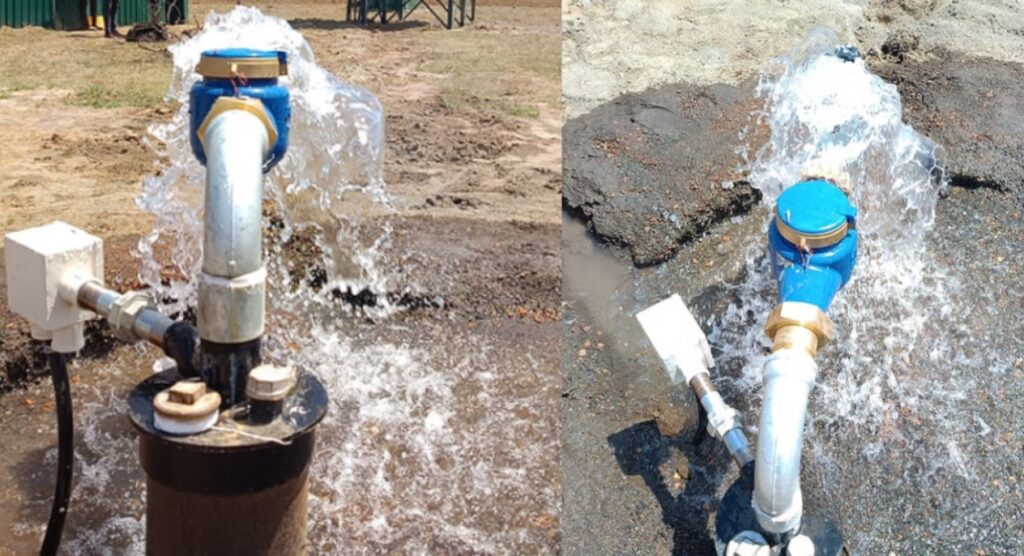
After construction, a borehole normally requires development.
Development helps remove drilling-related materials and improve the connection between the borehole and the surrounding water-bearing formation.
A properly developed borehole should be capable of producing water with acceptable clarity for the intended application, subject to the characteristics of the groundwater itself.
Development can involve suitable pumping, airlifting, surging, or other appropriate methods depending on the borehole construction and geological conditions.
Why Borehole Development Matters
A poorly developed borehole may experience:
-
Excessive sand
-
Cloudy water
-
Reduced yield
-
Pump wear
-
Blocked components
-
Poor hydraulic performance
-
Difficult filtration
-
Reduced system efficiency
Development is therefore an important stage rather than an optional cosmetic procedure.
Borehole Pump Testing in Awendo
A borehole may contain water without necessarily being capable of supplying the required volume continuously.
Pump testing helps determine how the borehole behaves under pumping conditions.
Important parameters can include:
-
Static water level
-
Pumping water level
-
Drawdown
-
Recovery
-
Pumping rate
-
Sustainable yield
-
Aquifer response
The results help inform pump selection and system design.
Static Water Level
The static water level is the water level in the borehole when it is not being pumped and has had sufficient time to recover.
This measurement is important when determining pump installation requirements.
Dynamic Water Level
The dynamic or pumping water level is the water level while the borehole is being pumped.
The difference between static and pumping water levels represents drawdown.
Understanding drawdown helps determine how the borehole responds to pumping.
Borehole Yield
Yield refers to the amount of water that can be obtained from the borehole under specified pumping conditions.
A high instantaneous flow rate does not necessarily mean that the same rate can be sustained indefinitely.
The design should therefore consider sustainable performance rather than simply selecting the largest available pump.
Borehole Water Quality Testing
Finding water is only one part of a successful borehole project.
The water should be tested to determine whether it is suitable for its intended use.
Groundwater may contain naturally occurring minerals, dissolved substances, microorganisms, or other contaminants depending on local geology and environmental conditions.
Water quality should therefore be established through appropriate laboratory testing.
Potential parameters can include:
-
Physical characteristics
-
pH
-
Turbidity
-
Electrical conductivity
-
Total dissolved solids
-
Hardness
-
Iron
-
Manganese
-
Fluoride
-
Nitrates
-
Chlorides
-
Sulphates
-
Microbiological parameters
-
Other parameters appropriate to the intended use
The specific testing requirements depend on how the water will be used.
Drinking Water
Water that looks clear is not automatically safe to drink.
If a borehole is intended for drinking water, appropriate laboratory testing and, where necessary, treatment should be undertaken.
Treatment may include:
-
Sediment filtration
-
Activated carbon filtration
-
Iron removal
-
Manganese treatment
-
Water softening
-
Disinfection
-
UV treatment
-
Reverse osmosis
-
Other treatment technologies
The treatment system should be based on actual laboratory results rather than assumptions.
Borehole Pump Installation in Awendo
After testing the borehole performance, a suitable pump can be selected.
The pump must match the borehole and the complete water system.
Pump selection should consider:
-
Borehole yield
-
Static water level
-
Dynamic water level
-
Required flow
-
Pumping depth
-
Vertical lift
-
Pipe length
-
Pipe diameter
-
Pressure requirements
-
Storage tank height
-
Friction losses
-
Irrigation requirements
-
Daily water demand
-
Electrical supply
Choosing a pump solely by horsepower can result in poor performance.
A properly engineered pump should deliver the required water at the required operating conditions without unnecessarily stressing the borehole.
Submersible Pump Installation
Submersible pumps are commonly used for borehole water extraction because they are designed to operate below the water level.
A typical installation can include:
-
Submersible pump
-
Rising main
-
Pump cable
-
Suspension arrangement
-
Non-return valve where required
-
Control equipment
-
Protection devices
-
Water-level considerations
-
Surface connection
The pump installation should be carried out carefully to reduce the risk of mechanical, electrical, and hydraulic problems.
Solar Borehole Pumping in Awendo
Solar pumping can be an attractive solution for properties where grid electricity is unavailable, expensive, unreliable, or where the customer wants to reduce dependence on conventional electricity.
Pro-Logic Technologies can integrate borehole pumping with solar power where the site and water requirements are suitable.
A solar borehole pumping system can include:
-
Solar panels
-
Solar pump controller
-
Submersible solar pump
-
Mounting structures
-
DC or AC equipment depending on system design
-
Protection devices
-
Water-level protection
-
Storage tanks
-
Distribution system
-
Optional backup power
The objective is to use solar energy to pump water during suitable solar conditions and store the water for later use.
Solar Pump Sizing
Solar pumping should not be designed simply by asking how many panels are needed for a particular pump horsepower.
Proper sizing considers:
-
Required daily water volume
-
Borehole yield
-
Pumping depth
-
Static water level
-
Dynamic water level
-
Total dynamic head
-
Pipe losses
-
Required flow rate
-
Solar resource
-
Pump efficiency
-
Controller characteristics
-
Storage requirements
-
Seasonal conditions
-
Backup requirements
Oversizing or undersizing individual components can affect the performance and economics of the complete system.
Water Storage Systems
Water storage is often an important part of a borehole installation.
Instead of requiring the pump to operate every time water is needed, water can be pumped into storage tanks and then distributed as required.
Storage can help provide water during:
-
Night-time
-
Low-solar periods
-
Temporary pump shutdown
-
Power interruptions
-
High-demand periods
-
Maintenance periods
The required tank capacity depends on water demand, borehole yield, pumping schedule, available power, and the customer's operating requirements.
Strong Water Systems for Awendo Properties
A strong water system is not necessarily the system with the biggest pump or the largest solar array.
A properly designed system is one in which the components work together efficiently.
A complete water system may combine:
Borehole → Submersible Pump → Rising Main → Storage Tank → Filtration/Treatment → Booster Pump → Distribution Network
For irrigation, the system may continue toward:
Storage → Pumping → Mainline → Filtration → Irrigation Control → Drip or Sprinkler Network
The correct configuration depends on the property.
Borehole Water Systems for Homes in Awendo
Domestic boreholes can provide water for:
-
Kitchen use
-
Bathrooms
-
Laundry
-
Cleaning
-
Toilet flushing
-
Gardening
-
Car washing
-
General household activities
Domestic systems should be designed around actual household demand.
A small household does not necessarily require the same pumping capacity as a large residential compound.
Water storage can also help manage variations in daily demand.
Boreholes for Apartments
Apartment buildings can have substantially higher water demand than individual homes.
A complete apartment water system may require:
-
Borehole
-
Submersible pump
-
Large storage tanks
-
Booster pumps
-
Pressure control
-
Distribution pipework
-
Water treatment
-
Level controls
-
Backup power
-
Electrical protection
The system should be sized according to the number of occupants, expected consumption, storage requirements, peak demand, and available borehole yield.
Borehole Drilling for Schools
Schools require dependable water for many activities.
These can include:
-
Drinking
-
Handwashing
-
Toilets
-
Kitchens
-
Cleaning
-
Laundry
-
Gardening
-
Landscaping
-
Staff facilities
A borehole project for a school should consider both average consumption and peak demand.
Storage capacity is particularly important because water requirements can increase significantly during school hours.
Boreholes for Hotels and Lodges
Hotels require water for guests, kitchens, laundry, bathrooms, cleaning, landscaping, swimming pools where applicable, and other operations.
Water shortages can directly affect customer experience.
A properly planned borehole and storage system can provide an independent or supplementary source.
Treatment may be necessary depending on water quality and intended application.
Boreholes for Farms in Awendo
Agriculture is one of the major applications for groundwater systems.
A borehole can support:
-
Vegetable farming
-
Fruit production
-
Greenhouse farming
-
Nursery operations
-
Livestock
-
Poultry
-
Landscaping
-
Irrigation
-
Washing and farm operations
The irrigation system should be designed around crop requirements, soil conditions, water availability, and the pumping capacity of the borehole.
Borehole Irrigation Systems
A complete irrigation system may include:
-
Borehole
-
Pump
-
Storage tank
-
Mainline
-
Filters
-
Valves
-
Pressure regulation
-
Fertigation equipment where appropriate
-
Drip irrigation
-
Sprinklers
-
Automated controls
Drip irrigation can be useful for crops where water needs to be delivered directly to the root zone.
Sprinklers may be appropriate for other crops and landscaping applications.
The best irrigation method depends on the agricultural operation.
Greenhouse Water Systems
Greenhouse farming requires controlled water delivery.
A borehole can provide the water source, while storage and filtration can provide consistency for irrigation.
A greenhouse system can include:
-
Borehole
-
Solar or electric pump
-
Storage tank
-
Filtration
-
Pressure pump
-
Drip lines
-
Valves
-
Timers
-
Controllers
-
Fertigation
-
Moisture-based control
Automation can help reduce unnecessary water consumption and improve irrigation scheduling.
Livestock Water Systems
Livestock operations require reliable water for animals, cleaning, and other farm activities.
A borehole system can supply water to:
-
Cattle
-
Goats
-
Sheep
-
Poultry
-
Pigs
-
Dairy units
-
Other livestock operations
Storage tanks can help ensure that water remains available even when the pump is not operating.
Commercial Borehole Systems
Businesses may require water for:
-
Offices
-
Restaurants
-
Shops
-
Car washes
-
Workshops
-
Construction
-
Cleaning
-
Accommodation
-
Production
-
Landscaping
Commercial systems should be designed according to actual water demand and operating hours.
Boreholes for Construction Projects
Construction sites need water for several activities.
These may include:
-
Concrete work
-
Block production
-
Dust suppression
-
Worker sanitation
-
Cleaning
-
General construction operations
A temporary or permanent borehole system can be considered where a suitable groundwater source is available.
Planning should account for the eventual use of the property so that infrastructure can be reused where practical.
Borehole Electrical Systems
Borehole pumps require suitable electrical systems.
An electrical installation may include:
-
Pump control panel
-
Circuit protection
-
Overload protection
-
Surge protection
-
Earthing
-
Isolation
-
Level controls
-
Dry-run protection
-
Motor protection
-
Solar controller where applicable
Electrical protection is important because borehole pumps operate in demanding conditions and replacement can be costly.
Dry-Run Protection
A pump should not operate without sufficient water.
Dry running can damage some pump systems.
Water-level sensors, control systems, appropriate pump settings, and other protection measures can help reduce the risk.
Borehole Automation
Modern borehole systems can incorporate automation.
Automation may control:
-
Pump starting and stopping
-
Tank water levels
-
Borehole water levels
-
Booster pumps
-
Irrigation cycles
-
Solar pumping
-
Pressure
-
Alarms
-
Fault conditions
Automation can reduce manual intervention and provide better control of water resources.
Borehole Booster Pump Systems
In some properties, the borehole pump can fill a storage tank while a separate booster pump distributes water to buildings.
This arrangement can be useful where the building requires consistent pressure.
A booster system may supply:
-
Bathrooms
-
Kitchens
-
Apartments
-
Showers
-
Irrigation
-
Commercial equipment
-
Fire-related non-potable systems where appropriately designed
The booster pump should be sized according to required pressure and flow.
Water Filtration Systems in Awendo
Groundwater quality varies.
Some boreholes produce water with relatively low treatment requirements, while others may require specialized filtration.
Common treatment components can include:
Sediment Filters
These remove suspended particles and sediment.
Activated Carbon
Carbon filtration can help reduce certain tastes, odors, and organic compounds depending on the application.
Iron Removal
Some groundwater sources contain elevated iron, which may cause staining, metallic taste, or other problems.
Manganese Treatment
Manganese may also require specialized treatment where concentrations are elevated.
Water Softeners
Hard water can contribute to scale formation in plumbing and equipment.
Disinfection
Where microbiological contamination is present or where disinfection is required, suitable treatment should be considered.
Reverse Osmosis
Reverse osmosis can be used for applications requiring substantial reduction of dissolved substances.
Treatment should always be selected based on laboratory results.
Borehole Maintenance
A borehole system should be maintained after installation.
Maintenance can help identify problems before they develop into major failures.
Routine checks can include:
-
Pump performance
-
Water levels
-
Water flow
-
Electrical current
-
Control panel condition
-
Solar panel condition
-
Tank levels
-
Pipework
-
Valves
-
Filters
-
Water quality
-
Pressure
-
Leakage
-
Irrigation equipment
The appropriate maintenance frequency depends on the system.
Common Borehole Problems
Customers may eventually experience problems such as:
-
Reduced water flow
-
No water
-
Pump failure
-
Frequent pump tripping
-
Sand in water
-
Cloudy water
-
Low pressure
-
Tank not filling
-
Pump running continuously
-
Solar pump stopping
-
Controller faults
-
Electrical faults
-
Water-level problems
-
Blocked filters
-
Leaking pipes
-
Booster pump failure
-
Unusual pump noise
-
Changing water quality
The cause needs to be diagnosed before replacement components are selected.
Reduced Borehole Yield
A reduction in water production can have several possible causes.
These may include:
-
Changes in groundwater conditions
-
Borehole clogging
-
Pump wear
-
Screen problems
-
Sediment
-
Excessive drawdown
-
Pump installation issues
-
Electrical problems
-
Changes in aquifer conditions
A systematic diagnosis is preferable to immediately replacing the pump.
Pump Failure
A failed borehole pump can result from several factors.
Potential causes include:
-
Electrical faults
-
Voltage problems
-
Motor failure
-
Pump wear
-
Sand abrasion
-
Dry running
-
Cable damage
-
Control-panel problems
-
Mechanical failure
The correct repair depends on the actual fault.
Borehole Sand Problems
Sand entering the water system can be caused by several factors, including borehole construction, geological conditions, screen selection, development, or pumping conditions.
Excessive sand can damage pumps and filtration equipment.
If sand production increases, the borehole should be assessed rather than simply continuing to operate the system.
Borehole Water Quality Problems
Changes in water quality can result from natural groundwater variations, contamination pathways, borehole construction issues, changes in pumping conditions, or other factors.
Where water quality changes unexpectedly, laboratory testing can help identify the problem.
Borehole Rehabilitation
Older boreholes may sometimes require rehabilitation.
Depending on the problem, rehabilitation can involve:
-
Cleaning
-
Redevelopment
-
Pump assessment
-
Camera inspection where appropriate
-
Screen cleaning
-
Sediment removal
-
Pump replacement
-
Water-quality assessment
The appropriate approach depends on the condition of the borehole.
Why Professional Borehole Drilling Matters
Borehole drilling is a technical project.
Poor planning can lead to unnecessary costs, poor water production, contamination risks, equipment failures, and difficult maintenance.
Professional planning helps coordinate:
-
Groundwater investigation
-
Drilling
-
Borehole construction
-
Pumping
-
Electrical systems
-
Solar systems
-
Water storage
-
Filtration
-
Distribution
-
Irrigation
-
Maintenance
This integrated approach is particularly useful when the customer wants a complete water solution rather than drilling alone.
Borehole Drilling for Residential Estates
Residential developments can have significant water requirements.
A borehole may supply a shared storage and distribution system.
The design can incorporate:
-
Central storage
-
Booster pumps
-
Water meters
-
Pressure zones
-
Automated pumping
-
Filtration
-
Solar backup
-
Grid backup
The final design depends on the development's size and water demand.
Borehole Systems for Institutions
Institutions can include:
-
Schools
-
Churches
-
Community organizations
-
Health facilities
-
Training centers
-
Government facilities
-
Private institutions
Reliable water is essential for sanitation and daily operations.
Institutional systems should consider peak demand and emergency storage requirements.
Borehole Drilling and Solar Energy
Combining borehole water systems with solar energy can create an efficient water supply arrangement.
During daylight hours, solar energy can power the borehole pump, while water is stored in tanks.
The stored water can then be used after solar production decreases.
This approach can reduce reliance on batteries because the water itself becomes the stored resource.
Solar Pumping Without Large Battery Banks
One advantage of many solar pumping applications is that water storage can replace some of the energy-storage function normally provided by batteries.
Instead of storing large quantities of electrical energy, the system can use solar power to pump water into a tank.
The tank then provides water when required.
The practicality of this approach depends on the pumping schedule and daily water demand.
Hybrid Borehole Systems
Some customers prefer systems that combine several energy sources.
A hybrid arrangement may include:
-
Solar
-
Grid electricity
-
Generator
-
Backup controls
-
Water storage
This can provide greater operational flexibility where uninterrupted water availability is important.
Borehole Cost in Awendo
The cost of drilling and developing a borehole varies significantly from project to project.
There is no responsible single price that can be applied to every property.
Cost can be affected by:
-
Drilling depth
-
Geological conditions
-
Borehole diameter
-
Casing requirements
-
Screen requirements
-
Drilling method
-
Site accessibility
-
Mobilization
-
Borehole development
-
Pump testing
-
Water-quality testing
-
Pump specifications
-
Rising-main length
-
Storage capacity
-
Solar requirements
-
Filtration
-
Booster pumping
-
Distribution pipework
-
Irrigation requirements
-
Automation
-
Electrical works
A proper quotation should therefore be based on the actual project.
What Determines Borehole Drilling Cost?
Depth
Deeper drilling generally requires more drilling time and materials.
Ground Conditions
Hard rock and difficult formations can affect drilling rates and equipment requirements.
Casing
The amount and type of casing required influence the project cost.
Pump
Pump capacity and installation depth affect equipment selection.
Solar System
A solar pumping system introduces additional components such as panels, controller, mounting structures, protection, and electrical equipment.
Water Treatment
Specialized filtration can add significant cost depending on laboratory results.
Storage
Large tanks and supporting structures increase the scope of the project.
Distribution
Long pipe runs, high-pressure requirements, and multiple buildings can require additional infrastructure.
Requesting a Borehole Assessment in Awendo
Before committing to drilling, property owners can discuss their requirements with Pro-Logic Technologies.
Useful information includes:
-
Location of the property
-
Intended use
-
Estimated water demand
-
Property size
-
Accessibility
-
Existing water source
-
Existing storage
-
Available electricity
-
Interest in solar pumping
-
Irrigation requirements
-
Number of buildings
-
Number of occupants or users
This information helps establish the scope of the project.
Borehole Drilling Areas Around Awendo
Pro-Logic Technologies can serve customers looking for borehole and water-system solutions in Awendo and surrounding parts of Migori County, subject to site assessment and project logistics.
Services can support:
-
Awendo town
-
Residential properties
-
Agricultural areas
-
Commercial properties
-
Schools
-
Institutions
-
Farms
-
Developing residential areas
-
Industrial and commercial projects
For properties farther from Awendo, service availability and mobilization can be discussed during project planning.
Borehole Drilling for Farmers in Awendo
Farmers need water systems that match agricultural production.
A borehole that produces sufficient water for domestic use may not automatically produce enough water for large-scale irrigation.
Irrigation projects should therefore start with an understanding of:
-
Borehole yield
-
Crop requirements
-
Irrigated acreage
-
Irrigation method
-
Daily pumping hours
-
Storage capacity
-
Seasonal demand
-
Available solar energy
This prevents designing an irrigation system that demands more water than the borehole can sustainably supply.
Drip Irrigation Borehole Systems
Drip irrigation can provide controlled water delivery directly to crops.
A typical system may include:
Borehole → Pump → Storage → Filter → Pressure Pump → Mainline → Drip Lines.
The system can be automated using timers, controllers, valves, or other control technologies.
Sprinkler Irrigation
Sprinkler systems can be suitable for particular crops, lawns, nurseries, and other applications.
Sprinkler selection should consider:
-
Required flow
-
Operating pressure
-
Coverage area
-
Pipe sizing
-
Pump capacity
-
Water availability
The borehole must be capable of supplying the irrigation system without excessive drawdown.
Borehole Water for Sugarcane and Other Agricultural Activities
The Awendo area is associated with agricultural activity, making reliable water valuable for farming operations.
However, irrigation planning should be based on the specific crop, soil, acreage, climate, and available groundwater.
A borehole can be part of the water infrastructure, but its sustainable yield must be respected.
Borehole Water for Dairy Farming
Dairy farms require dependable water for animals, cleaning, milking facilities, and general farm operations.
A complete system can include storage and automatic level control to maintain supply.
Where solar energy is used, water can be pumped during daylight and stored for use throughout the day and night.
Borehole Water for Poultry Farms
Poultry operations require water for birds, cleaning, sanitation, and equipment.
Reliable storage is particularly useful because water interruptions can affect farm operations.
Automated tank controls can help maintain supply.
Borehole Water for Car Washes
Car washes can have high water demand.
A borehole can provide an independent source where water quality and regulatory requirements are suitable for the application.
Water storage and pressure systems may be necessary to maintain consistent operations.
Water recycling can also be considered where appropriate to reduce consumption.
Borehole Water for Hotels
Hotels may require large quantities of water throughout the day.
A complete hotel water system can include:
-
Borehole
-
Pump
-
Storage
-
Booster pumping
-
Filtration
-
Water treatment
-
Solar backup
-
Automated controls
The system should be designed around occupancy and peak demand.
Borehole Water for Schools in Awendo
Schools can benefit from reliable water for sanitation, kitchens, gardens, and general use.
A properly designed storage system can help ensure that water remains available even during periods when the pump is not operating.
Borehole Water for Churches and Institutions
Churches and institutions may require water primarily during specific periods, making storage and pumping schedules important.
A properly sized borehole system can supply sanitation facilities, cleaning, landscaping, and other uses.
Borehole Drilling and Water Security
Water security means having a reliable and sustainable source that can meet the property's needs.
A borehole can improve water security, but the groundwater resource should be used responsibly.
Pumping should be matched to the borehole's performance.
Over-pumping can result in excessive drawdown and may negatively affect long-term performance.
Borehole System Design
A successful borehole project requires several systems to work together.
Water Source
The borehole provides access to groundwater.
Pumping System
The pump transfers water from the borehole.
Energy System
Solar, grid, generator, or hybrid power provides the energy required for pumping.
Storage System
Tanks store water for later use.
Treatment System
Filtration and treatment prepare water for its intended use where required.
Distribution System
Pipes and pumps deliver water to points of use.
Control System
Sensors and controllers manage operation.
This integrated approach creates a complete water infrastructure system.
Borehole Safety
Borehole projects involve heavy machinery, electrical systems, pressurized water, excavation, and other hazards.
Safety should therefore be considered throughout the project.
Electrical installations should include appropriate protection and earthing.
Drilling areas should be managed to keep unauthorized people away from machinery and open work areas.
The finished borehole should also be securely protected.
Borehole Headworks
The top of the borehole should be protected from contamination and physical damage.
Proper headworks can include:
-
Secure cover
-
Appropriate sanitary protection
-
Pump connections
-
Electrical protection
-
Drainage considerations
-
Access for maintenance
The exact construction depends on the borehole design.
Protecting Boreholes from Contamination
A borehole should be located and constructed with contamination risks in mind.
Potential sources of contamination can include:
-
Septic systems
-
Waste disposal areas
-
Chemical storage
-
Fuel storage
-
Agricultural chemicals
-
Drainage
-
Flooding
The actual requirements depend on site conditions and applicable regulations.
Borehole Regulatory Considerations in Kenya
Borehole development in Kenya can involve regulatory and environmental requirements.
Property owners should establish the applicable approvals, permits, water-resource requirements, and local requirements before drilling.
The requirements can depend on the location, intended use, borehole characteristics, and applicable authorities.
Pro-Logic Technologies can help customers understand the technical scope of their borehole project and the documentation or professional processes that may be required.
Why Customers Need Proper Borehole Planning
A borehole is a long-term infrastructure investment.
Planning the complete system before drilling helps avoid situations where:
-
The pump is too large
-
The pump is too small
-
Storage is insufficient
-
Solar capacity is inadequate
-
Pipework is undersized
-
Filtration is inappropriate
-
Water treatment is overlooked
-
Electrical protection is inadequate
The best results come from considering the complete system from the beginning.
Borehole Consultation in Awendo
Customers considering drilling can begin with a consultation.
The discussion can establish:
-
What the water will be used for
-
How much water is required
-
Whether solar pumping is desired
-
Whether irrigation is planned
-
Whether treatment is needed
-
How far the water must travel
-
Where tanks will be installed
-
Whether booster pumping is required
The project can then be developed around those requirements.
Borehole Drilling for Rural Properties
Many rural properties need independent water supplies.
A borehole can support:
-
Homes
-
Farms
-
Livestock
-
Gardens
-
Greenhouses
-
Rural businesses
-
Community facilities
Solar pumping can be particularly useful where grid electricity is unavailable.
Borehole Drilling for Peri-Urban Properties
As settlements grow, demand for reliable water increases.
Peri-urban properties may combine residential, commercial, and agricultural activities.
A flexible borehole system can be designed to support current requirements while allowing for future expansion where practical.
Future Expansion
A water system should ideally consider future needs.
For example, a property may initially require water for one house but later add:
-
Additional houses
-
Rental units
-
Greenhouses
-
Livestock facilities
-
Shops
-
Guest accommodation
Planning the system with future expansion in mind can reduce the need for major reconstruction later.
Borehole Pump Troubleshooting
When a borehole stops supplying water, several possible causes need to be considered.
The problem may be:
-
Pump-related
-
Electrical
-
Control-related
-
Hydraulic
-
Water-level-related
-
Pipe-related
-
Storage-related
A systematic assessment is important.
Replacing a pump without determining why it failed can result in another failure.
Solar Borehole Pump Troubleshooting
Solar pumping systems can experience:
-
Low solar production
-
Controller faults
-
Electrical connection problems
-
Pump faults
-
Cable issues
-
Water-level protection activation
-
Incorrect settings
-
Panel problems
-
Insufficient pumping head
-
Hydraulic restrictions
The complete system should be checked rather than assuming the solar panels are the problem.
Water Tank Troubleshooting
A tank that does not fill may be affected by:
-
Pump problems
-
Low borehole yield
-
Float-valve problems
-
Level sensor faults
-
Pipe leaks
-
Blockages
-
Control problems
-
Insufficient solar power
Diagnosis should begin at the water source and follow the system toward the tank.
Borehole Pumping Efficiency
Efficiency matters because pumping water consumes energy.
A properly designed system can reduce unnecessary energy use by matching:
-
Pump
-
Pipework
-
Water demand
-
Storage
-
Solar generation
-
Operating schedule
A pump that is excessively large may consume more energy and cause excessive drawdown.
Solar Water Pumping for Irrigation
Solar irrigation can be particularly useful for farms because irrigation demand often occurs during daylight hours when solar energy is available.
A typical arrangement can pump water into a tank or directly into an irrigation system depending on the design.
Storage provides additional flexibility.
Automated Irrigation
Automation can control irrigation according to:
-
Time
-
Tank level
-
Soil moisture
-
Weather information
-
Crop requirements
-
Water availability
Automation can reduce manual operation and help improve consistency.
Borehole System Upgrades
Existing borehole owners may not need a completely new borehole.
Possible upgrades include:
-
Pump replacement
-
Solar conversion
-
Larger storage
-
Booster pump installation
-
Filtration
-
Automation
-
Electrical protection
-
Irrigation
-
Pipework improvements
The appropriate upgrade depends on the existing system.
Converting an Electric Borehole to Solar
Where an existing borehole is suitable, the pumping system may be adapted to solar.
The existing borehole performance should first be established.
A solar system should then be designed according to the pump and water demand.
It is not always necessary to replace every component.
Borehole Pump Replacement
Pump replacement may be required when:
-
The pump has failed
-
Flow has reduced
-
Energy consumption has increased
-
Mechanical wear has occurred
-
The existing pump no longer meets demand
-
The borehole has changed performance
The replacement pump should be selected from current borehole information rather than simply duplicating the old pump.
Borehole Water Storage in Awendo
Storage can range from relatively small domestic tanks to large commercial and agricultural reservoirs.
The appropriate capacity depends on:
-
Daily consumption
-
Pumping rate
-
Pumping hours
-
Borehole yield
-
Solar availability
-
Peak demand
-
Required reserve
A larger tank is not automatically better if the borehole cannot fill it efficiently.
Borehole Distribution Systems
Once water reaches storage, it must be distributed.
Distribution systems may use:
-
Gravity
-
Booster pumps
-
Pressure tanks
-
Direct pumping
The best arrangement depends on building height, pipe length, pressure requirements, and usage points.
Borehole Pressure Systems
Properties with multiple bathrooms or elevated buildings may require pressure boosting.
Pressure systems can include:
-
Booster pump
-
Pressure controller
-
Pressure tank
-
Check valve
-
Isolation valves
-
Pressure gauges
Correct sizing improves reliability.
Borehole Services for Businesses in Awendo
Businesses cannot always afford prolonged water interruptions.
A borehole can provide an independent or supplementary water source.
Potential users include:
-
Restaurants
-
Hotels
-
Shops
-
Workshops
-
Offices
-
Car washes
-
Farms
-
Processing facilities
-
Commercial buildings
The system should be designed around the business's operating requirements.
Borehole Services for Property Developers
Developers can integrate boreholes into new projects.
Planning during construction allows for:
-
Pump rooms
-
Tank bases
-
Pipe routes
-
Electrical systems
-
Solar structures
-
Treatment systems
-
Irrigation
-
Building distribution
Early planning can reduce later modifications.
Borehole Systems for Rental Properties
Landlords can use boreholes to provide water to rental units where appropriate.
The system may include:
-
Borehole
-
Storage
-
Booster pump
-
Distribution
-
Individual meters
-
Automated controls
The design should consider the number of units and expected occupancy.
Borehole Water Meters
Water metering can help property managers understand consumption.
Meters can be useful in:
-
Apartments
-
Commercial buildings
-
Rental compounds
-
Institutions
-
Farms
Monitoring consumption can help identify leaks and unusual water use.
Leak Detection
Water leaks can waste large quantities of pumped water.
Signs may include:
-
Unexpected pump operation
-
Tank draining quickly
-
Reduced pressure
-
Wet areas
-
Higher electricity consumption
-
Continuous booster operation
Regular inspection can help identify leaks.
Borehole System Documentation
Customers should keep records of their borehole.
Useful records include:
-
Borehole depth
-
Construction details
-
Casing information
-
Screen intervals
-
Pump model
-
Pump installation depth
-
Test-pumping results
-
Water-quality results
-
Electrical specifications
-
Maintenance history
Good records make future maintenance easier.
Long-Term Borehole Management
A borehole should be treated as a long-term asset.
Regular monitoring can help identify changes in:
-
Water levels
-
Yield
-
Water quality
-
Pump energy consumption
-
Pressure
-
Sand production
Early identification of changes can support timely intervention.
Borehole Drilling and Environmental Responsibility
Groundwater should be used responsibly.
A borehole should not be pumped continuously at a rate that exceeds its sustainable performance.
Water conservation can also be incorporated through:
-
Efficient irrigation
-
Leak prevention
-
Controlled pumping
-
Storage
-
Reuse where appropriate
-
Water-efficient fixtures
Choosing a Borehole Drilling Company in Awendo
When selecting a borehole contractor, customers should consider more than drilling price.
Important questions include:
-
Is the project properly assessed?
-
Is the borehole tested?
-
Is the pump appropriately selected?
-
Is water quality considered?
-
Can the contractor integrate solar?
-
Can they provide storage?
-
Can they install filtration?
-
Can they troubleshoot the system later?
-
Are construction and electrical works properly coordinated?
A complete technical solution can be more valuable than a low initial drilling price.
Why Choose Pro-Logic Technologies?
Pro-Logic Technologies provides technical solutions that can bring multiple components of a water project together.
Instead of treating the borehole as an isolated installation, we can consider the wider system, including:
-
Borehole drilling
-
Pumping
-
Solar energy
-
Electrical systems
-
Water storage
-
Filtration
-
Booster pumping
-
Irrigation
-
Automation
-
Maintenance
This integrated approach can be particularly useful for customers who want one coordinated technical solution.
Borehole Drilling and Solar Solutions
Our services can combine groundwater development with renewable energy.
A complete project can potentially include:
Hydrogeological Assessment
↓
Borehole Drilling
↓
Casing and Construction
↓
Development
↓
Pumping Test
↓
Water Quality Testing
↓
Pump Selection
↓
Solar Pumping System
↓
Storage Tank
↓
Filtration/Treatment
↓
Booster Pump
↓
Distribution
↓
Irrigation or Domestic Supply
The actual configuration depends on the site and intended use.
Borehole Project Planning
A well-planned project starts with the customer's objective.
For example:
A homeowner may say, “I need enough water for my family and garden.”
A farmer may say, “I need water for irrigation.”
A school may say, “We need reliable water for students and sanitation.”
A hotel may say, “We need a dependable backup to the existing water supply.”
Each requirement results in a different system design.
Borehole Water for Domestic and Commercial Use
A properly planned borehole can support both domestic and commercial activities where the borehole yield and water quality are appropriate.
Where multiple uses are involved, the design should separate or prioritize water demands where necessary.
For example, drinking water may require more advanced treatment than irrigation water.
Water Treatment Should Follow Testing
One of the most important principles in borehole water projects is avoiding unnecessary assumptions.
Do not install a complex treatment system simply because the water comes from a borehole.
Instead:
-
Obtain a representative water sample.
-
Conduct appropriate laboratory testing.
-
Review the results.
-
Identify the parameters requiring treatment.
-
Select appropriate treatment equipment.
-
Install and commission the system.
-
Monitor water quality.
This approach avoids both under-treatment and unnecessary equipment.
Borehole Pumping and Water Levels
Water levels should be considered when selecting pump depth.
Installing a pump too high can cause inadequate submergence.
Installing equipment without considering dynamic water levels can contribute to operational problems.
Pump placement should therefore consider the pumping test and borehole construction information.
Borehole Rehabilitation in Awendo
If an existing borehole has deteriorated, drilling a new borehole is not always the first option.
Depending on its condition, rehabilitation may be possible.
Assessment can determine whether the issue is related to:
-
Pump failure
-
Clogging
-
Sand
-
Electrical faults
-
Reduced aquifer performance
-
Borehole construction
-
Water quality
A rehabilitation strategy can then be considered.
Borehole Inspection
Where necessary, borehole inspection technologies can help investigate internal conditions.
A borehole camera may sometimes provide information about:
-
Casing condition
-
Obstructions
-
Sediment
-
Screen condition
-
Structural problems
Such inspection is useful in selected troubleshooting and rehabilitation cases.
Borehole Maintenance Agreements
Businesses and institutions with critical water requirements may benefit from planned maintenance.
Maintenance can include periodic:
-
Pump checks
-
Electrical inspections
-
Tank inspections
-
Filter servicing
-
Pressure checks
-
Water-quality testing
-
Solar-system inspection
The frequency should be based on usage and system characteristics.
Borehole Drilling Service for Awendo Customers
Whether the requirement is a domestic borehole, farm water system, institutional installation, or commercial water project, Pro-Logic Technologies can help develop the technical scope.
The first step is to understand the property and the intended water use.
From there, the project can be planned around:
-
Groundwater conditions
-
Required water volume
-
Pumping requirements
-
Energy source
-
Storage
-
Treatment
-
Distribution
Questions to Ask Before Drilling a Borehole
Property owners should ask:
How much water do I need?
Water demand determines much of the downstream system design.
What is the expected groundwater potential?
A hydrogeological investigation can provide useful information, but groundwater outcomes cannot be guaranteed.
What depth will the borehole reach?
Depth depends on geological conditions and drilling results.
What pump will be required?
Pump selection should follow borehole testing and system design.
Should I use solar?
Solar can be considered where conditions and economics are suitable.
How large should the storage tank be?
Tank capacity should match demand, borehole production, pumping schedule, and energy availability.
Does the water need treatment?
Water quality testing should determine this.
Can the borehole support irrigation?
This depends on sustainable yield and irrigation demand.
Frequently Asked Questions About Borehole Drilling in Awendo
How deep should a borehole be in Awendo?
There is no single standard depth for every property. Geological conditions vary, so the appropriate depth must be determined through investigation and observations during drilling.
Does a borehole guarantee water?
No. A survey can improve the basis for selecting a drilling site, but groundwater exploration always involves uncertainty.
How much water can a borehole produce?
Yield varies from site to site and must be established through appropriate testing.
Can a borehole supply a whole farm?
It depends on the borehole yield and farm water requirements. Irrigation demand should be compared with sustainable borehole production.
Can a borehole be powered by solar?
Yes, solar pumping can be suitable for many borehole applications.
Do I need a water tank?
Storage is often beneficial, particularly for solar systems and properties with fluctuating demand.
Is borehole water safe to drink?
Not automatically. Drinking-water suitability should be established through appropriate laboratory testing and treatment where necessary.
Can an old borehole be repaired?
Some old boreholes can be rehabilitated depending on their condition.
Can you install the pump after drilling?
Yes. Pump selection should ideally follow borehole construction and pumping-test information.
Can you install filtration?
Yes, where filtration or treatment is required, the equipment should be selected based on water-quality results.
Can borehole water be used for irrigation?
Yes, provided the borehole produces sufficient water and the water quality is appropriate for the intended agricultural use.
Can solar pump water into a tank?
Yes. Solar pumping commonly uses daylight energy to pump water into storage.
Can the system work without batteries?
Many solar pumping systems can operate without large battery banks by pumping water into storage during available solar hours.
What happens if there is no sun?
Storage, grid power, generator backup, or another suitable backup arrangement can be incorporated depending on the customer's requirements.
Can the borehole supply apartments?
Yes, where the borehole yield is sufficient and the pumping, storage, pressure, and distribution systems are properly designed.
Can the system be automated?
Yes. Level sensors, controllers, pressure controls, timers, and other automation technologies can be incorporated.
Professional Borehole Drilling in Awendo
A borehole is a long-term investment in water infrastructure.
The quality of the final system depends on the decisions made at every stage, including site selection, drilling, borehole construction, development, testing, pump selection, electrical protection, storage, filtration, and distribution.
Pro-Logic Technologies focuses on developing complete technical solutions for customers in Awendo and surrounding areas.
Whether you need water for a home, farm, greenhouse, school, hotel, rental property, commercial building, institution, or other development, the system should be designed around the actual requirements of the site.
Your Awendo Borehole Project
A successful project can follow a structured process:
1. Consultation
We discuss your property and intended water use.
2. Site Assessment
The proposed drilling area is reviewed.
3. Hydrogeological Investigation
Available groundwater information and appropriate investigation methods are considered.
4. Drilling
The borehole is drilled according to the project requirements and ground conditions.
5. Borehole Construction
Casing, screens, gravel pack, and other components are installed as required.
6. Development
The borehole is developed to improve its hydraulic performance and remove drilling-related materials.
7. Testing
Pumping performance and water levels are assessed.
8. Water Quality
Laboratory testing is used to determine the quality and treatment requirements.
9. Pump Installation
A pump is selected and installed based on the borehole and water-system requirements.
10. Solar Integration
Where required, a solar pumping system can be designed and installed.
11. Storage
Water tanks are installed according to demand.
12. Treatment
Filtration and treatment are installed where required.
13. Distribution
Water is delivered to homes, buildings, irrigation systems, livestock areas, or other points of use.
14. Automation
Controls can be added to improve system operation.
15. Maintenance
The system can be maintained and serviced over its operating life.
Contact Pro-Logic Technologies
If you are planning borehole drilling in Awendo, Pro-Logic Technologies can help you assess the requirements of your project and develop a suitable borehole and water-system solution.
Our technical services can cover borehole drilling, pumping systems, solar borehole pumping, water storage, filtration, booster pumping, electrical systems, irrigation, automation, and related technical installations.
For enquiries and project planning:
Pro-Logic Technologies
Phone: 0723 763 173
Contact us to discuss your Awendo property, water requirements, borehole project, solar pumping needs, irrigation system, or complete water-supply installation.
A reliable water system starts with proper planning, accurate assessment, suitable equipment, and professional installation.