
Reliable Groundwater Solutions in Njoro, Nakuru – Borehole Drilling, Pumping & Water Systems
Water availability (contact us on 0723763173) can determine whether a residential development, farm, school, hospitality facility, industrial property or commercial project operates efficiently. In Njoro and surrounding parts of Nakuru County, groundwater can provide an important alternative or supplementary source of water when properly investigated, drilled, developed and equipped.
A borehole, however, is not simply a hole drilled into the ground. It is an engineered groundwater project that requires geological assessment, careful positioning, appropriate drilling techniques, proper borehole construction, development, pumping tests, laboratory water analysis and suitable pumping equipment.
For property owners considering groundwater development in Njoro, the objective should therefore be more than reaching water. The objective is to establish a productive, structurally sound and properly equipped water source that can serve the intended purpose for many years.
Groundwater Development in Njoro
Njoro is an important agricultural and residential area within Nakuru County. The region contains farms, homes, schools, institutions, businesses and other developments whose water requirements can differ considerably.
A small household may require a completely different borehole system from a large farm. A school may need significant daily storage and reliable pumping, while a commercial property may require a carefully calculated combination of borehole production, storage and distribution.
This is why borehole projects should be designed around the property rather than copied from another location.
A nearby borehole can provide useful information, but it should not automatically be used as proof that another property will encounter identical groundwater conditions. Subsurface formations can change over relatively short distances.
The drilling decision should therefore be supported by professional groundwater assessment.
What Makes a Good Borehole Project?
A successful borehole project combines several stages.
The first is investigation.
The second is drilling.
The third is borehole construction.
The fourth is development and testing.
The fifth is water-quality assessment.
The sixth is pump and water-system installation.
Finally, the complete system needs proper commissioning and maintenance.
Leaving out one of these stages can create problems later.
For example, drilling without adequate investigation can increase the risk of selecting a poor location. Installing an incorrectly sized pump can result in inefficient operation or excessive drawdown. Ignoring water testing can leave users unaware of minerals, salts, bacteria or other characteristics that may require treatment.
A professional project considers the entire chain.
Borehole Siting Before Drilling
One of the most important decisions is where the borehole will be drilled.
The drilling location needs to be selected with consideration for groundwater conditions, property layout, accessibility and the eventual use of the water.
A hydrogeological assessment can help establish the most promising drilling location.
Depending on the site, the assessment may consider:
- Geological formations
- Groundwater occurrence
- Fractures and geological structures
- Terrain
- Drainage patterns
- Existing boreholes
- Nearby water sources
- Potential contamination risks
- Property boundaries
- Accessibility for drilling equipment
- Intended water demand
The survey is therefore not merely an administrative step. It provides technical information for making the drilling decision.
Why Borehole Location Matters
A drilling rig can only work at the location selected for the borehole.
Once drilling begins, changing the position after significant depth has been reached can become expensive.
The ideal location should therefore be determined before mobilisation.
Property owners should also think about what happens after drilling.
Where will the pump be installed?
Where will the water tank stand?
Where will the pipeline run?
Will a solar array be required?
Will water need to be transported uphill?
Could agricultural chemicals, septic systems or waste-disposal areas pose contamination concerns?
These questions should be considered during planning rather than after construction.
Borehole Drilling in Njoro
Once the drilling location has been selected, the drilling contractor mobilises suitable equipment to the property.
The drilling method and equipment depend on geological conditions, expected depth, site accessibility and project requirements.
Drilling progresses through different formations beneath the surface.
During the operation, the drilling team observes the formations encountered and records relevant drilling information.
The resulting borehole needs to be constructed appropriately for the geological conditions.
A properly constructed borehole generally involves more than creating an open hole.
It may require:
- Casing
- Screens
- Gravel packing
- Sanitary sealing
- Borehole development
- Wellhead protection
- Pump installation
The exact construction specification should be determined according to the site conditions and applicable technical requirements.
Understanding Borehole Depth
One of the questions customers frequently ask is:
“How deep will the borehole be?”
There is no universally correct answer.
A borehole in one part of Njoro may encounter productive groundwater at a different depth from another property.
Depth can be influenced by:
- Local geology
- Geological structures
- Ground elevation
- Aquifer characteristics
- Existing groundwater information
- Drilling results
- Water-bearing formations
For this reason, companies that promise an identical depth for every property should be approached carefully.
Depth should be established from professional assessment and actual drilling conditions.
Deep Does Not Always Mean Better
A deeper borehole is not automatically a better borehole.
The objective is to access a suitable groundwater source capable of meeting the required demand with an economically viable pumping system.
Going deeper simply because a neighbouring borehole is deep can result in unnecessary expenditure.
The technical objective is productive groundwater development, not maximum depth.
Borehole Construction
After drilling reaches the planned formation, the borehole must be constructed.
The construction materials and design are important because the borehole has to remain structurally stable while allowing groundwater to enter efficiently.
Casing
Casing provides structural support to sections of the borehole and helps prevent collapse.
The type and diameter depend on the project specification and geological conditions.
Screens
Screen sections allow groundwater to enter the borehole while helping retain surrounding formation material.
Screen positioning should correspond to identified water-bearing formations.
Gravel Pack
A properly designed gravel pack can help support the screened section and reduce the entry of formation material.
Sanitary Seal
The upper part of the borehole requires protection against surface contamination.
A suitable sanitary sealing arrangement helps prevent unwanted materials from entering the borehole along the outside of the casing.
Developing the Newly Drilled Borehole
Drilling leaves behind cuttings, fine particles and other materials.
The borehole therefore needs to be developed before normal operation.
Development is intended to improve the connection between the borehole and surrounding water-bearing formation while removing drilling residues.
Depending on the borehole design, development can involve appropriate pumping, surging, airlifting or other approved techniques.
The objective is to obtain a cleaner and more productive borehole.
A borehole that has not been adequately developed may produce excessive sand or sediment and may not demonstrate its true production characteristics.
Borehole Yield
Borehole yield refers to the rate at which water can be produced under defined pumping conditions.
This is one of the most important technical parameters for pump selection.
A customer may say:
“I need a powerful pump.”
That is not enough information to choose the correct pump.
The pump needs to correspond to the borehole's tested performance and the hydraulic requirements of the water system.
For example, a farm requiring irrigation water may have different requirements from a household using water for domestic purposes.
The appropriate design therefore considers both:
How much water the borehole can produce
and
How much water the property needs.
Those two figures should not be confused.
Test Pumping
Test pumping provides valuable information about how the borehole behaves when water is extracted.
A pumping test can help determine parameters such as:
- Pumping rate
- Static water level
- Pumping water level
- Drawdown
- Recovery
- Sustainable operating conditions
The results can then assist in selecting the pumping equipment.
Test pumping is especially important for larger projects because an incorrectly assumed yield can affect the entire water-system design.
Water Quality Testing in Njoro
Finding groundwater does not automatically mean that the water is suitable for every purpose.
Groundwater chemistry varies between locations.
Water should therefore be tested before being used for drinking or other applications where quality matters.
Laboratory analysis can examine characteristics such as:
- pH
- Electrical conductivity
- Total dissolved solids
- Turbidity
- Hardness
- Major ions
- Iron
- Fluoride
- Nitrates
- Microbiological parameters
The appropriate test panel depends on the intended use and applicable requirements.
If the laboratory results identify a water-quality issue, treatment can then be considered.
Borehole Water Treatment
Not every borehole requires the same treatment system.
Water treatment should be based on laboratory results rather than assumptions.
Depending on the test results, a system might require:
Sediment filtration
Useful where suspended particles need to be reduced.
Activated carbon
Can be considered for certain taste, odour and organic-compound concerns.
Iron removal
Where iron concentrations are elevated, appropriate treatment can be incorporated.
Fluoride reduction
Where fluoride exceeds the applicable drinking-water limit, specialised treatment may be required.
Water softening
Where hardness is problematic for the intended application, a suitable softening system may be considered.
Disinfection
Microbiological contamination may require appropriate disinfection.
The important principle is simple:
Test first. Treat according to the results.
Borehole Pumps for Njoro Properties
Once the borehole has been tested, the next major component is the pump.
Most modern boreholes use a submersible pump installed below the water level.
Pump selection should take into account:
- Borehole depth
- Water level
- Tested yield
- Required flow
- Vertical lift
- Pipe length
- Pipe diameter
- Storage tank height
- Friction losses
- Daily consumption
- Power availability
The pump should not be selected merely by looking at horsepower.
A larger motor is not necessarily the best solution.
An oversized pump can draw water faster than the borehole should be pumped, potentially causing excessive drawdown and operational problems.
Solar Borehole Pumping
Solar pumping has become an attractive option for properties that need water in locations where grid electricity is unavailable, unreliable or expensive.
A solar borehole system can include:
- Solar panels
- Mounting structure
- Solar pump
- Pump controller
- Protection equipment
- Borehole cable
- Water-level controls
- Storage tank
- Elevated tower
- Distribution pipeline
The advantage of storing water in a tank is that the system does not necessarily need to pump water at the exact moment it is being consumed.
Solar energy can pump during suitable daylight conditions while stored water serves users later.
This can make the system more practical for farms, rural homes, schools and other properties.
Designing a Solar Borehole System
A solar system should be designed from the hydraulic requirements rather than by simply purchasing a certain number of panels.
The design should begin with the required daily water volume and pumping head.
For example, engineers may need to determine:
Required daily volume → required pumping rate → total dynamic head → pump selection → solar power requirement → storage capacity.
The solar array is then sized to operate the selected pump under expected conditions.
The system should also include suitable electrical protection and controls.
Borehole Water Storage
Storage is an important part of the overall water system.
A borehole can produce water while users consume it at another rate.
A storage tank creates a buffer between production and consumption.
Tank sizing can depend on:
- Household size
- Farm requirements
- Livestock numbers
- Irrigation demand
- School population
- Commercial consumption
- Pumping schedule
- Solar availability
- Backup water requirements
A small household may require a relatively modest storage arrangement, while a large institution or farm may need multiple tanks or substantial storage capacity.
Borehole Tank Towers
An elevated tank can provide gravity pressure to downstream users.
The tower height influences available static pressure.
However, tank elevation should be designed alongside the pipeline system.
A very tall tower is not automatically necessary.
The required elevation depends on:
- Desired pressure
- Terrain
- Building height
- Pipeline distance
- Fittings
- Irrigation equipment
- End-use requirements
A hydraulic calculation can help determine a suitable configuration.
Borehole Pipelines
After water reaches the storage tank, it needs to be distributed.
Pipeline design is therefore another important part of the project.
The pipe size should be selected according to the expected flow and distance.
Using a pipe that is too small can increase friction losses.
Using an unnecessarily large pipe can increase installation costs.
A properly planned pipeline system balances performance and cost.
The design can include:
- Main water lines
- Branch lines
- Valves
- Storage connections
- Irrigation outlets
- Domestic connections
- Livestock points
- Water kiosks
Boreholes for Agriculture in Njoro
Agriculture is a major consideration when developing groundwater systems around Njoro.
A farm may require water for:
- Vegetables
- Greenhouses
- Fruit crops
- Livestock
- Nurseries
- Cleaning
- Spraying
- General farm operations
Irrigation demand can be considerably higher than ordinary household consumption.
This means the borehole yield, pump capacity and storage arrangement need to be evaluated carefully.
Greenhouse Water Supply
Greenhouse farming requires consistent water management.
Instead of simply connecting a borehole pump directly to irrigation lines, a properly designed system can use storage tanks and controlled distribution.
This provides greater flexibility.
The system can be configured around drip irrigation, sprinklers or another appropriate irrigation method.
Boreholes for Homes in Njoro
Homeowners may choose groundwater to supplement municipal supplies, rainwater harvesting or other sources.
A residential borehole system can be designed to provide water for:
- Showers
- Toilets
- Laundry
- Kitchen use
- Cleaning
- Gardening
- Car washing
Where borehole water is intended for drinking, laboratory testing and any necessary treatment should be completed before consumption.
Boreholes for Schools
Schools require reliable water for much more than drinking.
Water is required for:
- Toilets
- Handwashing
- Kitchens
- Cleaning
- Dormitories
- Landscaping
- Laboratories
- Staff facilities
The design should therefore consider peak demand rather than simply average daily consumption.
Storage capacity is particularly important for institutions because interruptions can affect many people simultaneously.
Boreholes for Hotels and Lodges
Hospitality properties can have substantial water demand.
Guests may consume water through showers, toilets, laundry, kitchens and swimming-pool operations.
A hotel borehole system should therefore be designed around actual occupancy and operational requirements.
Where groundwater is used for hospitality purposes, water quality becomes particularly important because guests expect clean and reliable water.
Commercial Borehole Projects
Commercial properties may use groundwater for:
- Office facilities
- Retail premises
- Workshops
- Manufacturing
- Cleaning
- Landscaping
- Construction
- Staff facilities
The water requirement can be calculated from the property's operating schedule.
A commercial project should also consider backup arrangements in case the borehole is temporarily unavailable.
Borehole Rehabilitation
Not every water problem requires drilling a new borehole.
An existing borehole may sometimes experience reduced production, increased sand, pump problems or other performance issues.
Rehabilitation may involve investigation and corrective work depending on the cause.
Possible issues include:
- Pump wear
- Screen blockage
- Mineral deposits
- Sediment accumulation
- Borehole deterioration
- Electrical faults
- Reduced groundwater levels
A technical assessment should establish the cause before rehabilitation is undertaken.
Borehole Pump Replacement
Submersible pumps do not last indefinitely.
A pump can eventually experience:
- Motor failure
- Bearing wear
- Cable damage
- Reduced efficiency
- Impeller problems
- Electrical faults
- Sand-related wear
When a pump fails, replacing it with an identical model is not always the best solution.
The replacement should be checked against the current borehole performance and water-system requirements.
Borehole Maintenance
A borehole is an asset that should be maintained.
Routine checks can help identify problems before they become expensive failures.
Maintenance can include monitoring:
- Pump performance
- Water level
- Flow rate
- Electrical consumption
- Water quality
- Sand production
- Tank operation
- Solar equipment
- Valves
- Pipework
Keeping records is useful.
If the normal pumping rate gradually falls, the change can be detected through comparison with earlier measurements.
Why Borehole Performance Should Be Monitored
Suppose a borehole originally produces a certain flow rate and later produces substantially less.
Without historical records, the owner may not know when the decline began.
With proper records, changes can be identified more easily.
Useful records may include:
Date | Pumping duration | Flow rate | Water level | Tank volume | Observations
This information can assist technicians when diagnosing problems.
Borehole Drilling Equipment
Professional drilling operations use specialised equipment.
Depending on the drilling environment, equipment can include:
- Drilling rig
- Compressor
- Drill rods
- Drill bits
- Mud systems
- Air lines
- Casing tools
- Water pumps
- Lifting equipment
- Support vehicles
The exact equipment depends on the chosen drilling method and site requirements.
Site access is also important.
A large drilling rig needs sufficient space to enter and operate safely.
Before mobilisation, property owners should inform the drilling contractor about:
- Gates
- Narrow roads
- Overhead cables
- Buildings
- Trees
- Slopes
- Fences
- Underground services
This can prevent avoidable logistical problems.
Preparing Your Property for Drilling
The client can help the project run smoothly by preparing the site.
Clear unnecessary obstacles from the proposed drilling area.
Ensure that the rig can access the property.
Identify power lines and other hazards.
Protect valuable landscaping where possible.
Discuss working hours with neighbours if drilling noise could affect surrounding properties.
The contractor should also establish a safe working area around the drilling equipment.
Borehole Drilling and Environmental Responsibility
Groundwater development should be conducted responsibly.
The project should account for:
- Surface-water protection
- Waste drilling fluids
- Disposal of drilling cuttings
- Sanitary protection
- Appropriate abstraction
- Protection of groundwater resources
The borehole should not become a pathway through which contaminants can enter underground water formations.
Borehole Permits and Regulatory Requirements
Borehole drilling in Kenya is subject to regulatory requirements.
Property owners should confirm the current requirements applicable to their project before drilling.
Depending on the project, documentation may involve groundwater assessment, regulatory approvals, drilling records, abstraction-related requirements and water-quality documentation.
Because regulatory requirements can change, clients should verify the current process with the relevant Kenyan authorities rather than relying on outdated online advice.
A professional drilling company should be able to explain which approvals and technical documents apply to the proposed project.
Njoro Borehole Drilling Area
A service page targeting Njoro should not imply that every property has identical groundwater conditions.
Njoro includes different settlements and land uses, and groundwater conditions can vary.
Borehole services can be considered for properties around areas such as:
- Njoro town
- Njoro agricultural areas
- Mau Narok direction
- Egerton surroundings
- Residential developments
- Farming zones
- Institutional properties
- Commercial developments
The exact drilling point should still be established through technical assessment.
What Determines Borehole Cost?
The cost of a borehole project depends on the scope.
Important cost drivers include:
1. Survey
The initial groundwater investigation has a cost.
2. Mobilisation
Moving heavy drilling equipment to the site contributes to project expenditure.
3. Drilling depth
Greater drilling depth generally means more drilling time and materials.
4. Geological formation
Hard or difficult formations can influence drilling productivity and equipment requirements.
5. Casing
The quantity and specification of casing affect the total cost.
6. Screens
Screen requirements depend on the aquifer and borehole design.
7. Gravel packing
This is part of appropriate borehole construction where required.
8. Development
A newly drilled borehole requires development before final production assessment.
9. Pumping test
Testing establishes performance characteristics.
10. Laboratory analysis
Water testing contributes to the total project cost.
11. Pump
Pump specifications depend on the borehole and hydraulic system.
12. Solar system
Solarisation adds panels, controller, mounting structures and related electrical components.
13. Storage
Tanks and towers can represent a significant part of the complete water system.
14. Distribution
Long pipelines, multiple outlets and irrigation infrastructure increase project scope.
Avoid Choosing a Borehole Contractor on Price Alone
A very low drilling quotation may appear attractive.
But customers should ask:
What exactly is included?
Two quotations may show completely different prices because they cover different scopes.
One may include drilling only.
Another may include:
- Survey
- Drilling
- Casing
- Screens
- Development
- Test pumping
- Water analysis
- Pump
- Solarisation
- Tank
- Tower
- Plumbing
These are not equivalent quotations.
The correct comparison is therefore based on scope, specification, workmanship and deliverables, not simply the headline price.
A Better Way to Request a Borehole Quote
When contacting a drilling company, provide as much site information as possible.
Useful details include:
- Location
- Property size
- Intended use
- Approximate number of users
- Agricultural activities
- Existing water source
- Electricity availability
- Whether solar pumping is required
- Approximate distance to the proposed tank
- Terrain
- Accessibility
The contractor can then understand the project before preparing a quotation.
Borehole Project Process
A typical project can follow this sequence:
Stage One — Initial Consultation
The client explains the water requirement and site conditions.
Stage Two — Site Assessment
The location is inspected and relevant information gathered.
Stage Three — Hydrogeological Investigation
Groundwater prospects are evaluated and a drilling location is recommended.
Stage Four — Documentation
Required approvals and project documentation are addressed.
Stage Five — Rig Mobilisation
The drilling equipment is transported to the site.
Stage Six — Drilling
The borehole is drilled through the encountered geological formations.
Stage Seven — Borehole Construction
Casing, screens, gravel pack and sealing are installed as required.
Stage Eight — Development
The borehole is developed to remove drilling residues and improve performance.
Stage Nine — Pumping Test
The borehole's production characteristics are established.
Stage Ten — Water Analysis
Samples are submitted for laboratory testing.
Stage Eleven — Pump Design
The appropriate pump is selected using the borehole and water-system data.
Stage Twelve — Installation
The pump and associated equipment are installed.
Stage Thirteen — Storage and Distribution
Tanks, towers and pipelines are installed where required.
Stage Fourteen — Commissioning
The system is tested and handed over.
Why Professional Borehole Design Matters
The most expensive component of a borehole project is not always the drilling itself.
A poorly designed pumping system can create years of operational problems.
For example, an unsuitable pump may:
- Consume unnecessary electricity
- Over-pump the borehole
- Cause excessive drawdown
- Increase wear
- Reduce pump life
- Deliver inadequate pressure
- Fail to meet the property's water demand
Good design prevents these problems by connecting the pump specification to actual field data.
Groundwater and Long-Term Reliability
A borehole should be treated as a long-term water infrastructure asset.
The owner should know:
- Borehole depth
- Construction details
- Pump model
- Pump installation depth
- Tested yield
- Static water level
- Dynamic water level
- Water-quality results
- Maintenance history
Keeping this information makes future repairs and upgrades easier.
If a pump fails several years later, a technician can work from documented information instead of starting the investigation from scratch.
Njoro Borehole Services for Farms
Farmers considering groundwater development can benefit from a system designed around agricultural demand.
The design may include:
Borehole + solar pump + storage + filtration + irrigation network.
Depending on the crop and irrigation method, the system can supply water to different sections of the farm.
Drip irrigation can help deliver water close to plant roots, while other irrigation methods may be appropriate for different agricultural applications.
The borehole itself should not be assumed to provide unlimited water.
The irrigation schedule needs to remain within the established pumping conditions.
Water for Livestock
Livestock farms require dependable water.
A borehole system can feed:
- Troughs
- Dairy units
- Poultry facilities
- Cleaning points
- Veterinary areas
- Farm residences
Automatic float valves can help regulate water levels in tanks or troughs.
Storage is particularly useful where livestock require water throughout the day but pumping is concentrated into specific periods.
Boreholes for Residential Estates
Property developers planning residential estates may consider a central borehole system.
The system can include:
- Production borehole
- Pumping equipment
- Treatment
- Storage tanks
- Distribution network
- Pressure controls
- Individual connections
The water demand should be calculated from the anticipated number of residents and the intended services.
A system designed for ten households should not be assumed to serve fifty households without reassessment.
Boreholes for Construction Projects
Construction sites can also require significant amounts of water.
Water may be needed for:
- Concrete works
- Dust suppression
- Cleaning
- Workers' facilities
- Curing
- General site operations
Where a borehole is developed for a temporary construction project, the system can be planned around the project's duration and water requirements.
Borehole Solarisation in Njoro
Solarisation can convert a conventional groundwater source into an independently powered water system.
Instead of relying entirely on grid electricity, solar panels supply energy to the pump controller.
A properly designed system can operate automatically during suitable solar conditions.
Water can then be stored for later use.
This approach can be especially useful for rural properties where electricity infrastructure is limited.
Automatic Borehole Systems
Modern borehole installations can incorporate automatic controls.
These can help manage:
- Tank filling
- Dry-run protection
- Pump operation
- Water levels
- Solar pumping
- Pressure
- Electrical protection
Automation reduces the need for constant manual intervention.
However, controls should be properly configured.
Automation cannot compensate for an incorrectly designed pump or inadequate borehole.
Borehole Security
The borehole head should be protected.
A secure borehole installation can reduce the risk of:
- Accidental damage
- Contamination
- Unauthorised interference
- Weather exposure
- Animal access
The surrounding area should be maintained appropriately.
A borehole is an important infrastructure asset and should be treated accordingly.
Common Borehole Mistakes
Several mistakes occur when customers focus exclusively on drilling.
Mistake 1: Choosing a location without proper investigation
A visually convenient location is not necessarily the best groundwater location.
Mistake 2: Assuming neighbouring depth
A nearby borehole is useful information but not a guarantee.
Mistake 3: Buying the biggest pump
Pump size should be based on hydraulic calculations and borehole performance.
Mistake 4: Ignoring water testing
Clear water is not necessarily safe drinking water.
Mistake 5: Installing insufficient storage
A productive borehole can still provide an inconvenient water service if storage is poorly planned.
Mistake 6: Failing to maintain records
Without records, diagnosing future problems becomes harder.
Questions to Ask Before Drilling in Njoro
Before signing a drilling contract, ask:
Has the site been assessed?
What drilling method will be used?
What borehole construction specification is proposed?
Is casing included?
Are screens included?
Is borehole development included?
Will test pumping be performed?
Will water samples be analysed?
Is pump installation included?
Is solarisation included or quoted separately?
What warranty applies to equipment?
What documentation will be provided after completion?
These questions help establish exactly what the contractor is offering.
Choosing the Right Water System
Not every customer needs the same configuration.
Small residential property
A basic borehole, submersible pump, storage tank and household distribution system may be adequate.
Farm
The system may require larger storage, solar pumping and irrigation infrastructure.
School
Higher storage capacity and dependable distribution may be necessary.
Hotel
Water treatment and substantial storage may be required.
Commercial property
The system should be designed around operating hours and consumption.
Large agricultural project
The system may require detailed hydraulic modelling, substantial pumping capacity, solarisation and multiple storage/distribution points.
Njoro Borehole Drilling: Focus on the Complete Solution
The strongest borehole projects are not defined by how quickly a drilling rig reaches water.
They are defined by what happens afterward.
A properly developed borehole should be:
Constructed correctly. Tested properly. Analysed for quality. Equipped appropriately. Protected. Maintained.
That is what transforms a drilled hole into a dependable water supply.
Frequently Asked Questions
How much does borehole drilling cost in Njoro?
There is no universal price. Cost depends on drilling depth, geology, casing, screens, testing, pump specifications, solar equipment, storage and the overall project scope.
How deep should a Njoro borehole be?
The required depth is site-specific. A hydrogeological assessment and drilling results provide a better basis for determining depth than a general figure.
Can a borehole be solar powered?
Yes. Solar pumping can be integrated into an appropriately designed borehole system.
Is borehole water automatically safe for drinking?
No. Water should be laboratory tested. Treatment may be necessary depending on the results.
Can a borehole supply irrigation?
Yes, provided the tested borehole yield and system design support the intended irrigation demand.
Can an old borehole be repaired?
Potentially. The cause of poor performance should first be investigated. Some boreholes can be rehabilitated rather than abandoned.
Do I need a water tank?
A storage tank is often useful because it separates pumping from consumption and provides a reserve supply.
Is a large pump better?
Not necessarily. Pump selection should match borehole yield and the required total dynamic head.
Can borehole water be used for livestock?
Yes, subject to appropriate water-quality considerations and system design.
Can borehole water be used in a greenhouse?
Yes. The system can be designed around greenhouse irrigation requirements, storage and suitable irrigation equipment.
How long does borehole drilling take?
The duration varies according to depth, geology, drilling method, site access and construction requirements. A contractor should provide a realistic project programme after assessing the site.
Can drilling be done anywhere on my property?
The drilling point should be selected based on technical considerations, regulatory requirements, contamination risks and practical site conditions.
Your Njoro Groundwater Project Starts With the Right Assessment
If you are planning to develop groundwater in Njoro, Nakuru County, avoid beginning with the question:
“How much is drilling?”
A better starting point is:
“What groundwater system does my property require?”
That question leads to better decisions.
The project should establish the likely groundwater conditions, select an appropriate drilling location, construct the borehole correctly, determine its production through testing, analy
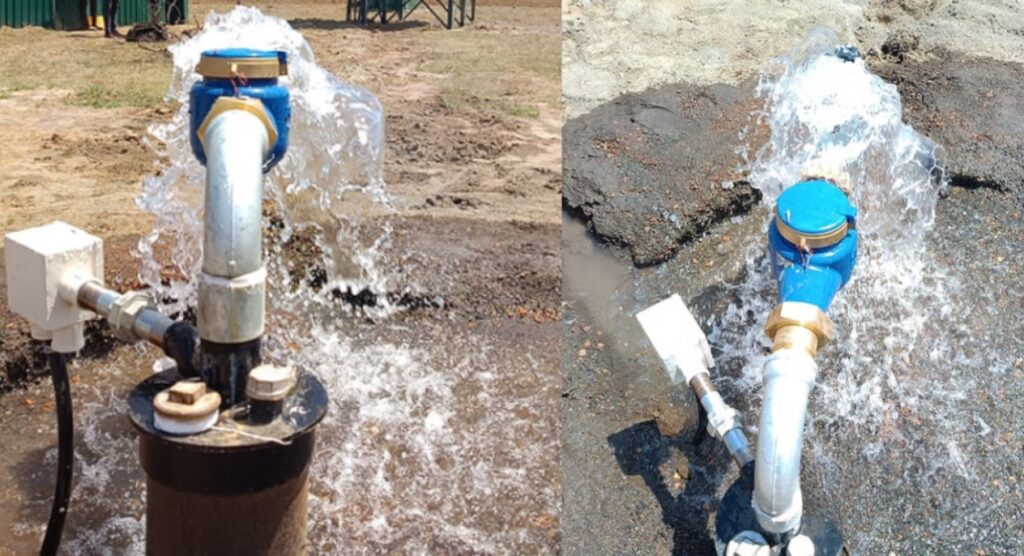
se the water, select suitable pumping equipment and design storage and distribution around the actual demand.
Whether the property is a home, farm, school, hotel, institution, commercial building or development project, groundwater infrastructure should be designed according to its specific requirements.
Njoro borehole drilling is not just about drilling into the ground. It is about developing a reliable water resource from investigation through to final delivery.